
BEHIND THE ALARM
Fred R. LaPoint | Fire Chief & Paramedic, Stronach Township Fire Department
A viral theory says wildland firefighters let fires burn because big fires pay better. Its own statistics come from a state law written to argue the opposite — and they don’t mean what the theory says they mean.
There is a version of this argument in every comment section now, and it always begins the same way. Somebody sees a fire start. They drive past it on a forest road, or they watch the smoke column from a ridge, and there are firefighters near it, and the firefighters are not doing what the person watching expects firefighters to do. They are standing. Some of them are sitting. A week later that fire has a name and a perimeter map and an evacuation order, and the person who drove past has an explanation ready: nobody put it out because nobody wanted to put it out. There is money in a big fire.
The current name for this is the wildland fire industrial complex. The claim is that fires have grown because letting them run pays better than stopping them — that suppression has quietly become a revenue model with a payroll attached. And the proof offered is almost always the same set of numbers, presented as a progression: the average wildfire in Washington State consumed about 86,000 acres in the 1990s, roughly 189,000 acres by the mid-2000s, and somewhere between 500,000 and 812,000 acres over the last five years.
I want to take the underlying observation seriously, because it is not crazy. Fires are bigger. Seasons are longer. Something real has changed; people can see it from their own porches, and they are entitled to an explanation. But a bad explanation for a real problem is still a bad explanation, and this one collapses the moment you look up where its numbers came from. So let’s look.
Where Those Numbers Actually Came From
They did not come from a whistleblower or a leaked contract. They came from Washington state law.
Those three figures appear, nearly word for word, in RCW 76.04.505 — the legislative findings section of House Bill 1168, the Wildfire Response, Forest Restoration, and Community Resilience Act, passed in 2021. The statute states that in the 1990s an average of 86,000 acres burned annually; that in the 2000s the average annual acreage rose to 189,000; that over the preceding five years the annual average grew to more than 488,000 acres; and that the year before the bill, wildfires burned more than 812,000 acres.
Read that again and put your thumb on one word: annually.
Every one of those numbers is the total acreage burned across the entire state of Washington in a single year — every fire, every jurisdiction, every cause, added together. Federal, state, tribal, and private land. Lightning starts and cigarettes and dragging trailer chains. Not one fire. Not the average fire. The whole state, the whole season, one line in a statute.
The viral claim takes a statewide annual total and reports it as the size of one average wildfire. That single substitution is the entire argument. Take it away, and there is nothing left standing behind it.
The Arithmetic Anybody Can Run
This is the kind of error you can test at your own kitchen table in about ninety seconds.
Washington recorded 1,806 wildfire ignitions in 2024, and those fires burned 275,593 acres. Divide one by the other. The average Washington wildfire in 2024 was about 153 acres — call it a quarter section. A hard afternoon for a couple of engines, a dozer, and a helicopter with a bucket. Widen the window and the picture holds: from 2016 through 2025, Washington had roughly 16,020 ignitions burning about 3,648,515 acres. That is an average wildfire of 228 acres.
Now run the claim. If the average Washington fire really consumed 86,000 acres, then those 1,806 ignitions in 2024 would have burned about 155 million acres. The entire state of Washington — mountains, wheat country, cities, and the surface of Puget Sound included — is roughly 43 million acres. The claim asks you to believe that Washington burns itself down about three and a half times over, every year, and that nobody has gotten around to mentioning it.
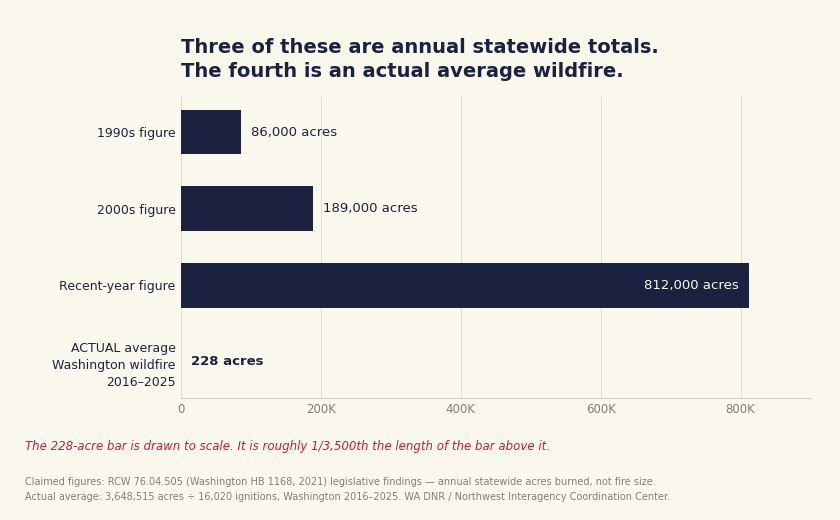
Three of these figures are annual statewide totals from state law. The fourth is what an average Washington wildfire actually is.
And Then There’s the Calendar
The second problem is the date on the paperwork. Those findings were written for a bill passed in 2021, which means “the last five years” in that statute covers roughly 2016 through 2020, and “last year” means 2020. Five-year-old legislative findings are being circulated as this season’s trend line.
What actually happened after that law passed is inconvenient for the theory. Washington burned about 173,000 acres in 2022, roughly 151,000 in 2023, about 275,000 in 2024, and approximately 251,840 acres across 1,851 ignitions in 2025. Four straight seasons far below the 842,000 acres of 2020 and the 647,000 of 2021 — during precisely the years when, on this theory, the industry should have been posting its best returns in history.
It gets worse for the theory. Washington’s Commissioner of Public Lands credited the HB 1168 investment with helping hold more than 94 percent of the state’s fires to ten acres or less in 2022. And in 2025 — the very season that produced the fire everyone is arguing about — the Forest Service’s own Pacific Northwest regional summary reported 325 fires on National Forest land in Washington burning 124,785 acres, and credited a high initial-attack success rate with limiting the number of large fires and holding down total acreage.
That is the tell, and it is worth saying slowly. If the business model were big fire, this would be the least competent racket in American history. It catches the overwhelming majority of its own product at under ten acres, in the dark, on a two-track, with a hand crew and a saw.
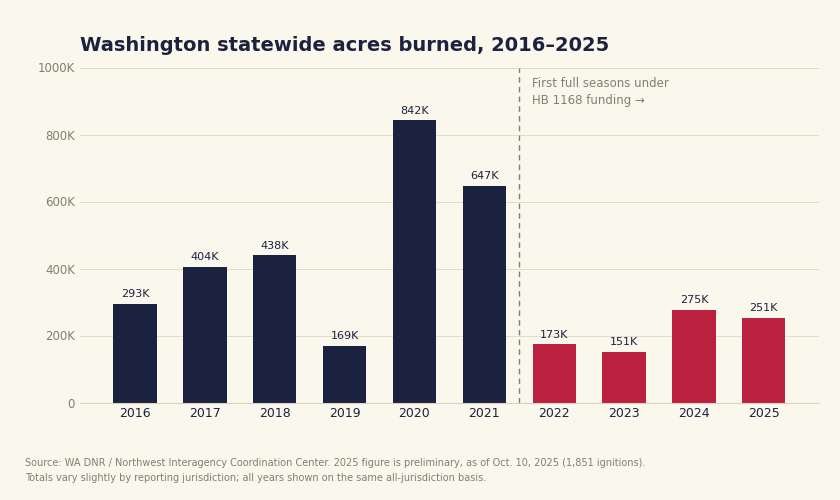
Washington’s worst recent seasons came before the state-funded suppression and fuels work — not after.
The Fire He Watched
Now the specific fire. The one people describe as a small start that firefighters stood around and let blow up is the Lower Sugarloaf Fire in Chelan County, Washington — ignited by a dry lightning storm on August 31, 2025, and reported at about 9:21 the next morning.
Here is what was assigned to it in its first hours: three engines, helicopters, air attack, the Baker River Hotshots, the Navajo Hotshots, three Type 2 crews, and an incoming Washington DNR surge task force with a dozer and five more engines. Anyone who has ever waited on a resource order can read that list correctly. You do not put two interagency hotshot crews on a fire you intend to let burn. Hotshots are what you order when you mean to fight.
And it ran anyway. It was 861 acres by late morning and past 3,500 acres that same afternoon, under a red flag warning and an extreme heat warning, in fuels that were part 1994 Tyee Fire footprint, part 2018 Cougar Creek footprint, and part timber and brush with no recorded fire in it at all. It reached 6,223 acres by September 4 with zero containment and 150 people assigned, and 9,077 acres by September 6. Local fire districts staffed overnight brush strike teams for structure protection, and the joint release called the fire uncontrolled and dangerous, which it was.
By the end of September, the Lower Sugarloaf had 42 crews, 150 engines, 13 helicopters, 8 dozers, 50 water tenders, and 1,835 people working it, plus a state mobilization with eight additional strike teams authorized by the Washington State Patrol. It finished around 43,000 acres, 99 percent contained, in mid-October.
Somebody watched the first hour of that and concluded nobody was trying.
Why Firefighters Stand Still
This is the part I can speak to without looking anything up, because I have been the man standing still and I have been the man who ordered everyone to stand still.
A crew holding at a road on the flank of a fire is not idle. They are anchored. They are holding a line that will matter at four in the morning when the wind lies down and the fire comes back to them on their terms instead of its own. They may be staged for structure protection on a road that is the only way out for the families up that draw or drainage. They may be waiting on aircraft, because a retardant line dropped ten minutes before a hand crew arrives is worth more than both of them working separately. Or the fire may simply be doing something at two in the afternoon, on a slope, in cured fuel, that no competent supervisor sends people into. We have a word for engaging anyway. We spell it out in line-of-duty-death reports.
Lookouts, communications, escape routes, safety zones. That is not bureaucracy, and it is not slow-walking. It is the reason a crew that stood on a road at noon is still available to cut line at midnight. Every wildland firefighter fatality report I have ever read describes people who engaged when the conditions said wait.
There is a second reason, less dramatic and just as real. On a dry lightning day, a single forest can take dozens of new starts in an afternoon. Washington had 1,851 ignitions in 2025. Initial attack is not everywhere at once; it is a triage system, and somewhere in a dispatch center a person with too few resources is deciding which start gets the helicopter. If you happen to drive past the fire that is third in line, what you see looks exactly like indifference. It is arithmetic.
Where the Critique Is Not Entirely Wrong
I am not going to pretend the whole thing is invented, because it isn’t, and anyone who denies the true parts hands the conspiracy its best evidence.
Managed wildfire is real. Agencies do sometimes manage a fire for resource benefit rather than pursue full perimeter control — in wilderness, in the right fuels, under the right weather, with a documented decision behind it. Fire is a natural process in most of these ecosystems; a century of excluding it is a large part of why the fuels are loaded, and putting some of it back on the ground deliberately is sound science. Reasonable people argue hard about where and when. That is a real argument, and it deserves to be had in daylight.
The money has also genuinely warped the agency. Suppression’s share of the Forest Service budget grew from roughly 16 percent in 1995 to more than half by 2015, while non-fire staffing was cut by nearly 40 percent. Contract aviation and heavy equipment costs on large incidents deserve exactly the kind of scrutiny a taxpayer is entitled to bring. There is an honest case that our funding structure rewards the emergency and starves the prevention.
But notice where that argument actually lands. The distortion drains money away from thinning, prescribed fire, and fuels reduction — the unglamorous work that keeps fires small — and pours it into the emergency after the fact. The problem is not that somebody profits from letting a fire run. The problem is that we underfund the only work that would have kept it from running. Those two conclusions point in opposite directions, and only one of them is supported by the budget documents.
The Money, Specifically
If the theory is that firefighters personally profit from big fires, then the theory has to survive contact with a federal pay stub, and it does not.
Federal wildland firefighters were placed on a special base rate salary table under the full-year appropriations act signed in March 2025 — a permanent raise that replaced four years of temporary supplements and repeated pay-cliff scares. That same law created Incident Response Premium Pay for extended deployments away from the home unit. That premium is capped at the daily equivalent of a GS-10 step 10, and at no more than $9,000 in a year.
Nine thousand dollars, capped, is the ceiling on the incentive being described. That is the whole conspiracy. Meanwhile, these same firefighters have historically drawn hazard pay only on wildfires and not on prescribed burns, despite facing much the same fire and smoke — a gap the Office of Personnel Management has only recently proposed closing. Ask yourself what kind of racket pays its people less for the deliberate fire and more for the emergency, and then works hard to get the deliberate fire paid for too.
What the Story Costs
I have spent more than fifty years in this business and better than three dozen disaster deployments, and I have never once met the person this theory requires to exist. What I have met is a twenty-three-year-old on a hotshot crew, sixteen days into a roll, with a saw on her shoulder and somebody’s house behind her. She is who absorbs this accusation. It does not land on a budget line in Washington, D.C. It lands on her, in a gas station in Entiat, from a stranger with a phone.
And it costs more than her feelings. People who believe firefighters are the arsonists do not leave when the Level 3 order comes. They do not clear the five feet around their foundation. They do not vote for the fuels money or the prescribed burn window, and they stand in the middle of a one-lane road filming while an engine tries to get up it. Every one of those is a real cost, paid in structures and occasionally in people.
So here is the ask, and it is a small one. Before you pass along a statistic that explains everything, spend ten minutes finding out what it measures. In this case, the trail ends somewhere the theory never expected: a state legislature that looked at exactly these numbers, understood them correctly as annual statewide totals, and concluded that Washington needed more capacity, more thinning, more prescribed fire, and more people on the line — not fewer. Then they funded it, and the four seasons since have been the mildest in years.
Fires are bigger. That much is true, and it deserves a real explanation rather than a villain. I have written that explanation elsewhere, and I will keep writing it. But it starts with fuel, weather, and where we have chosen to build — not with a conspiracy of tired people in yellow shirts who, on the evidence, are catching ninety-four out of every hundred fires before they reach ten acres.
SOURCES
Washington State Legislature, RCW 76.04.505 — legislative findings, HB 1168 (2021), Wildfire Response, Forest Restoration, and Community Resilience Act.
Washington Department of Natural Resources / Northwest Interagency Coordination Center — annual statewide ignition and acreage figures, 2016–2025; DNR 2025 fire season report to the Legislature (Nov. 25, 2025).
KING 5 — 2022 Washington fire season summary, including the state’s report that more than 94 percent of fires were held to 10 acres or less.
Washington State Standard and KOMO News — preliminary 2025 statewide figures: 1,851 ignitions, 251,840 acres (Oct. 2025).
USDA Forest Service, Pacific Northwest Region — 2025 Annual Wildfire Summary: 325 fires on Washington National Forest lands, 124,785 acres, initial-attack success cited.
Washington State Patrol — State Fire Mobilization authorization, Lower Sugarloaf Fire (Sept. 2025).
NCWLIFE, Wenatchee World, Lake Chelan Now, Lake Chelan Mirror, KPQ, KHQ, IQAir — Lower Sugarloaf Fire daily resource assignments, growth, evacuation levels, and final containment.
U.S. Department of the Interior — permanent pay increase announcement for federal wildland firefighters, March 2025; USDA Forest Service firefighter pay guidance; Federal News Network reporting on Incident Response Premium Pay caps and proposed prescribed-fire hazard pay.
Every figure in this piece is sourced. If you find an error, send it with a source, and I will publish the correction.
Fred R. LaPoint is Fire Chief and paramedic of Stronach Township Fire Department in Manistee County, Michigan, with over 50 years in emergency services. A Vietnam-era Coast Guard veteran and Team Rubicon disaster responder with more than three dozen deployments, he writes Behind The Alarm and Guardians of Truth.
This article first appeared in Behind The Alarm, the newsletter of Fred R. LaPoint, Fire Chief Paramedic of the Stronach Township Fire Department, on August 11, 2026. Read the original.