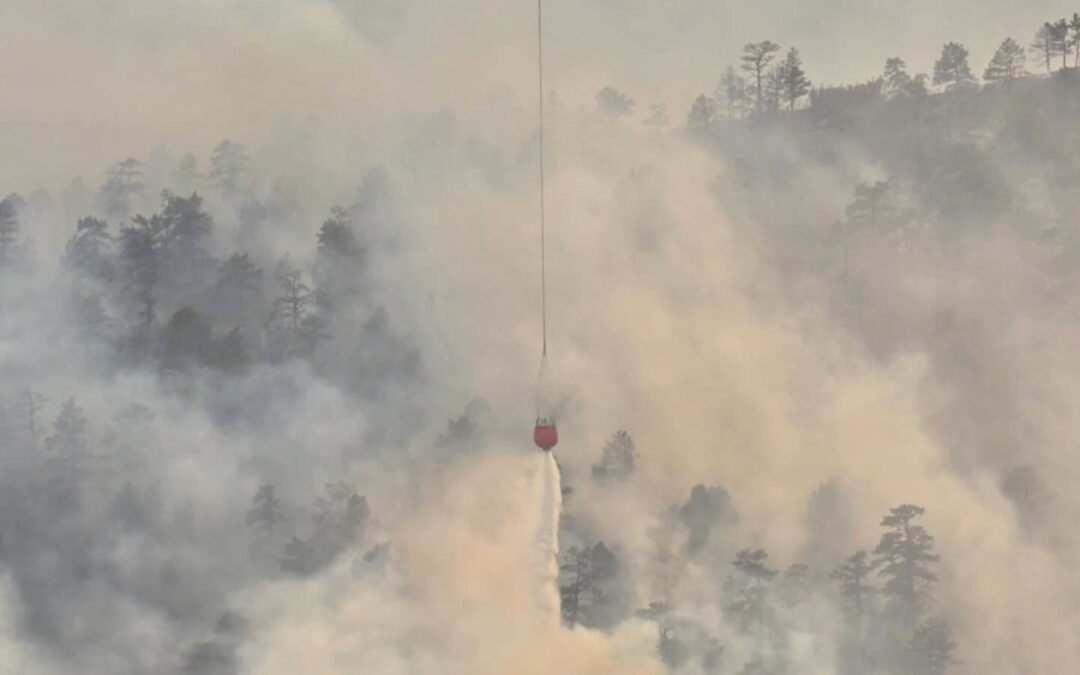
A friend of mine flies a Chinook on fires. He posted a clip the other day from the Aspen Acres Fire in southern Colorado — working out of Lake Isabel, two thousand gallons on the line, ninety-five hundred feet. His caption was five words long: needed a bigger bucket, lol.
That is pilot understatement, and it is worth unpacking, because almost everything the public believes about aerial firefighting is wrong in the same direction. People see the drop. They think the drop is the firefight. It isn’t, it never was, and the gap between what that clip looks like and what it actually is explains most of the frustration you hear every fire season.
So let’s take it apart.
What is actually hanging under that aircraft
Water weighs 8.34 pounds a gallon. Two thousand gallons is roughly sixteen thousand seven hundred pounds — more than five full-size pickup trucks — hanging on a synthetic long line a hundred to two hundred feet below the aircraft, swinging, while the pilot flies a precise line over broken terrain at low altitude and low airspeed.
Now add elevation. A CH-47D can lift something on the order of twenty-eight thousand pounds at sea level. But rotors don’t bite air, they bite air density, and at ninety-five hundred feet on a hot July afternoon the density altitude — the altitude the aircraft thinks it’s at — can easily be running twelve thousand or better. Every pound you’re carrying costs more power to carry. Every hundred feet of density altitude buys you less margin. And a bucket operation means hovering out of ground effect to dip, which is the single most power-hungry thing a helicopter does.
This is why the Chinook is on that fire in the first place. Tandem rotors mean every bit of engine power goes into lift and thrust instead of bleeding off to a tail rotor fighting torque, and the airframe keeps meaningful lift in heat and elevation where lighter ships start running out of options. It is the right tool. That does not make it an easy one.
So when a pilot says he needed a bigger bucket at ninety-five hundred feet, what he is telling you is that he went up to the load where the performance math stops being comfortable, because the fire needed it and the margin was there to spend. That is a decision made in the aircraft, in the moment, by somebody who knows exactly what he is spending.
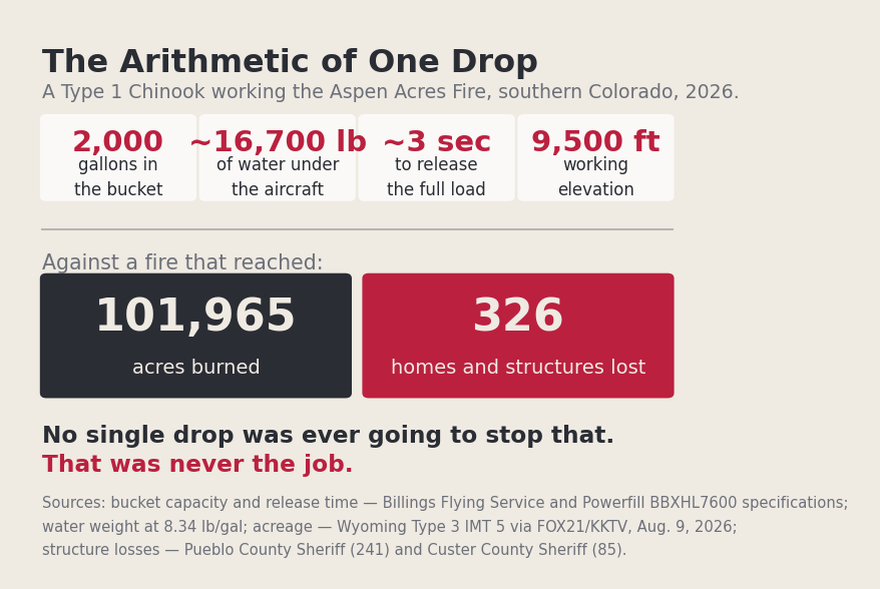
One aircraft, one afternoon, against a fire that ran past a hundred thousand acres.
What the drop actually does
Here is the part that never makes the evening news. Water is a short-term agent. It cools the flaming front, knocks intensity down, and buys a window — and then it evaporates, runs off the fuel, or soaks into the ground. That is why helicopters drop directly on the fire’s edge rather than out ahead of it. Drop water a quarter mile in front of an advancing fire and by the time the fire arrives, the water is gone.
Long-term retardant is a different animal. It’s more viscous, it clings to vegetation, it holds moisture, and it keeps interfering with combustion even after it dries. That’s why the big fixed-wing tankers lay it ahead of the fire, along ridgelines, or on a planned indirect line — sometimes thousands of feet from any flame. Two different agents, two different missions, two different kinds of aircraft. Comparing them is comparing a hoseline to a firebreak.
And neither one puts the fire out. What they do is create conditions in which people on the ground can get line in and hold it. Aviation buys time. Ground crews buy the fire. If the drops go in and nobody follows them up with saws, hand tools, and dozers, the window closes, and the fire keeps walking.
What the data actually says
This isn’t just shop-floor opinion. The Forest Service ran the Aerial Firefighting Use and Effectiveness study — AFUE — from 2012 onward, and the final report landed in August 2020. Four dedicated modules of experienced firefighters observed 27,611 drops between 2015 and 2018, across eighteen states and all nine Forest Service regions. It cost around eleven million dollars, and it was the most serious attempt anybody has made to answer a question the GAO and the USDA Inspector General had been asking for years: how do you know these aircraft work?
Two findings matter for our purposes. On large fires, drops from helicopters that actually reached the fire had a probability of success around 0.73 — and when you set aside the small hundred-gallon ships that mostly do reconnaissance and spot work, the larger helicopters came in around 0.84. Retardant-dropping airtankers landed around 0.72. Type 1 helicopters like the one my friend flies had an interaction rate roughly ten points higher than the average airtanker, which makes sense: if you’re dropping water, you’re dropping it on flame, so you interact with the fire almost every time.
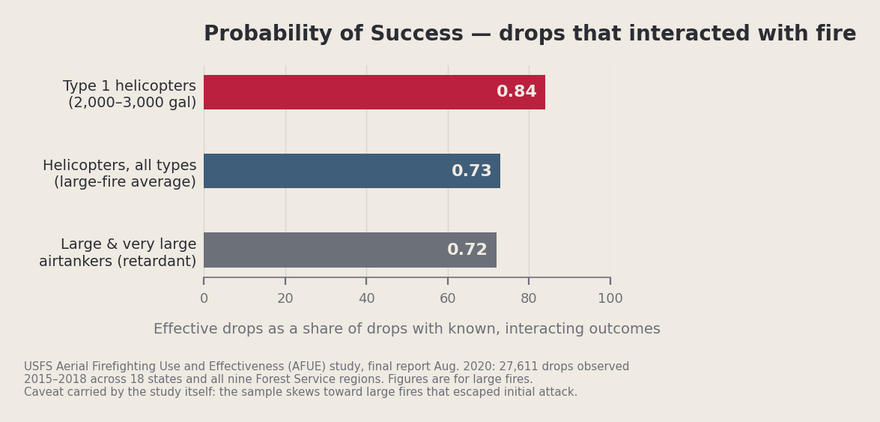
AFUE, final report August 2020. Read the caveat with the number.
The study is honest about its own limits, and so should we be. The sample skewed toward large fires that had already escaped initial attack, because it takes time to mobilize observers. The fires where aircraft worked best — the small ones caught early and killed before anybody outside the county heard about them — are underrepresented. And AFUE made no recommendations at all about fleet size or composition, which was supposed to be the whole point, and never analyzed cost. In fiscal 2018, the Forest Service spent five hundred and seven million dollars on firefighting aircraft. The word “cost” does not appear in the study.
The part that runs backwards from intuition
Here is the finding that ought to be on a poster in every newsroom in the country: as fire conditions become extreme, aircraft become less effective.
Read that again, because it is the opposite of what everyone assumes. The public assumes that the worse the fire, the more aircraft you throw at it. Firefighters know it doesn’t work that way. Past a certain fire intensity, water and retardant simply do not reach the fuel in any useful quantity — the convection column tears the drop apart before it lands, or it lands and flashes off. Add gusty winds, and you have added serious risk to pilots flying low and slow and to the crews underneath them, in exchange for an effect that isn’t there.
So when you see a smoke column and no aircraft over it, the answer is often not that nobody sent them. The answer is that somebody with judgment looked at the conditions and decided the drop would accomplish nothing and might kill somebody. That is a hard sentence to say at a community meeting. It is still the right call.
The people in the aircraft
A Chinook works a fire with a crew of three — pilot, co-pilot, and a flight engineer monitoring the aircraft — backed by a ground crew of engineers and a fuel truck driver who nobody photographs. During fire operations, the endurance drops to roughly two and a half hours before they have to come back for fuel, and then they go again.
This is dangerous work. Low altitude, heavy loads, turbulent air over a heat source, mountainous terrain, smoke, and other aircraft in the same block of sky. Every fire season the aviation community loses people, and it does not make national news for long. If you have never watched a heavy helicopter fight to pick up a load at elevation on a hot afternoon, the video makes it look effortless. It is not effortless. It is a professional making something difficult look routine, which is what professionals do, and which is exactly why the public misjudges it.
What to say when somebody asks
The Aspen Acres Fire burned 101,965 acres in Pueblo and Custer counties. Two hundred forty-one homes and commercial structures were lost in Pueblo County alone — two hundred eight of them in Beulah — with eighty-five more in Custer. Then, after the fire, the rain came, and the burn scar sent flash floods down on the same communities, damaging homes in Beulah and San Isabel that the fire had spared.
Somewhere in the middle of that, one aircrew put two thousand gallons where the ground boss asked for it, at an altitude where two thousand gallons is a real ask, and then went back and did it again. It did not stop the fire. It was never going to stop the fire. It held one flank long enough for people with chainsaws to get a line in, which is the entire job.
So the next time somebody at the coffee counter asks why they don’t just dump more water on it, here is the short version. The water only works where crews can follow it. The bigger the fire, the less the water does. And the aircraft is not the firefight — the aircraft is what buys the firefight time.
Then tell them about the pilot who needed a bigger bucket, and what it costs to say that out loud at ninety-five hundred feet.
SOURCES
1. USDA Forest Service, Aerial Firefighting Use and Effectiveness (AFUE) final report, August 20, 2020 — 27,611 drops observed 2015–2018; interaction percentage and probability of success figures; the study’s own sampling caveats.
2. Bill Gabbert, “What did we learn from the Aerial Firefighting Use and Effectiveness study?” Wildfire Today, April 16, 2021 — analysis of the AFUE findings, the FY2018 aviation spending figure, and the water-versus-retardant distinction.
3. U.S. Government Accountability Office, GAO-13-684 (August 2013), and USDA Office of Inspector General, review of Forest Service replacement planning for aerial firefighting resources.
4. Billings Flying Service, CH-47D aerial firefighting specifications (lift capacity, cruise speed, tandem-rotor performance in heat and elevation).
5. Aviation Spotters Online, CH-47D firefighting profile — Powerfill BBXHL7600 bucket capacity (2,000 gallons), crew composition, and fire-operations endurance.
6. Aspen Acres Fire operational updates, Wyoming Type 3 Incident Management Team 5, reported by FOX21 News Colorado and KKTV, August 9–10, 2026 — acreage and containment.
7. Pueblo County Sheriff David Lucero and Custer County Sheriff Rich Smith, structure loss totals, via FOX21 News Colorado.
8. Colorado Springs Gazette, July 30, 2026 — flash flooding in the Aspen Acres burn scar affecting Beulah and San Isabel.
Fred R. LaPoint is Fire Chief and paramedic of Stronach Township Fire Department in Manistee County, Michigan, with over 50 years in emergency services. A Vietnam-era Coast Guard veteran and Team Rubicon disaster responder with more than three dozen deployments, he writes Behind The Alarm and Guardians of Truth.
This article first appeared in Behind The Alarm, the newsletter of Fred R. LaPoint, Fire Chief Paramedic of the Stronach Township Fire Department, on August 20, 2026. Read the original.