Retired FDNY Lieutenant Gerard M. Reilly of Ladder 22 died on September 3, 2026. He had given the department twenty-one years. What killed him was a World Trade Center-related illness, contracted at a fire scene he was ordered to and never really left.
He died eight days before the twenty-fifth anniversary of the attacks. He is not among the 2,977.
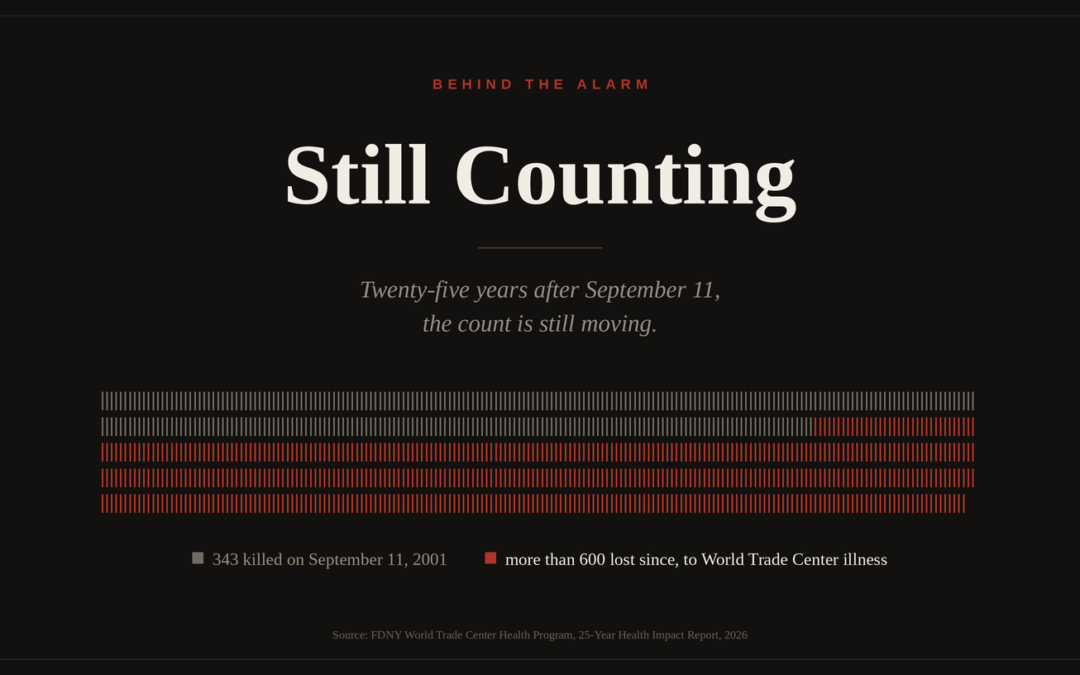
That is the thing about this anniversary that I want you to carry, and it is the only thing I am going to ask of you. We speak about September 11 in the past tense. We say 2,977 and we say never forget and we mean it, and then we go back to work. But the number is not finished. It was still moving last week. It will be moving next year. The morning was one day; the dying has been a quarter of a century, and it is not close to over.
I am not writing this to relitigate how or why it happened. I have no interest in scoring points and no patience for anyone who uses this week to do it. I am writing it because a nation is judged by how it remembers its fallen, and remembering means knowing who is actually still falling.
What the fire department published two weeks ago
On September 1, FDNY leadership briefed the public on the department’s 25-Year Health Impact Report. The next day, they added thirty-six more names to the World Trade Center Memorial Wall at headquarters in Brooklyn — thirty-six members who died of illnesses tied to the rescue and recovery.
The report is the fourth of its kind, and it follows nearly sixteen thousand FDNY members who worked in Lower Manhattan through roughly ten months of rescue, recovery and cleanup. More than twelve thousand of them have now been certified with at least one health condition linked to that work — better than ten thousand five hundred with a physical condition, nearly four and a half thousand with a mental health condition. Department officials put the number who have had at least one cancer at 4,257, and about a quarter of those members have been certified for more than one type.
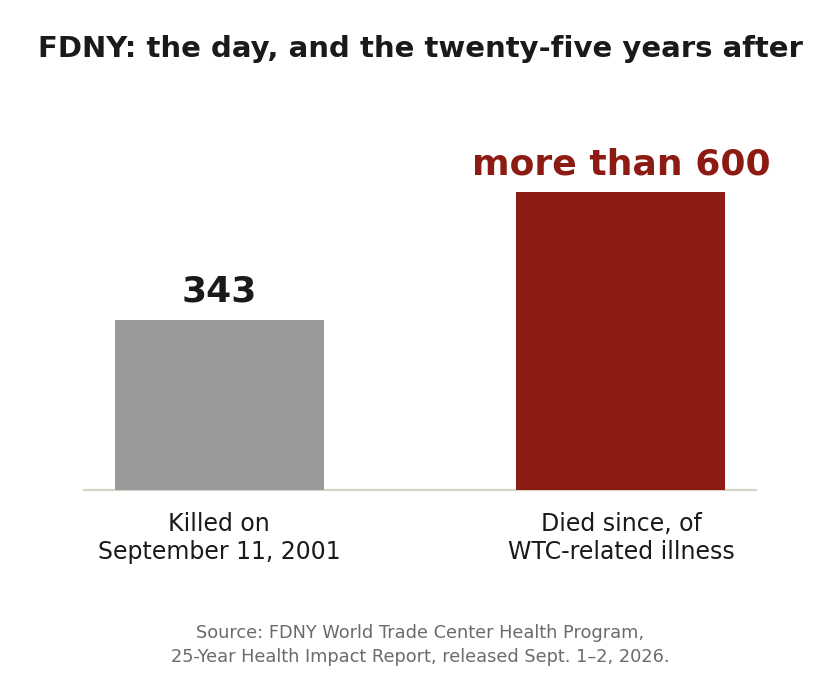
And more than six hundred FDNY members have died of illnesses linked to what they breathed at that site.
Three hundred forty-three died on the day. That is the number carved into every memorial in this country. The number that has died since is nearly double it, and it is the number almost nobody knows.
Beyond the fire department, the federal World Trade Center Health Program now attributes more than nine thousand deaths to 9/11-related illness — more than three times the toll of the morning itself.
A note on the numbers, because you should not have to take my word for anything
I want to be straight about something rather than let a clean figure do work it has not earned. In December 2025, when the FDNY announced its anniversary plans, it referred to more than four hundred members lost to World Trade Center illnesses. The health report released this month says more than six hundred. Only thirty-six names went onto the memorial wall in between.
Those are two different ledgers. The memorial wall is a departmental honor with its own criteria and its own annual ceremony. The health program’s count is a medical count of deaths among its enrolled members. I cannot reconcile the two from the public reporting, and I am not going to smooth it over by pretending they are one number. The figure I have used above is the one the department itself published this month, in its own report, about its own people. If the reconciliation comes out and it changes the picture, I will publish the correction here.
Everything else in this piece is sourced at the end. Check me.
The office that never stopped
There is a laboratory in Manhattan where, for twenty-five years, people have gone to work every day trying to give the dead their names back.
Last month the Office of Chief Medical Examiner announced the identification of the 1,654th victim of the World Trade Center attacks — an adult woman whose family asked that her name be withheld. She is the first 9/11 victim ever identified using forensic investigative genetic genealogy, a technique developed for cold cases and missing persons, applied here for the first time in collaboration with NYPD detectives.
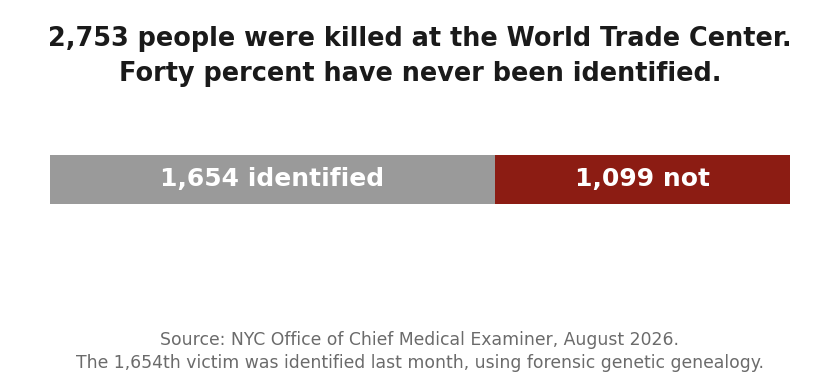
Two thousand seven hundred fifty-three people were killed at the World Trade Center. One thousand ninety-nine of them — forty percent — have never been identified at all.
Think about what that sentence means for a household. Eleven hundred families who have never had anything to bury. Who have gone twenty-five years without the thing every other grieving family in America gets: a body, a box, a place in the ground. Some of them still keep a phone number current with a city agency in case a call ever comes. Some of them have gotten that call, decades late, and had to decide what to do with the news.
That is not a wound that healed. That is a wound somebody has been holding open with both hands for a quarter of a century so that the work can continue. It is the least publicized and most quietly heroic thing about this whole story, and the anniversary coverage almost never mentions it.
The people nobody pictures
When Americans think about who got sick from September 11, they picture firefighters. They should — but the picture is badly incomplete, and the incompleteness has cost people their lives.
The federal health program covers more than a hundred and thirty thousand people. As of the program’s March 2024 figures, the largest single category was not the fire department at all. General responders — construction workers, ironworkers, sanitation crews, truck drivers, volunteers, the people who cleared the pile and hauled it to Fresh Kills — made up better than half the enrollment at roughly 69,600. FDNY responders were about 17,000. And survivors — people who simply lived there, worked in an office there, went to school or daycare there — were about 44,500.
That survivor number is the one that ought to stop you. In June 2019 it was around 21,600. Five years later it had more than doubled. Those people did not get sick twice as fast. They found out. They found out slowly, one at a time, usually after a diagnosis, often after a lawyer or a neighbor mentioned it, and always years after the exposure. The dust did not check anyone’s credentials on the way down.
And there is a fourth category, the smallest and the most forgotten. Responders at the Pentagon and at the Shanksville crash site are eligible for the same federal health program. About thirteen hundred of them are enrolled. Thirteen hundred, out of everyone who worked those two scenes. One hundred eighty-four people were killed at the Pentagon and forty in that Pennsylvania field, and I would bet real money that a good number of the people who responded to both have never once been told that any of this applies to them.
The promise, and the gap between the promise and the appointment
Here is a piece of good news, and I want to give it its due, because there has been little enough of it and because it was genuinely bipartisan.
On February 3, 2026, legislation was signed that fixed the health program’s funding formula. For years the program received a fixed appropriation that could not keep pace with inflation or with an enrollment that grows every single year, and it was staring down a projected multi-billion-dollar shortfall that would have forced it to stop taking new members and then to cut care for the ones it had. The new law builds in an automatic annual increase plus a per-person adjustment through 2040. If more sick people enroll, the budget grows to cover them. That is how it should have been written the first time, and the people who spent a decade pushing for it earned the win.
But funding a program and staffing one are two different things. Reporting at the time of the signing described the program operating with roughly a quarter fewer staff after a year of cuts and restructuring, with an agency-wide hiring freeze preventing those positions from being refilled, and with the wait for an appointment stretching past six months.
Six months. For a firefighter with a shadow on a scan, six months is the distance between stage one and stage four. That is not an abstraction and it is not a talking point; it is the arithmetic of every cancer any of us has ever watched a brother go through. The money is appropriated. The door is still half shut. Both things are true at once, and you can hold both without picking a team.
It is also worth knowing that petitions to add cardiac and autoimmune conditions to the program’s covered list remain pending. The exposed population is aging into exactly the diseases that take twenty-five years to show up — cardiovascular disease, autoimmune conditions, hearing loss, cognitive decline. The researchers are still working out what belongs on the list. The people are getting sick on their own schedule, not the list’s.
What this has to do with a reader in Michigan
You may be thinking this is a New York story. It is not, and this is the part of the piece I most want people to actually use.
Care under the World Trade Center Health Program is delivered nationwide. Members outside the New York metropolitan area are treated through a Nationwide Provider Network — you do not have to live there, move there, or travel there. There are members of this program in every state in the country, because responders came from every state in the country, and because the people who lived and worked in Lower Manhattan in 2001 have since scattered across it.
So the question is not whether you were in New York. The question is whether you know somebody who was.
Somebody in your department who took leave in the fall of 2001 and went east. A retired ironworker or truck driver at your church. A neighbor who was a college student downtown, or who had an office job on Broadway, or whose kid went to a school below Houston Street. A cop, a federal responder, a volunteer who drove out with a trailer and stayed three weeks. Anybody who worked the Pentagon scene or the Shanksville scene. Any of those people may be eligible and may have no idea.
Broadly, eligibility runs like this. Responders qualify based on work at Ground Zero or elsewhere in Lower Manhattan south of Canal Street, the Staten Island Landfill, certain barge loading piers, the PATH tunnel, or the Medical Examiner’s Office if they handled remains, with minimum-hour thresholds that vary by period. Pentagon responders qualify for work at that site between September 11 and November 19, 2001. Shanksville responders qualify for work at that site between September 11 and October 3, 2001. Survivors qualify if they lived, worked, attended school, or attended daycare in the New York City disaster area — Manhattan south of Houston Street, plus Brooklyn blocks within a mile and a half of the site — at any point between September 11, 2001 and July 31, 2002.
Two practical things, and then I will get out of the way:
World Trade Center Health Program — 1-888-982-4748, or cdc.gov/wtc. Eligibility criteria, the exposure-area maps, and the application forms are all posted there.
Enrolling is not the same as filing a claim, and you do not have to be sick to enroll. Monitoring is the entire point. The FDNY data on this is unambiguous — five years after a 9/11-related cancer diagnosis, 86 percent of program members were alive, against 63 percent of unexposed New Yorkers diagnosed with the same cancers. That gap is what surveillance buys. It is early detection, and early detection is the whole ballgame.
What remembering is for
My wife Sue and I have been to all three sites, more than once, some of them before there was anything there to see but a hole and a fence. We have ridden in memorial rides, raised money, stood in the rain at more than one ceremony. And every year it feels a little more like we are among a shrinking number of people for whom this is still a live thing rather than a date on a calendar.
I understand why. Twenty-five years is a long time. There are Americans voting this fall who were not born when it happened, and there is nothing wrong with them for that. But it does mean the remembering has to change shape. It cannot only be ceremony, because ceremony is for the dead and the dead are past our help. The people we can still help are the ones the dust is still working on.
So if you want to honor them on Friday, by all means go to the ceremony. Stand for the moment of silence. But then go one step further and do the thing that costs something. Find the person in your life who was in that zone and never enrolled. Make the phone call for them if they will not make it themselves. That is not sentiment. That is a chance at stage one instead of stage four, and it is the only kind of remembrance that can still change an outcome.
Twenty-five years on, the count is still moving. The least we can do is know that, and act like people who know it.
Fred R. LaPoint is Fire Chief and a licensed paramedic with the Stronach Township Fire Department in Manistee County, Michigan. He has more than fifty years in emergency services, including forty years as a professional firefighter with the City of Manistee Fire Department, and is a U.S. Coast Guard veteran and a disaster responder with Team Rubicon. He writes Behind The Alarm.
Sources
Every figure in this piece traces to one of the following. Where a source says “more than,” I have written “more than” rather than inventing a precise number.
FDNY World Trade Center Health Program, 25-Year Health Impact Report, released September 1–2, 2026. Deaths of more than 600 FDNY members from WTC-related illness; nearly 16,000 members enrolled; more than 12,000 certified with at least one condition; more than 10,500 physical and nearly 4,500 mental health certifications; 4,257 members with at least one cancer, about 26 percent of those with more than one type; PTSD prevalence improved to 6 percent from a prior 16 percent; five-year cancer survival of 86 percent among program members against 63 percent for unexposed New York State residents. Reported by NY1, FOX 5 New York, NBC New York and Fire & Safety Journal Americas, September 2–3, 2026.
City of New York / FDNY, “FDNY holds 2026 World Trade Center Memorial Wall Plaque Dedication,” September 2, 2026 — 36 names added. And FDNY, “FDNY announces plans to commemorate the 25th anniversary of September 11th,” December 9, 2025 — reference to more than 400 members lost to WTC-related illnesses.
Death of Lieutenant Gerard M. Reilly, Ladder 22, September 3, 2026 — reported by PIX11 and other outlets, September 6–7, 2026.
NYC Office of the Chief Medical Examiner, announcement of the identification of the 1,654th World Trade Center victim using forensic investigative genetic genealogy, August 2026 — including the figures of 2,753 killed at the World Trade Center and 1,099 (40 percent) still unidentified.
World Trade Center Health Program (CDC/NIOSH), program statistics as of March 31, 2024: 132,530 total members — 69,651 general responders, 17,059 FDNY responders, 44,516 survivors, 1,304 Pentagon and Shanksville responders. Program enrollment by member type, cdc.gov/wtc. June 2019 survivor enrollment of 21,609 from the same series.
World Trade Center Health Program eligibility criteria, exposure-area definitions and site-specific date ranges, including Pentagon (September 11 – November 19, 2001) and Shanksville (September 11 – October 3, 2001): CDC responder and survivor eligibility materials, cdc.gov/wtc/eligiblegroups.html.
Funding legislation signed February 3, 2026, revising the program’s funding formula with an automatic annual increase plus per-person adjustment through 2040 — reported by Newsday, News10, and summarized by Citizens for the Extension of the James Zadroga Act. Staffing reductions of roughly 25 percent, the hiring freeze, and appointment waits exceeding six months reported by FireRescue1, February 2026. Pending petitions on cardiac and autoimmune conditions per coverage of the FDNY 25-year report, September 2026.
Total of 2,977 victims: 2,753 at the World Trade Center, 184 at the Pentagon, 40 near Shanksville, Pennsylvania.
Corrections to this piece will be published here. If you find an error, send it and I will run it.
This article first appeared in Behind The Alarm, the newsletter of Fred R. LaPoint, Fire Chief Paramedic of the Stronach Township Fire Department, on September 8, 2026. Read the original.