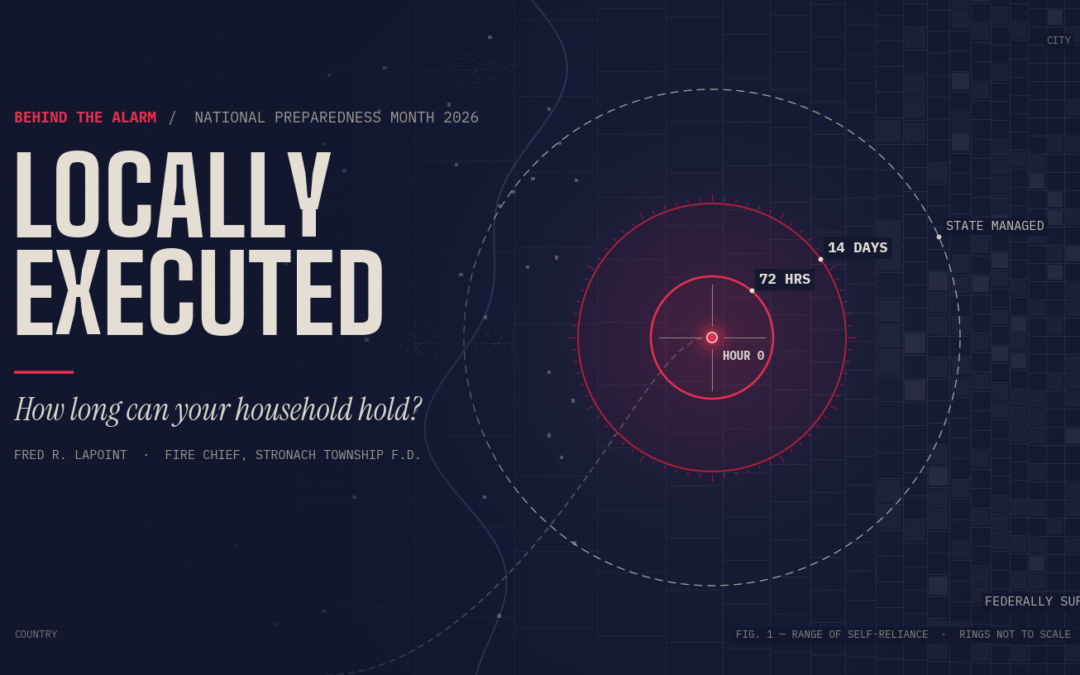
In May, the council the President appointed to reexamine the Federal Emergency Management Agency delivered its final report. Near the top is a sentence every household in America ought to read twice. Disaster response, the council wrote, should be “locally executed, state or tribally managed, and federally supported.”
I have spent more than 50 years working inside the first two words of that sentence. Locally executed means the volunteer who leaves supper on the table when the tones drop. It means the county road crew, the township fire hall, the lone deputy covering half a county on a Saturday night. And before any of us get there, it means you: the person already standing in the kitchen when the power fails, the water rises, or the roof comes down.
That has always been true. What has changed is how long “local” may have to hold before the rest of the system catches up, and how thin the rest of that system has become. September is National Preparedness Month, and FEMA chose “Americans Stand Ready” as this year’s theme, casting preparedness as a civic responsibility and a patriotic duty. I don’t quarrel with the theme. I would only add the question every incident commander asks the moment a resource is ordered: how long until it gets here, and what do we do until it does?
This piece is my honest attempt to answer that for the months ahead, for readers in the country and in the city alike.
The backstop is thinner and slower
Let me lay out what the record shows, and leave the adjectives out of it.
In August, the Government Accountability Office reported that more than 4,300 people left FEMA in fiscal year 2025, a 55 percent jump in separations over the year before, from a workforce that averaged about 25,000. Between January 2025 and January 2026, 58 members of the agency’s senior executive service departed, roughly half of FEMA’s top career leadership, compared with an average of 13 a year over the three years prior. GAO found that FEMA rescinded its strategic plan in 2025 and made its cuts without first analyzing what workforce its mission actually requires. The Department of Homeland Security concurred with GAO’s recommendations.
FEMA did settle on a number: a target of 11,383 employees, about half its size, even though its own program and regional offices had recommended something closer to 23,000. In a March 31 deposition in a union lawsuit over the cuts, the acting administrator at the time said of that target, “We didn’t have a plan,” explaining that this was why she had tasked her staff to write one. The number came first; the path to it came after. Meanwhile, the review council’s own report acknowledges that FEMA is carrying more than 300,000 projects across more than 600 open disaster declarations, with a workforce roughly 14 percent smaller than it was in January 2025.
Money has been as uncertain as people. The Department of Homeland Security, FEMA’s parent, went without appropriations from February 14 to April 30 of this year. During that lapse, the Disaster Relief Fund fell from about $9 billion to about $3 billion, and FEMA limited spending to lifesaving and life-sustaining work while other recovery waited. The stopgap funding bill Congress passed on September 1 keeps the government open only through December 11. That puts the next deadline squarely in the middle of winter.
The wait for federal help after a disaster has also grown. An Associated Press analysis published in July found that major disaster declarations have taken an average of about a month and a half to approve after a governor’s request, compared with about three weeks during the President’s first term and under President Biden. Because damage assessments take weeks before a request is even filed, total waits have often run past two months. The White House has said the President reviews requests more thoroughly than any predecessor, and Pete Gaynor, who led FEMA during the first Trump administration, told the AP that the added scrutiny is “probably the right thing to do.” Reasonable people in my own profession land on both sides of that question.
There are signs of steadier footing, and fairness requires saying so. On August 7 the Senate confirmed Cameron Hamilton as FEMA administrator, the first permanent administrator of this term, and he has pledged to speed up declaration decisions and reimbursements. The council’s proposals, including one to raise the damage threshold a state must meet to qualify for a federal declaration, remain recommendations, and most would require an act of Congress. The National Weather Service is in the middle of a nationwide hiring push for entry-level meteorologists.
So hold two things at once. You can believe these reforms are overdue or believe they are reckless, and the arithmetic for your household comes out the same. The federal help that arrives after the first days of a disaster is coming later, and with fewer experienced hands, than it did two years ago. The gap between the moment disaster strikes and the moment organized help reaches your door is getting longer. Whatever fills that gap will be you, your family, and your neighbors.
In incident command terms, federal assistance was never the first-due engine. It is the resource you order, the relief that shows up in the second or third operational period. The question for every household this fall is the one I ask on every incident: how long can we hold with what we have?
What the coming months hold
The forecast for the months ahead cuts two ways, and I want to give you both.
The Atlantic has been remarkably quiet. As of September 22, the season had produced six named storms and not one hurricane, the first time since 1914 that the basin reached late September without one. Even so, three tropical storms came ashore between Texas and Louisiana, and the season runs through November 30. Quiet years carry their own danger. They are the years emergency kits get raided for camping trips and never restocked.
The larger story is in the Pacific. NOAA’s Climate Prediction Center now puts the odds that the developing El Niño will be very strong this fall and winter at better than 90 percent, and gives a 75 percent chance that October through December will surpass every El Niño on record back to 1950. A strong El Niño tends to shove the storm track south, favoring a wetter, stormier winter across California, the Southwest, the Gulf Coast and the Southeast, and a milder, drier one across the northern tier. California isn’t waiting to find out. On September 21, Governor Newsom declared a statewide emergency to stage equipment and supplies ahead of the flooding, landslides and coastal surge the state expects.
For those of us up north, a warmer winter is not the same thing as a safe one. NOAA is careful to say that even a historically strong El Niño shifts the odds rather than writing the script. Northern Michigan knows what a single bad setup can do. In March 2025, the northern Lower Peninsula took three days of freezing rain; the warning coordination meteorologist at the Gaylord weather office has noted the region typically sees six to twelve hours of freezing rain across an entire winter. Phone and cell service went down with the power lines, and some households waited more than two weeks for the lights to come back. This past March, another ice storm brought another state emergency declaration, this one covering seven northern counties. And as I wrote in August, a thin-snow winter here tends to hand us an early, fast spring fire season.
Power is the common thread in nearly every one of these scenarios. The U.S. Energy Information Administration reports that the average electricity customer went without power for 11 hours in 2024, nearly twice the annual average of the decade before, with major weather events accounting for most of it. But averages hide the tails, and preparedness lives in the tails.
How long can you hold?
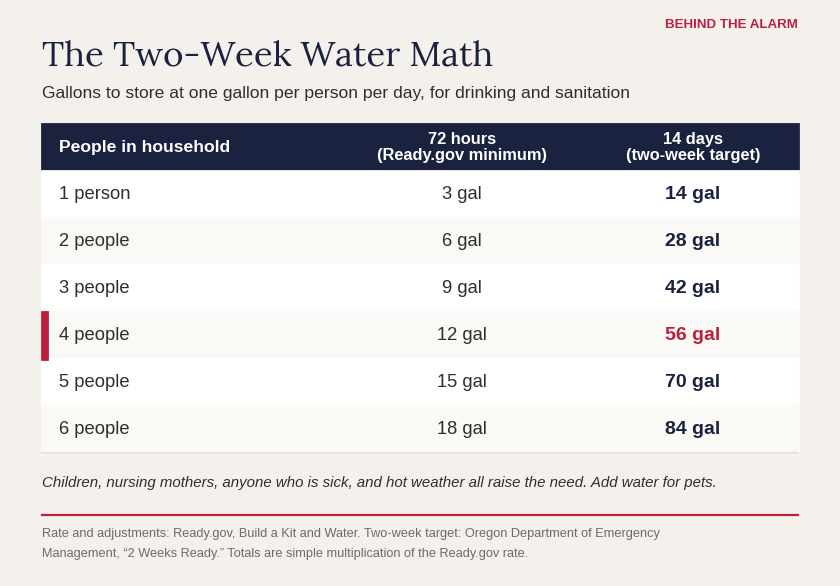
For years, the standard advice was 72 hours. Ready.gov still recommends at least three days of food and water, figuring water at one gallon per person per day for drinking and sanitation. Treat that as the floor, not the goal. Oregon’s emergency managers built their “2 Weeks Ready” campaign on the reasoning that responders may not be able to reach everyone for days after a major disaster, and that households able to hold on their own for two weeks let responders focus on the most critical, life-threatening calls. Given everything above, I believe two weeks at home is the right target for every American household, with a 72-hour kit kept in the vehicle or by the door for the day you have to leave. Parts 2 and 3 of my Before the Order Comes series walk through the go-bag and protecting your paper life in detail.
Two weeks sounds daunting until you do the math. A family of four at one gallon per person per day needs 56 gallons of water for fourteen days. That’s a lot of jugs, but it’s a single purchase you rotate, not a project you repeat. Food is easier than most people think: two weeks of the canned and dry goods your household already eats, built up a few extra items per shopping trip and rotated front to back.
We are not starting from zero, but we are not where we need to be. In FEMA’s 2023 National Household Survey, 48 percent of Americans said they had assembled or updated disaster supplies in the past year, and 37 percent said they had made a plan. Only 12 percent had planned anything with their neighbors, the least common action on the list. And the share who had signed up for alerts and warnings fell from 46 percent to 36 percent in a single year.
At the end of the gravel road
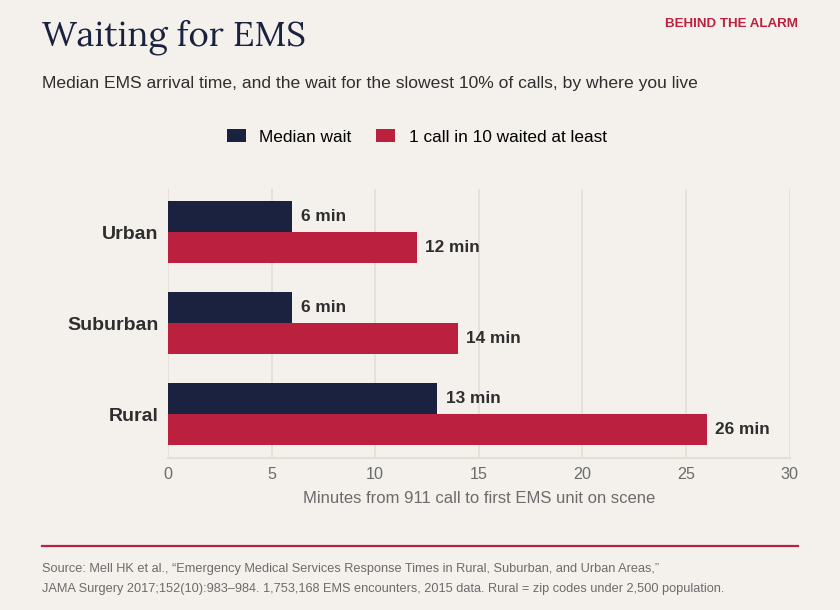
Rural readers already know help is farther away. The research puts numbers to it. A national study of more than 1.7 million EMS responses, published in JAMA Surgery in 2017, found that the median time from 911 call to the first EMS unit on scene was six minutes in urban and suburban areas and thirteen minutes in rural ones. One rural call in ten waited 26 minutes or longer. The authors’ conclusion was blunt: recognizing that “you are the help until help arrives” may be lifesaving.
The people who make up rural response are also fewer than they were. The National Fire Protection Association counted 676,900 volunteer firefighters in 2020, the lowest number it has ever recorded, down from nearly 898,000 in 1984. Most rural departments I know run on neighbors, and most of them are short of neighbors.
Rural preparedness starts with water, because for many of us the power line and the water line are the same line. About 15 percent of Americans, roughly 43 million people, get their drinking water from private wells, according to the CDC, and a well pump without electricity delivers nothing. Store water before you need it. When a storm is forecast, fill the bathtub and a few buckets for flushing while the pressure tank still has something in it.
Generators are the rural answer to that problem, and they are also how people die in the dark. The Consumer Product Safety Commission estimates that about 85 Americans die each year from carbon monoxide produced by portable generators. Run one outdoors only, at least 20 feet from the house, with the exhaust pointed away from windows and doors. Never in the garage, and never in the basement, no matter how far the door is open. If you are buying one this fall, look for a model with an automatic carbon monoxide shutoff, and put battery-powered CO alarms with digital readouts outside every sleeping area in the house.
After an ice or wind storm, rural driveways and roads fill with downed timber, and the chainsaws come out. I have run a saw as a Team Rubicon sawyer, and I will tell you plainly that the saw is the tool that hurts the people who were never trained to read what a bent, loaded tree is about to do. If you don’t know, leave that tree for someone who does. Two cheaper pieces of preparedness matter more. A reflective address sign at the end of the driveway, readable from both directions, is how a crew finds you at 2 a.m. when your road is one of dozens. And a NOAA Weather Radio with a tone alert keeps working when, as happened in northern Michigan in March 2025, the cell service goes down with the grid.
On the fourteenth floor
City readers face a different version of the same problem. On an ordinary day, help is closer. In a regional disaster, every call comes in at once, and the median response time on paper stops meaning very much.
Tall buildings carry vulnerabilities most residents never consider until the lights go out. In many multi-story buildings, water reaches the upper floors through electric booster pumps, and when the power fails, the pumps stop, and the upper floors lose pressure. Backup generators typically carry only the life-safety systems: emergency lighting, fire pumps, sometimes an elevator. California’s guidance for its own state office buildings notes those generators typically hold enough fuel for at least eight hours. After that, anyone who can’t manage the stairs may be stranded. If you live high up, store water in your unit. If a neighbor on your floor uses a wheelchair or a walker, your building’s plan should include that person by name, and so should yours.
Apartments have less storage, so think in shelves rather than rooms: water under the bed, a two-week pantry in the cupboard you already use. Refill prescriptions before you run low, not on the last day; a pharmacy without power may not be able to fill anything. Keep some cash in small bills, because card readers and ATMs need electricity too. Expect traffic signals to go dark and transit to stop. And remember the one real advantage the city has over the country: density. More neighbors within earshot means more help within reach, provided you’ve met them before the day you need them.
What the country and the city have in common
I have been on more than three dozen Team Rubicon deployments, from Mozambique, Honduras and the Bahamas to disasters here at home. On deployment after deployment, the pattern held: by the time organized help arrived, much of the lifesaving had already been done by the people next door. The neighbor who knew the widow down the road lived alone. The man with a tractor who opened the lane. The retired nurse who went house to house checking on medications.
Remember that only 12 percent of Americans had planned anything with a neighbor. That is the cheapest, most effective preparedness gap in the country, and closing it costs nothing. Oregon’s guide asks a question worth putting to your next block party or township meeting: who in your neighborhood has medical skills, a generator, or a chainsaw? Add one more. Who on your street would be in real trouble alone for two weeks? The elderly neighbor, the person on home oxygen or dialysis, the new mother, the man whose family all live out of state.
Then get trained. CPR, Stop the Bleed, and Community Emergency Response Team courses are offered in many communities, often at no cost. Sign up for your county’s emergency alerts, and check that Wireless Emergency Alerts are switched on in your phone’s settings. Know your fire department’s non-emergency number. Speaking as a chief: we would much rather hear from you before the storm than meet you after it.
The October list
If you do nothing else before the first hard freeze, do these.
1. Store water: one gallon per person per day for fourteen days, plus extra for pets.
2. Build a two-week pantry from food your household already eats, and rotate it.
3. Refill prescriptions early, and keep a written list of medications and doses.
4. Put battery-powered carbon monoxide alarms outside sleeping areas, and test your smoke alarms.
5. Make a generator plan: outdoors only, 20 feet from the house, exhaust pointed away.
6. Get a NOAA Weather Radio, and sign up for your county’s alerts.
7. Write down the phone numbers that matter, and keep some cash in small bills.
8. Meet two neighbors, and learn who on your road would be in trouble alone.
9. Post a reflective address sign where the road meets your driveway.
10. In a high-rise, learn your building’s backup power plan and who can’t use the stairs.
The council’s sentence has three parts, and the first has always mattered most. Locally executed. Not because Washington says so this year, but because of distance, physics, and time. The water rises on your street before it rises anywhere else. The tree comes down across your line. The first person who can help is the one already standing there.
Make sure that person is ready. Stand ready, as this year’s theme says, and plan to stand for two weeks.
SOURCES
1. President’s Council to Assess the Federal Emergency Management Agency, Final Report, May 7, 2026 (dhs.gov).
2. FEMA, “FEMA Kicks Off National Preparedness Month 2026,” press release, Sept. 1, 2026.
3. U.S. Government Accountability Office, FEMA Workforce: Staff Reductions and Lack of Planning May Impact Mission Readiness, GAO-26-108427, Aug. 4, 2026.
4. Federal News Network, “GAO: FEMA staffing cuts lacked strategy, hit regional staff hardest,” Aug. 4, 2026 (senior executive departures).
5. NOTUS, “FEMA Cut Staff Without Planning for Future Work, Watchdog Says,” Aug. 4, 2026 (11,383 target; 23,000 recommendation).
6. Government Executive, “FEMA came up with a goal to cut half its staff without a plan to get there, records show,” Apr. 13, 2026.
7. Bipartisan Policy Center, “FEMA Reform: Comparing the Review Council’s Recommendations and Congressional Proposals,” May 26, 2026.
8. Committee for a Responsible Federal Budget, “Appropriations Watch: FY 2027,” updated Sept. 3, 2026 (DHS lapse dates; continuing resolution through Dec. 11).
9. WJXT News4Jax, “FEMA funding restored after shutdown ends,” Apr. 30, 2026 (Disaster Relief Fund balance).
10. Associated Press analysis of disaster declaration approval times, July 16, 2026; Associated Press, May 2025 (White House statement; Pete Gaynor).
11. Association of State Floodplain Managers, “Senate Confirms Hamilton as FEMA Administrator,” Aug. 8, 2026.
12. ICMA, “FEMA Review Council Releases Final Report: What Local Governments Need to Know,” June 1, 2026.
13. National Weather Service, entry-level meteorologist vacancy announcement, 2026.
14. WCAX, “First Atlantic hurricane season without a hurricane by Sept. 21 in 112 years,” Sept. 21, 2026; WMC Action News 5, “Tropics Breakdown,” Sept. 22, 2026.
15. NOAA Climate Prediction Center, ENSO Diagnostic Discussion, September 2026; NOAA, “El Niño forms, expected to strengthen,” 2026.
16. Office of Governor Gavin Newsom, state of emergency proclamation for the 2026–2027 El Niño event, Sept. 21, 2026.
17. Northern Express, “The March 2025 Ice Storm, A Retrospective,” Mar. 21, 2026; CBS News Detroit, March 2025; Alpena Power Company, Ice Storm Summary, Mar. 25, 2026.
18. U.S. Energy Information Administration, “Hurricanes in 2024 led to the most hours without power in the United States in 10 years,” Dec. 1, 2025.
19. Ready.gov, “Build a Kit” and “Water.” Oregon Department of Emergency Management, “2 Weeks Ready.”
20. FEMA, 2023 National Household Survey on Disaster Preparedness.
21. Mell HK, Mumma SN, Hiestand B, et al., “Emergency Medical Services Response Times in Rural, Suburban, and Urban Areas,” JAMA Surgery 2017;152(10):983–984.
22. National Fire Protection Association, U.S. Fire Department Profile (2020 data); National Volunteer Fire Council.
23. Centers for Disease Control and Prevention, private well fact sheet; Pennsylvania Department of Health, Private Well Water fact sheet.
24. U.S. Consumer Product Safety Commission, Fatal Incidents Associated with Non-Fire Carbon Monoxide Poisoning from Engine-Driven Generators and Other Engine-Driven Tools, 2011–2021 (2022), and generator safety guidance.
25. California Department of General Services, State Administrative Manual illustration MM09-04a3, power outage guidance for state buildings.
HOW I WORK
I write two newsletters, and I write both of them with help.
Some of that help is human: firefighters, clerks, retired chiefs, neighbors who’ve noticed something and can’t get anyone to listen. Some of it is artificial. I use AI to dig through public records, to organize a year’s worth of meeting minutes into something I can actually see, to draft and redraft until a paragraph says what I mean, and to argue with me when my reasoning is thin.
What it does not do is decide what matters. Intelligence is the ability to solve problems; wisdom is knowing which ones are worth solving. The second part is the job, and no machine is going to do it for me. Choosing which story to chase, which official to press, which figure doesn’t add up — that comes from fifty years on fire scenes, in union halls, and at township board meetings, and it isn’t something I’d hand off if I could.
I hold this work to one standard: every figure sourced, no invented precision, no overclaiming, corrections published where the error ran. AI is fast, and it is useful, and it is sometimes confidently wrong, which is exactly why that standard exists and why I don’t relax it. Nothing appears here because a machine said so.
For a while I turned off the AI detection on my work, worried readers would take it as proof I hadn’t thought about what I wrote. I’ve stopped doing that. Tools are neither the virtue nor the vice — how we use them is. My name is on every piece. That means I chose it, I checked it, and I’ll answer for it.
Fred R. LaPoint is Fire Chief and paramedic of Stronach Township Fire Department in Manistee County, Michigan, with over 50 years in emergency services. A Vietnam-era Coast Guard veteran and Team Rubicon disaster responder with more than three dozen deployments, he writes Behind The Alarm and Guardians of Truth.
This article first appeared in Behind The Alarm, the newsletter of Fred R. LaPoint, Fire Chief Paramedic of the Stronach Township Fire Department, on September 26, 2026. Read the original.