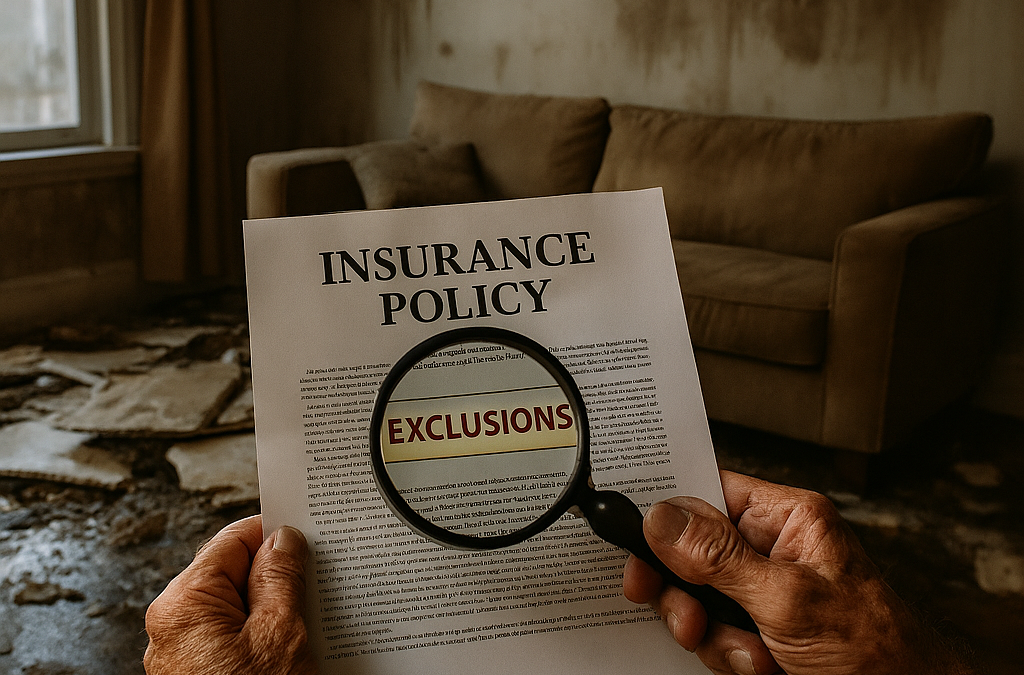
I’m standing in what used to be a living room. The hurricane came through a week ago. The family is here – exhausted, shell-shocked, but grateful they survived. They’re already talking about rebuilding, about insurance covering it, about how they’ll get through this.
Then the adjuster delivers the news: the water damage isn’t covered, not under their policy. The wind damage is, sure – but the storm surge that ruined everything on the first floor and basement? That requires flood insurance. Which they don’t have.
I’ve watched that same scene play out more times than I can count. Different disasters, different states, different families. Same devastating moment when they realize the coverage they paid for all those years won’t cover the loss they’re standing in.
Why I’m Writing This
My name is Fred LaPoint. I’ve spent over 40 years in fire service, currently serving as Fire Chief of Stronach Township Fire Department. I’m also a U.S. Coast Guard veteran and a disaster responder with Team Rubicon, with more than three dozen deployments – from Mozambique to Honduras to the Bahamas, and countless domestic disasters here in the U.S. I’ve served in just about every role you can imagine in disaster response.
I’m not an insurance expert. I’m not selling policies. I’m not marketing fear. But I’ve seen what happens when people don’t have the right coverage, and I’ve watched hearts break when families learn too late that the insurance they trusted won’t cover their loss.
This post is about preventing that moment. Because the time to learn what your insurance won’t cover isn’t while you’re standing in the ruins of everything you own.
The Hard Truth: Insurance Isn’t Insurance
Here’s what most people don’t realize: not all insurance policies are created equal. Two homeowners’ policies sitting side by side might have vastly different coverage, different exclusions, and different fine print that determines whether you rebuild your life or lose everything.
You can pay premiums for decades and still be woefully underinsured. Or you might be paying for coverage you don’t actually need while missing the coverage that would save you.
And here’s the kicker: when disaster strikes, you’re bound by what you signed. The insurance company will follow its policy to the letter. Saying “I didn’t know” won’t help you. Saying “I thought it was covered” won’t rebuild your home or business.
What You Think Is Covered vs. What Actually Is
Let me walk you through some of the most common – and most devastating – gaps I’ve seen:
The Tree That Cost $15,000
Storm comes through, takes down a massive oak tree in your yard. No problem, right? You’ve got homeowners’ insurance.
Wrong. In most policies, if that tree doesn’t hit your house or another structure, you’re paying out of pocket to remove it. I’ve seen families spend $10,000 to $20,000 removing storm-damaged trees that never touched their homes. Trees, they assumed, their insurance would cover.
Water Damage: The Nightmare Scenario
This is where it gets really complicated. Water damage might be covered… or it might not. It depends entirely on where the water came from.
Rain through a wind-damaged roof? Usually covered.
Storm surge or flooding? Not covered without separate flood insurance.
Water that backs up through your sewer line during a flood? Often requires a special rider.
Slow leak from a pipe that’s been seeping for weeks? Many policies won’t cover gradual damage.
I’ve responded to hurricanes where entire neighborhoods were devastated by water, and half the families had coverage while the other half – living on the same street, hit by the same storm – had nothing. The only difference was whether they’d purchased flood insurance.
If You Rent or Lease, Listen Up
This is critical: your landlord’s insurance does NOT cover your personal belongings. I cannot stress this enough.
I’ve met renters who lost everything in fires, floods, and storms, and only then learned that the property owner’s insurance covers the building – not your furniture, not your clothes, not your electronics, not your family heirlooms.
Renters insurance is usually cheap – often $15 to $30 a month. But I’ve seen people lose $30,000 worth of possessions because they didn’t have that $20-a-month policy.
The Foundation That Wasn’t a Total Loss
Here’s one that catches people completely off guard: your house burns to the ground, but the foundation is still intact. In your mind, it’s a total loss.
Your insurance company might disagree. They may consider the foundation still usable and deduct its “value” from your payout. Suddenly, instead of receiving enough to rebuild, you’re tens of thousands of dollars short because they valued that concrete slab at $40,000.
The Municipality That Holds Your Money
Some cities, counties, and municipalities have ordinances that require insurance companies to withhold a portion of your claim payout until you either rebuild or properly clean up and dispose of the damaged structure.
The insurance company issues the check. But you don’t get to access all of it. Sometimes, 25-30% is held in escrow until you meet local requirements.
When you’re trying to secure temporary housing, replace basic necessities, and figure out your next move, having that money locked up can be devastating.
RV and Off-Grid Living
1. If you live in an RV full-time, is it insured as a vehicle or as a home? There’s a massive difference in coverage. Warranty issue: People buying RVs for full-time living need to read the warranty carefully and ask specifically whether full-time use voids coverage. Most manufacturers exclude it unless explicitly stated otherwise.
2. Insurance issue: This is critical – having standard recreational RV insurance while living full-time can result in denied claims. Full-time RV insurance costs more but provides essential coverage for personal liability when parked, contents/personal property (often with much higher limits), emergency lodging, and other homeowner-style protections.
The insurance issue is particularly devastating because people might pay premiums for years, thinking they’re covered, only to have a claim denied when disaster strikes because they were living in the RV full-time under a recreational-use policy.
Living off-grid? Your standard homeowners policy might not cover your solar equipment, your well system, or your alternative heating setup. Some companies don’t even want to insure off-grid properties at all.
These situations require specialized policies, and assuming you’re covered under standard insurance is a recipe for disaster.
The Fine Print That Will Destroy You
Every insurance policy has exclusions and requirements. Violating them – even unknowingly – can void your coverage entirely. Here are some I’ve seen cost people everything:
Vacancy clauses: Many policies require that a home not be vacant for more than 30-60 days. You go on an extended trip, a fire happens, and suddenly you’re not covered because the house was “vacant.”
Maintenance requirements: Neglecting basic home maintenance can void coverage. That roof you kept meaning to fix? If it fails and causes damage, your claim might be denied.
Code violations: Some policies won’t cover losses if the property has/had existing code violations. That unpermitted addition? It might disqualify your entire claim.
Business use: Running a business from your home without declaring it can void coverage if something happens.
Acts of God and government: Some policies exclude coverage for certain types of disasters or government-ordered evacuations. Read those exclusions carefully.
Undisclosed wood stoves and fireplace inserts: Many homeowners don’t realize that wood stoves, pellet stoves, and fireplace inserts must be disclosed to their insurance company – even if they were installed by a previous owner. Insurance companies view these as increased fire risks and need to know about them to properly assess coverage. If you have a fire loss and the insurance company discovers you had an undisclosed wood-burning appliance, they may deny your entire claim – even if the wood stove had nothing to do with the fire. When you buy a home with these appliances already installed, it’s your responsibility to notify your insurance company. This also applies to any wood-burning appliance you install yourself, whether it’s permitted or not.
This is especially important in rural areas where wood heat is common and people often don’t think twice about it. But from an insurance perspective, it’s a major disclosure item that can sink a claim.
State Laws Matter – A Lot
Insurance laws vary wildly from state to state. What’s standard coverage in Michigan might not even be available in Florida. Some states require certain coverages, while others leave it entirely up to you.
If you live in a flood zone, lenders usually require flood insurance. But flood zones change. FEMA updates maps. You might not have been in a flood zone when you bought your home, but you could be now.
Earthquake insurance, hurricane coverage, wildfire protection – these are often separate policies or riders depending on where you live.
Don’t assume what worked in your old state works in your new one.
What You Need to Do Right Now
Stop reading for a moment and ask yourself: Do you actually know what your insurance covers? Not what you think it covers – what it actually covers?
Here’s what you need to do:
1. Read Your Actual Policy
Not the summary. Not what the agent told you. The actual policy document. Yes, it’s boring. Yes, it’s dense. Read it anyway. Look specifically for:
-
Exclusions
-
Coverage limits
-
Deductibles
-
Replacement cost vs. actual cash value
-
Special riders or endorsements
2. Document Everything You Own
When you’re filing a claim, you need to prove what you owned. Memory isn’t enough. Take photos or videos of every room in your home. Open closets, drawers, and cabinets. Photograph serial numbers on electronics and appliances. Store these off-site – cloud storage, external drive at a friend’s house, safety deposit box. It doesn’t take a huge amount of time, especially with cell phones with cameras capable of video or picture taking. But this is a critical step to take to help ensure you get reimbursed for all of your covered losses.
3. Understand These Key Terms
Replacement cost: Pays to replace the item at today’s prices
Actual cash value: Pays the depreciated value (much less)
Guaranteed replacement cost: Covers rebuilding even if costs exceed your policy limits (this is gold)
Ordinance or law coverage: Covers costs to bring the rebuilt structure up to current building codes
4. Ask These Specific Questions
Call your insurance company or agent and ask directly:
-
“If a tree falls in my yard but doesn’t hit my house, is removal covered?”
-
“What types of water damage are excluded from my policy?”
-
“Do I need separate flood insurance based on my location?”
-
“If my house burns down but the foundation remains, how is that calculated?”
-
“What could void my coverage?”
-
“Am I insured for replacement cost or actual cash value?”
Get the answers in writing.
5. Consider These Additional Coverages
Depending on your situation, you might need:
-
Flood insurance (through NFIP or private insurers)
-
Earthquake insurance
-
Sewer backup coverage
-
Ordinance or law coverage
-
Equipment breakdown coverage (for HVAC, electrical, plumbing)
-
Scheduled personal property (for jewelry, art, collectibles beyond standard limits)
-
Umbrella liability policy
· Specialized equipment and vehicles: Standard homeowners policies typically don’t cover tractors, compact track loaders (CTLs), skid steer loaders (STLs), farm equipment, boats, or other specialized vehicles – even if they’re stored on your property. These require separate policies or special riders added to your homeowners’ insurance. A $40,000 tractor stolen from your barn or damaged in a fire might not be covered under your basic homeowners policy. If you own this type of equipment, ask your insurance agent specifically about coverage and don’t assume it’s protected just because it’s on your property. The same goes for boats, whether they’re in your driveway, in storage, or at a dock.
This is especially relevant in rural Michigan and beyond, where lots of folks have equipment sitting around that they think is covered.
· Food spoilage from power outages: Many people assume their homeowners or renters’ insurance automatically covers food loss during power outages. The reality is far more restrictive. Most policies provide only $500 to $1,000 in food spoilage coverage, and that’s only if the power outage was caused by damage to your property, like a tree falling on your power line. Area-wide power outages from grid failures, storms that don’t directly damage your property, or your refrigerator simply breaking down are typically NOT covered. Your deductible also applies, so if you have a $500 deductible and lose $400 worth of food, you get nothing. This is especially important for people in rural areas or those who keep freezers full of meat, or families who stock up on groceries. Consider adding equipment breakdown coverage, which can significantly increase your food spoilage limits. And before filing a small food spoilage claim, consider whether it’s worth potentially raising your insurance premiums over a few hundred dollars in losses.
6. Review Your Coverage Annually
Your life changes. You renovate, you acquire valuables, property values increase, and building costs rise. What was adequate coverage five years ago may not be today.
Review your policy every year. Adjust as needed.
7. For Renters: Get Renters Insurance Today
If you rent and don’t have renters’ insurance, stop reading and get it right now. It’s cheap, it’s essential, and you won’t regret having it.
If you do regret it, it’ll be because you didn’t have it when disaster struck.
The Bottom Line
I’ve held people while they sobbed because their insurance wouldn’t cover their loss. I’ve watched families who thought they were prepared realize they weren’t. I’ve seen the long-term damage – not just financial, but emotional and physical – that comes from discovering too late that you’re not protected.
You cannot control when disaster strikes. But you can control whether you’re prepared for it.
The policy you sign today is the one you’ll be stuck with when your house is burning, when the floodwaters are rising, when the tornado has passed through. There are no do-overs. There’s no “I wish I’d known.”
You’re reading this right now – that means you have time to get it right.
Don’t be the person standing in the ruins wishing you’d paid attention to the fine print. Don’t be the family that learns about policy exclusions from an adjuster delivering bad news.
The devil isn’t just in the details. The devil IS the details.
Read your policy. Know your coverage. Ask the hard questions. Get the protection you actually need, not just the protection someone sold you.
Because what you don’t know absolutely can hurt you. And by the time you find out, it’s too late to fix it.
Fred R. LaPoint
Fire Chief, Stronach Township Fire Department
Team Rubicon Disaster Response
U.S. Coast Guard Veteran
Behind The Alarm brings you insights from over 40 years of fire service and disaster response. If this post helped you, share it with someone who needs to read it. Knowledge shared is lives saved.
Have questions or experiences to share? Drop them in the comments. Let’s learn from each other.
This article first appeared in Behind The Alarm, the newsletter of Fred R. LaPoint, Fire Chief Paramedic of the Stronach Township Fire Department, on November 14, 2025. Read the original.