Most people carry the same picture of an ambulance call, and it is a reasonable picture, because it is the one they have seen. The truck arrives. The patient is right there. The crew goes to work, gets the patient on the cot, loads up, and drives away. Three steps, and the whole thing fits inside the time it takes to watch it from a front porch.
That picture is accurate for a great many calls. It was not remotely accurate for one we ran recently in a remote corner of this township, and the difference between the two is worth explaining, because the part you, the public, never sees is the part that takes the time and consumes the people.
What the picture leaves out is everything on either end of it. Before anyone can treat a patient, somebody has to find them. After the treatment starts, somebody has to get them back out. On an ordinary call, those two phases take about as long as walking up a driveway. On a call in the woods, along a mountain biking trail, or along a narrow hiking path along a river bank, each of them can take longer than everything in between, and together they are where a department finds out exactly how many people it has.
Finding them
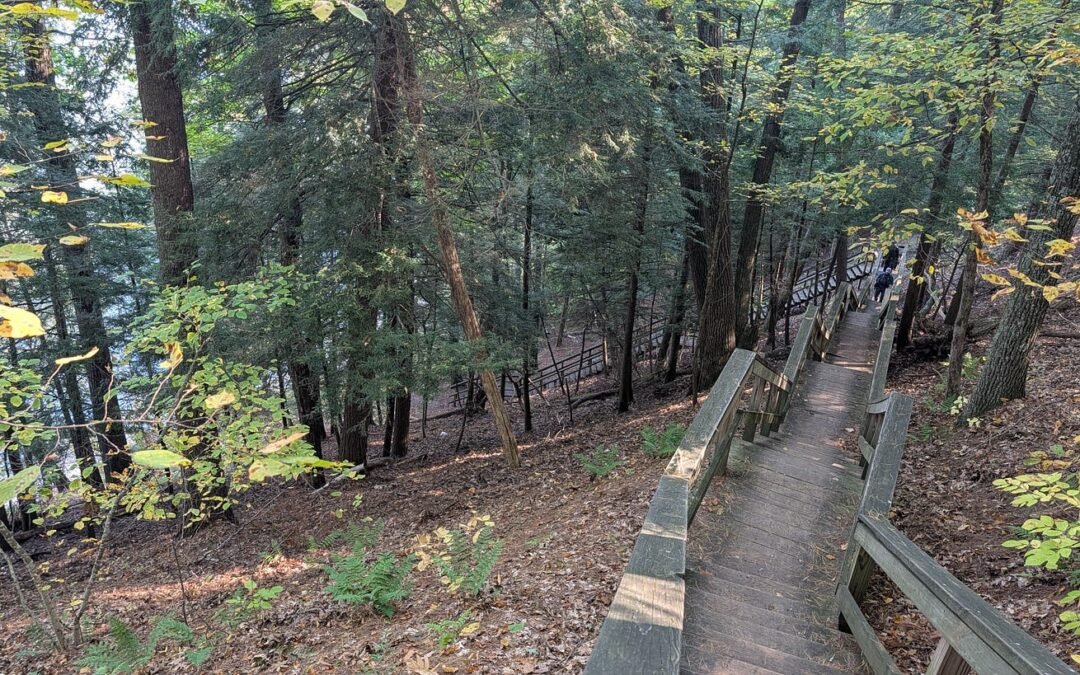
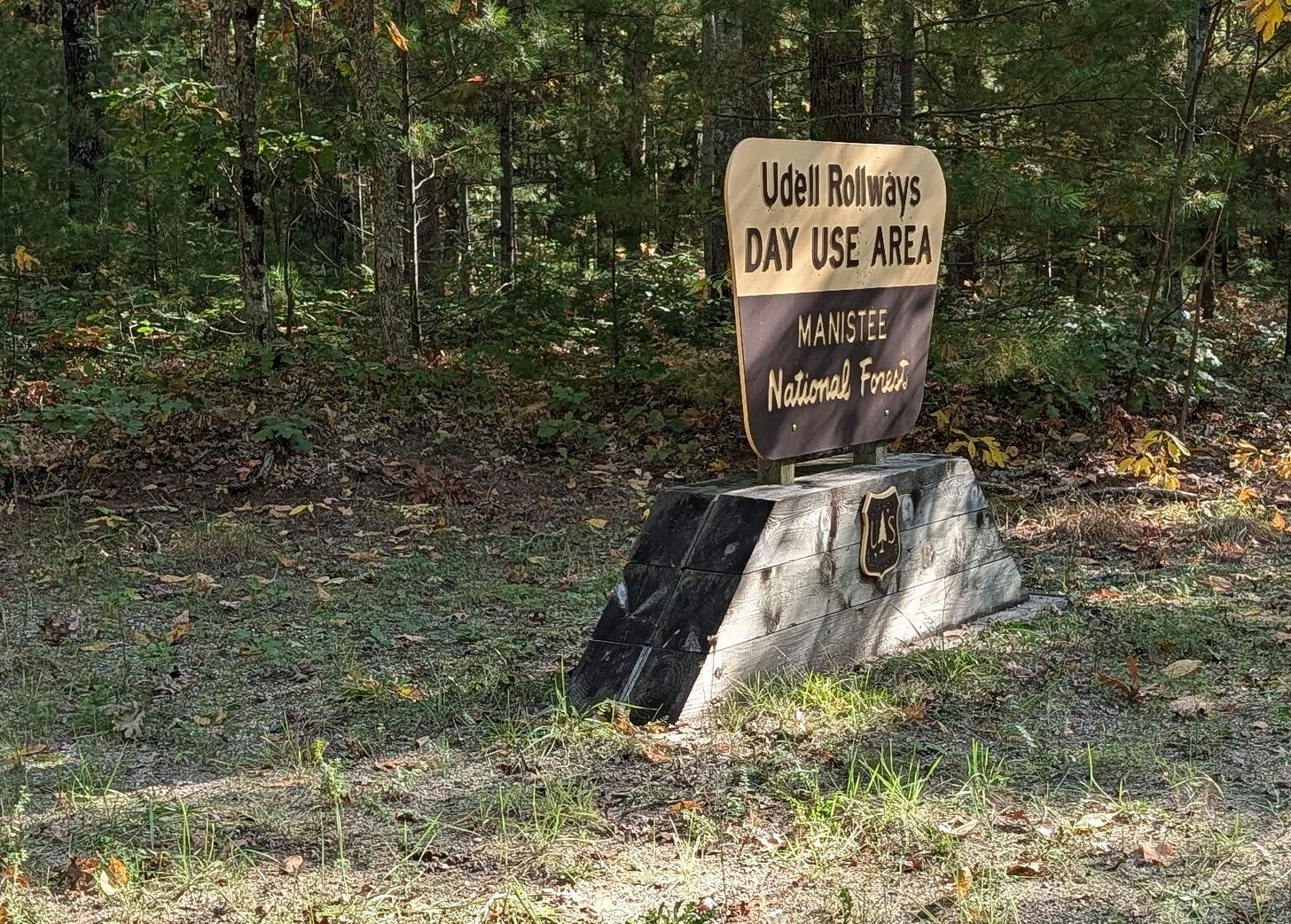
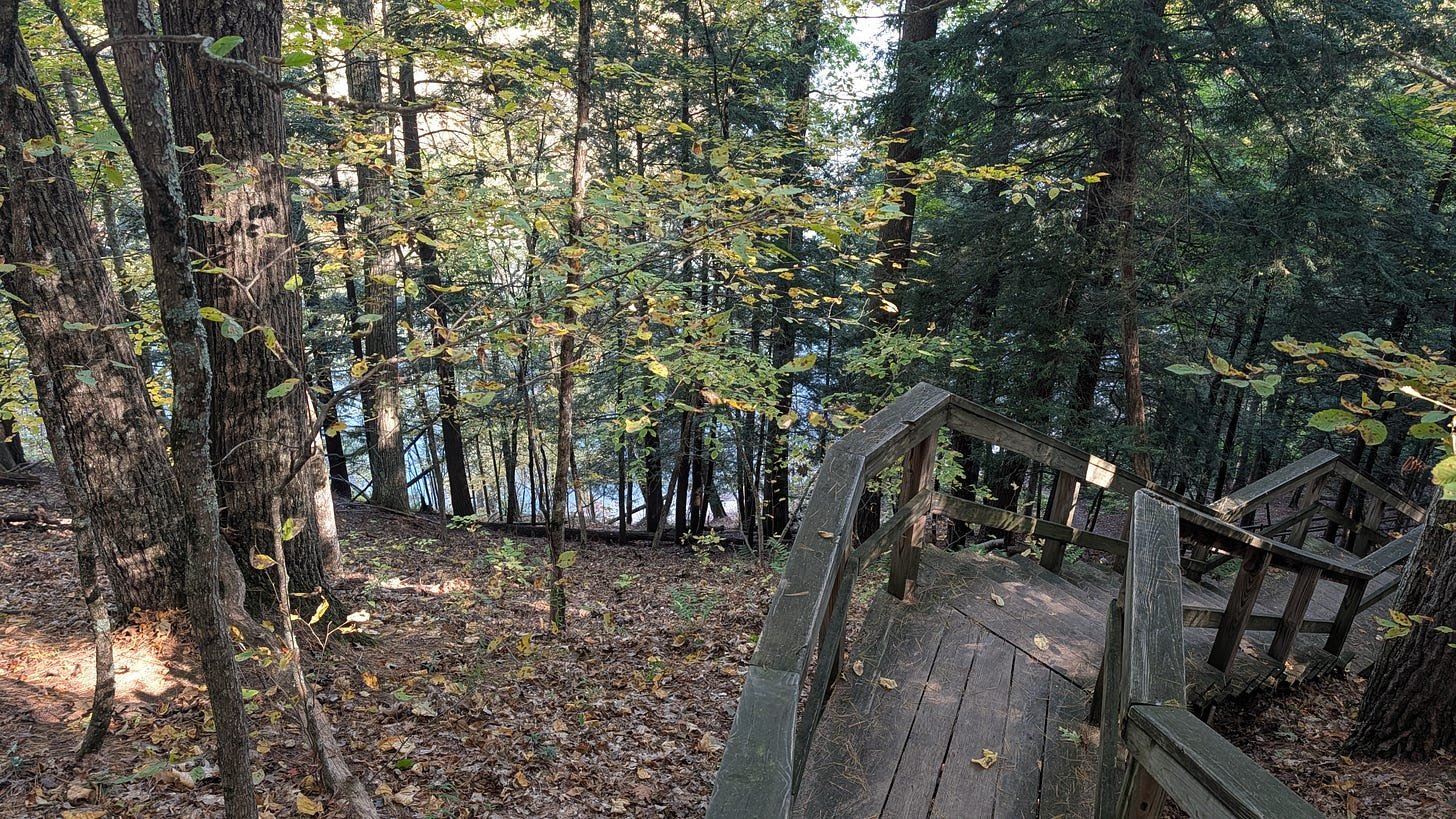
The call came from the day-use area at the end of Horseshoe Bend Road, where there is a disc golf course, a parking lot, and a long wooden staircase running down the bank toward the Manistee River. The report placed the patient at the top of those stairs.
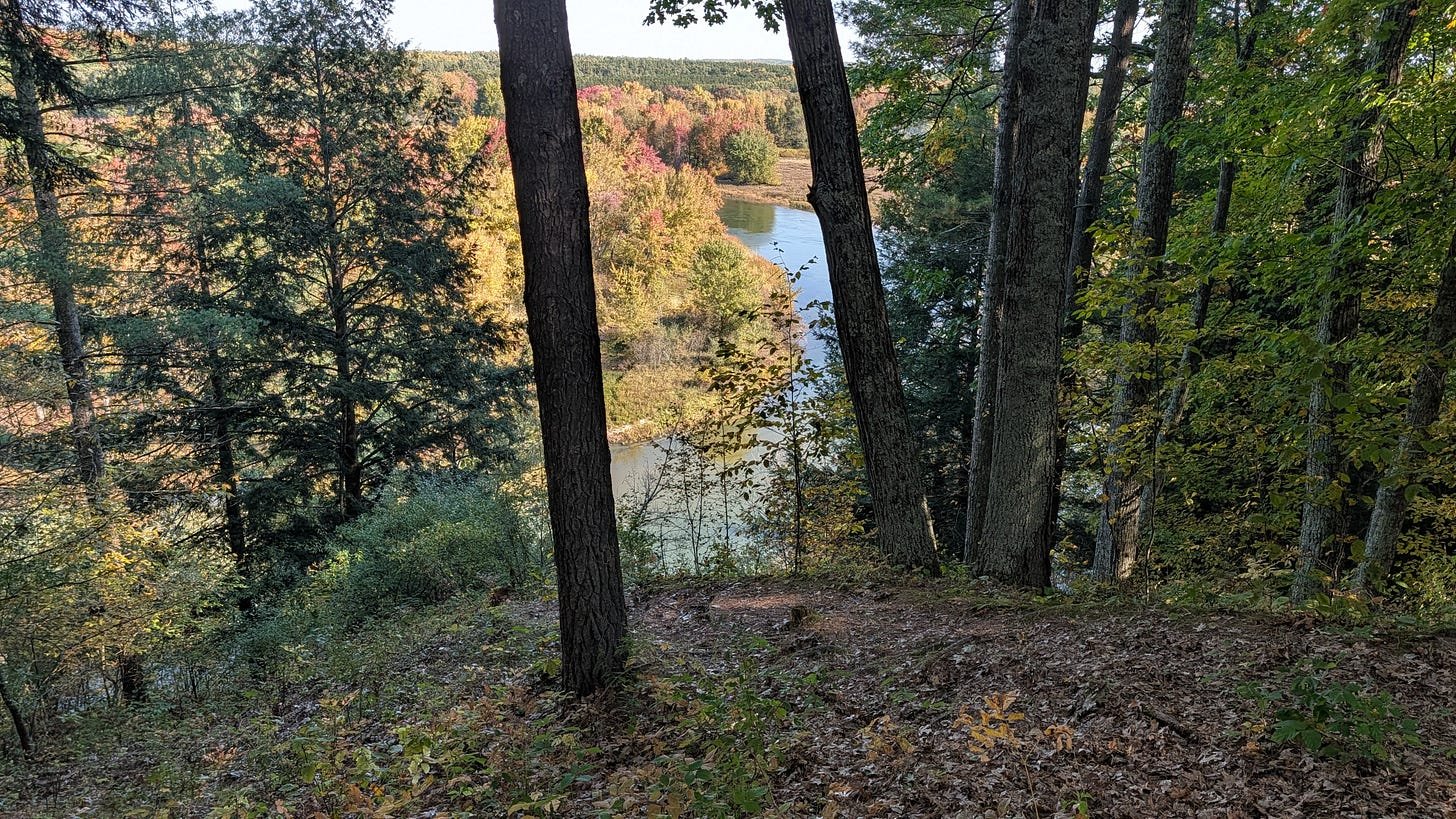
That is not where the patient was. The patient was at the bottom of them, and then a considerable distance downriver past where Pine Creek comes in, at a campsite that had just been pitched. Our best estimate puts that a quarter of a mile beyond the foot of the staircase.
None of that is a criticism of whoever made the call. It is simply what happens out there. People report where they started, or where they last had a bar of signal, or where they believe help will be able to meet them. There is no street number at the bottom of a river gorge, and a phone under a canopy of hardwoods does not always know where it is either. Dispatch can hand a crew a road name and a direction. The rest belongs to whoever is walking.
And until somebody puts eyes on the patient, nobody knows what the call actually is. Not how sick the patient is, not how far they have to be moved, not what it will take to move them, and not how many people to start toward the scene. Every decision a chief/incident commander would like to make early has to wait on a set of eyes that are still 180 steps away.
Reaching them
One hundred eighty steps one way. We counted them. They run down a bank that drops, by our rough estimate, somewhere between 250 and 300 feet, and I want to be plain that this is an estimate drawn from the stair count and the terrain, not a surveyed figure. At the bottom, the staircase still leaves you roughly 50 feet above the riverbank itself.
Mobile Medical Response (MMR) ambulance personnel and Stronach Fire Dept members went down those stairs carrying what the call sounded like at the time: a stair chair, a backboard, the monitor, the airway, and drug bags. That is the honest nature of this work. The equipment you carry in is a guess, and the guess does not get corrected until you find the patient. In this case, the answer turned out to be a Stokes basket and a rope system, and none of that was doing anybody any good sitting in the parking area, and we needed the manpower and equipment we didn’t have from Norman Township Fire Department.
Getting them out
This is where the public picture breaks down entirely, and where most of our two hours went.
The obvious plan is to put the patient in the basket and carry the basket back up the stairs. We could not do that, and the reason is purely physical. A Stokes basket wants six tenders, three to a side, hands on the rail the whole way. Those stairs are wide enough for two people abreast and a little more. They are not wide enough for six people to keep contact all the way around a loaded basket.
Take those six away, and the arithmetic turns ugly in a hurry. A loaded basket, counting the patient, the packaging, and the basket itself, runs well north of three hundred pounds. Spread across six people on level ground, that is a hard carry. Carried front and back by two or three people, tilted, up 180 steps cut into a hillside, it is not a hard carry. It is a drop waiting to happen, and on that bank a drop does not end with a dropped basket. It ends with the basket and the people going down the hill together.
So we did not carry the patient up. We hauled them up, which is a different problem solved with different tools.
The move broke into two pieces. The first was the carry from the campsite, across the creek, to the base of the embankment by the stairs. That took six people on the basket and a seventh carrying the gear, so the six never had to take a hand off the rail. It included crossing the creek, which means footing you cannot see, a basket that has to stay level, and six people with no free hand to catch themselves if a rock rolls. There is no fast way across that, and no safe way to do it short-handed.
The second piece was the raise. Thank you, Norman Township Fire Department, for the use of your rope rescue system and for providing the set-up and additional manpower. We used a large oak about a hundred feet back from the edge as our anchor and rigged a 5-to-1 mechanical advantage. Setting the anchor that far back keeps the system off the least stable dirt on the hill, gives a straight line of pull, and leaves the haul team room to actually walk the rope.
Mechanical advantage is the piece worth understanding, because it explains the clock better than anything else in this account. It does not make the load lighter for free. It trades distance for force. At 5-to-1, the team pulls five feet of rope for every one foot the basket rises. With about a hundred feet of working ground between the oak and the edge, one full pull brings the basket up roughly twenty feet. Then everything stops. The load is held, the system is reset and walked back out, and you do it again. A raise like that is not one smooth pull. It is a series of them with a reset between each one, and the patient is on that face for all of it with attendants handling/riding the basket.
Choosing a 5-to-1 instead of something faster was itself a manpower decision. A lower ratio moves quicker and takes fewer resets, but it needs more muscle on the rope. We ran the system the people on hand could actually run, and we paid for it in minutes.
The part that comes after
The story usually stops when the helicopter lifts. The work does not.
Everything that went down that hill has to come back up it. Two more of our people carried the stair chair, the backboard, and the rest of the equipment back up all those steps, after the urgency was over, with nothing left in the tank and no adrenaline left to borrow against. That is exactly where people get hurt. Not during the rescue, but during the cleanup, when tired people carry awkward loads up stairs, and nobody is watching anymore.
The headcount
Add it up. Seven people at the bottom moving the patient. Six at the top running the raise: the Norman Township fire chief operating the system he brought, three MMR personnel on the line, myself, and a neighbor from the area who stepped in and took hold of a rope. Two more carrying equipment back up the stairs. Fifteen people on that hillside.
They were not interchangeable. The seven at the bottom had to be at the bottom. The six at the top had to be at the top. At the same time, for the same single patient. Nobody was spare, and nobody was standing around.
That is the answer to a question people ask in complete good faith when they see a scene like this one: why does one patient require two ambulances, an Echo unit, two fire departments and a helicopter? Because the terrain decided it, and the terrain does not negotiate.
It is also worth saying plainly that this department does not own rope rescue equipment, and many departments our size do not. Norman Township does; they train on it, and they brought it. Without that gear and the people who know how to run it, we would have been out there a great deal longer with no good options in front of us. That is the real argument for mutual aid, and it is better made with a rope and an oak tree than with a slogan.
Why we do it the way we do
Two things govern a scene like this, and at first hearing they sound like they contradict each other.
The first is that the clock is real, and it started before we did. On a time-dependent medical emergency, the window that matters opens when the problem starts, not when the ambulance pulls into the lot. Every minute spent finding someone and reaching them comes out of that window, and no amount of good work afterward buys it back. That is also why the care goes down the hill to the patient rather than waiting at the top for the patient to arrive. When the trip out is measured in tens of minutes, you cannot hold treatment until the patient reaches the ambulance. The ambulance is not the finish line. It is where the next phase starts.
The second is that nobody sprints. Every instinct says hurry, and hurrying on a bank that steep is how a rescuer becomes a second patient on the wrong side of 180 steps. Then the whole system has to turn around and go get its own, and the person we came for waits while that happens. Deliberate is not the opposite of urgent. On ground like that, deliberate is the only version of urgent that works.
Everything else follows from those two facts. The size-up before anyone moves. The assignments. The accountability. A fire chief on a rope line instead of standing behind a clipboard.
The neighbor on the rope
One more thing deserves saying. Of the fifteen people on that hill, one of them never got a page and does not wear a badge. He lives nearby, saw what was happening, and put his hands on a rope.
In a rural township, that is not a charming detail. That is infrastructure. The people who live at the end of the road know the ground; they are there before we are, and on more days than anyone cares to admit, they are part of the reason it works at all.
To every crew, every agency and every neighbor who was on that hillside: thank you. Two hours, fifteen people, one patient, and not one rescuer hurt getting it done.
A note on the numbers
The 180 steps are counted. The elevation drop, the distance from the campsite, and the reset arithmetic on the raise are estimates based on that stair count, the terrain, and the rigging we used, and are presented here as estimates rather than measurements. No patient information appears anywhere in this account.
Fred R. LaPoint is Fire Chief and paramedic of Stronach Township Fire Department in Manistee County, Michigan, with over 50 years in emergency services. A Vietnam-era Coast Guard veteran and Team Rubicon disaster responder with more than three dozen deployments, he writes Behind The Alarm and Guardians of Truth.
This article first appeared in Behind The Alarm, the newsletter of Fred R. LaPoint, Fire Chief Paramedic of the Stronach Township Fire Department, on October 13, 2026. Read the original.