
There is a rule on the fireground that every officer learns early and never unlearns: the people who fight the fire and the people who set the conditions for it have to belong to the same conversation.
On a structure fire, that means the inspector who walked the building and the crew forcing the door work for the same chief. On a wildland fire, it means the people who thinned the stand, ran the prescribed burn, wrote the forest plan, and know which two-track will hold a Type 3 engine in April mud are the same organization as the people who show up when it lights off. That connection is not sentiment. It is the entire reason a federal land management agency runs its own fire program instead of contracting one.
Washington is preparing to break that connection on a scale this country has never attempted. It is doing it in the middle of a severe fire season; it is doing it after Congress twice declined to pay for it, and as of this month there is a push to do it by emergency order rather than by law.
What is actually being proposed
In June of 2025, the President signed an executive order directing the Department of Agriculture and the Department of the Interior to consolidate their wildland fire programs within ninety days. The vehicle is a new agency — the U.S. Wildland Fire Service — housed inside Interior. The idea is to take the fire people out of the Forest Service, the Bureau of Land Management, the Park Service, the Fish and Wildlife Service, and the Bureau of Indian Affairs and put them under one roof with one chain of command.
The legislative vehicle came from Senator Tim Sheehy of Montana, who introduced a bill with Senator Alex Padilla of California directing both secretaries to build the consolidation plan. Sheehy is a former Navy SEAL who founded Bridger Aerospace, an aerial firefighting company in Bozeman, and he has been the loudest voice on Capitol Hill for unifying federal fire under Interior since he took office. His bill never received a committee hearing. The administration moved anyway.
On August 14 of this year, E&E News reported that Sheehy had drafted a letter to the President asking for a ninety-day emergency order to move the Forest Service’s wildfire responsibilities to Interior on a temporary basis. The draft, which surfaced publicly on the forest policy blog The Smokey Wire, asks for immediate consolidation of asset control, coordination, “carding” and contracting under a single command. For readers outside the fire service, carding is the red-card qualification system — the mechanism that says who is certified to do what on a fire. That is not a budget line. That is the spine of the interagency system.
Where it stands right now
Here is the part that ought to concern anyone who cares about how this republic is supposed to work. Congress has not agreed to this. Both House and Senate appropriators refused to fund the transfer. Senate appropriators went further and specifically prohibited federal funds from being used to move Forest Service firefighting resources to Interior. House members demanded a Government Accountability Office study of how the proposal would actually function. The chairman of the House Interior appropriations subcommittee put it about as plainly as a chairman can: there was no sense combining the agencies in the bill before the study he had ordered was finished.
The agencies proceeded regardless. The U.S. Wildland Fire Service took effect in January of this year. By March, roughly 3,900 Interior employees had been moved into it. The Forest Service — which accounts for more than two-thirds of federal wildland firefighting personnel and contracting — was left outside, for now. The FY 2027 budget proposal puts the full merger back on the table. And in August, rather than wait for the study or the authorization, the push turned toward an emergency order.
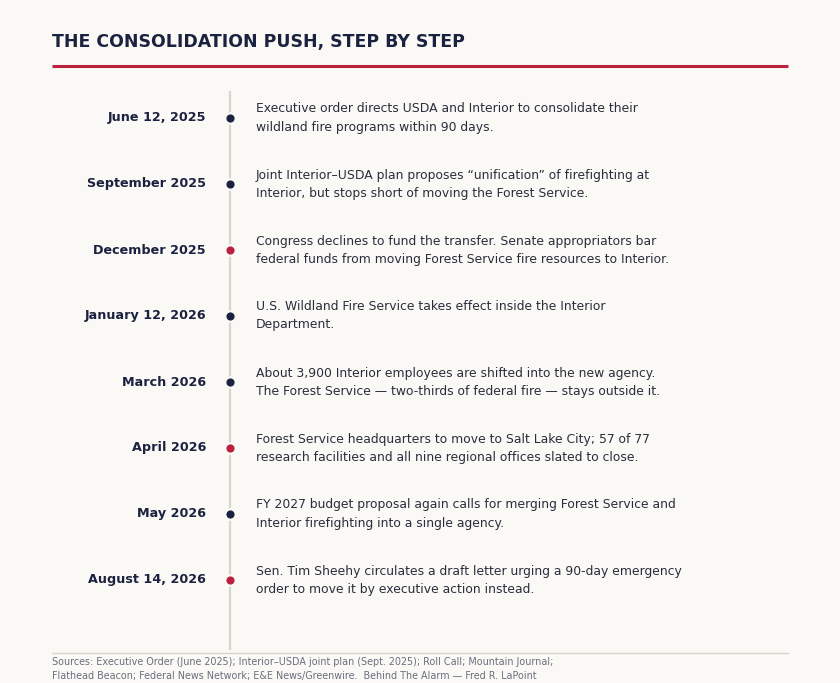
Fourteen months of moving a fire agency without an authorization to move it.
Why this is not a filing-cabinet question
Reasonable people can argue about org charts. This is not an org chart argument, and I want to be specific about why.
Federal wildland fire is not a fire department in the way my department is a fire department. The Forest Service does not simply respond to fire; it produces the conditions under which fire behaves. Fuels reduction, prescribed burning, timber management, road maintenance, water source development, forest planning — those decisions determine whether a start on a red-flag afternoon is a ten-acre problem or a ten-thousand-acre problem. The district ranger who knows which drainage runs, which road washes out, which private inholding has three elderly residents at the end of it, and where the gate key is kept — that person is not in the fire organization. Under this plan, that person and the incident commander no longer answer to the same agency.
Consider what happens to the money. When suppression sits in one department and fuels work sits in another, the two stop competing in the same budget — and the one with the flames on television wins every year. Prescribed fire is already the hardest thing in this business to fund, the easiest thing to postpone, and the first thing cut when a program is under pressure. Splitting it away from suppression does not protect it. It orphans it.
Consider also the doctrine. When draft consolidation proposals circulated through the fire community, they drew criticism for leaning toward full suppression of every wildfire — an approach that runs against decades of fire science and against everything the last twenty years of megafires have taught us. We know what a century of putting out every fire produced. We are living in the fuel bed it built. A new agency whose entire identity is suppression is not structurally equipped to say no to a suppression response, and that is precisely the decision that has to be made correctly, on the ground, in the first hour.
The Forest Service itself reports that roughly ninety-eight percent of wildfires are contained before they reach a hundred acres. If initial attack were the failure point, that number would look very different. The failure is in the two percent — and the two percent is a fuels, weather, planning, and land use problem. Reorganizing the initial-attack force does not touch it.
Dale Bosworth, who ran the Forest Service as chief, described separating firefighting from the agency’s land management expertise as “a solution in search of a problem.” I have read a great deal of testimony on this proposal. I have not found a better seven-word summary.
The precedent nobody wants to discuss
We are not guessing about what happens when you pick up a federal land agency and move it. During the first Trump administration, Interior relocated the Bureau of Land Management headquarters from Washington to Colorado. Analysis of that move found that eighty-seven percent of affected staff left rather than relocate. That is not a reorganization. That is an institutional casualty event, and the agency has never recovered the expertise it lost.
The Forest Service is now being run through the same sequence. In April, USDA announced the agency’s headquarters would move to Salt Lake City. In the same reorganization, fifty-seven of seventy-seven research facilities are slated to close, along with all nine regional offices. The agency’s chief told House appropriators that about five hundred employees would need to relocate and that the intent was not to push anyone out the door.
Take a moment on the research facilities, because they get the least attention and matter enormously. Forest Service research is where fire behavior modeling comes from. It is where fuels science, fire weather, smoke modeling, and firefighter health research come from. The tools my crews use to size up a fire — the models behind the spread predictions, the smoke forecasts that drive our public health advisories — exist because that research infrastructure exists. Closing three-quarters of it while simultaneously arguing that we need to fight fire more effectively is not a coherent position.
Follow the aircraft
I would rather write about tactics than about money. But you cannot understand this proposal honestly without looking at who stands to gain from it, and that record is documented rather than rhetorical.
Senator Sheehy founded Bridger Aerospace and, according to reporting by ProPublica in partnership with Montana Free Press, has continued to hold stock in the company while pushing to reduce regulation and expand federal use of private aircraft on wildfires. That reporting found he pushed to cut firefighting aircraft inspections during the same month his former company failed one. He was a founding board member of the United Aerial Firefighters Association, an industry group that has advocated for letting contractors develop their own inspection standards. The September consolidation plan includes creation of a joint federal firefighting aircraft service.
Set the politics aside and look at the structure of that arrangement. A sitting senator with an equity position in an aerial firefighting company is working to restructure the command, carding, and contracting authority that governs how the federal government buys and directs aerial firefighting. In December, a hold he placed over this dispute helped tie up an entire appropriations package. Whatever one concludes about his motives, no reasonable person should be asked to evaluate this proposal without that fact in front of them.
The part I have to say out loud
This is not a one-party project, and I am not going to pretend it is.
Senator Padilla, a Democrat, co-introduced the consolidation bill and has partnered with Sheehy on a string of wildfire measures. I went looking for a comparable financial entanglement on his side and did not find one. What I found is a senator whose state burned catastrophically in January of 2025 and who has since introduced more than ten wildfire bills covering intelligence sharing, hazard pay, firefighter paycheck protection, mitigation, and rebuilding. If there is a personal financial interest there, it is not in the public record, and I am not going to invent one because the symmetry would make a better column.
What is worth telling readers is that a specific advocacy ecosystem has shaped nearly all of this legislation, and its fingerprints are on both parties’ versions. Megafire Action, the Association for FireTech Innovation — whose founding chair also runs a venture capital firm investing in wildfire technology — and the United Aerial Firefighters Association appear as endorsers on bill after bill in this package. That is not corruption. It is how modern policy is written. But when the same handful of organizations supply the language, the endorsements, and the expert quotes for a restructuring of federal fire, the public deserves to know whose vocabulary they are reading.
And the case for consolidation is not frivolous. Federal fire really is split across two departments and five agencies. Ordering can be slow. Aviation coordination genuinely suffers at the seams. Pay and classification for federal wildland firefighters have been a national disgrace for decades, and a unified service could, in principle, fix that. I have run enough multi-agency operations to know what a single ordering point is worth at three in the morning. If someone brought me a plan that unified qualifications and pay while leaving fire attached to land management, I would read it with interest.
That is not the plan on the table. The plan on the table takes the fire people out of the land agency, leaves the land agency being dismantled behind them, and is being executed by emergency order because it cannot pass.
Why this matters in Manistee County
Someone will ask what a Michigan fire chief is doing writing about western fire policy. Here is the answer. The Huron-Manistee National Forests are not something I read about in the trade press. They are across the street from my house. Part of that ground backs up against the rear of my own twelve and a half acres. Federal land, federal fuels, federal fire responsibility — inside the township I am responsible for protecting, and at my own back fence line.
When a fire starts on that ground, my people are the ones standing on it first. That is how it works everywhere the national forest meets a township: the local department holds what it can until the federal system arrives, and everything about how well that goes depends on the ordering system, the qualification standards, and the command relationships that this reorganization is rearranging. A chief in Manistee County has exactly the same stake in that machinery as a chief in Montana. The only difference is that nobody in Washington is asking us.
Beyond that, every small department in this country is a beneficiary of federal fire infrastructure whether we recognize it or not. The incident command structure we train on, the qualification standards our people card under, the fire weather products we plan around, the smoke modeling behind the air quality advisories we issued all last summer, the mutual aid compacts that send Michigan crews west and western crews east — all of it runs on the same federal spine. Michigan has burned before, badly, and anyone who thinks the Great Lakes are a firebreak has not read the history or looked at what the last two summers of smoke actually meant.
There is a timing problem stacked on top of all of this, and it is worth stating carefully. NOAA’s Climate Prediction Center has an El Niño Advisory in force and, in its August 13 diagnostic discussion, puts a greater than ninety percent chance on a very strong event through this fall and winter — with a sixty-nine percent chance that the October through December period exceeds every El Niño in the record going back to 1950. NOAA’s own description of a typical El Niño winter includes warmer-than-usual conditions across the northern United States. CPC is careful to note that impacts consistent with El Niño become more likely with an event of that magnitude but are not guaranteed, and I am going to be just as careful. I have been a weather spotter for years. That does not make me a forecaster, and I am not going to stand here and tell you what next April looks like.
What I will tell you is what every chief in the northern Great Lakes already knows about the shape of our risk. Our fire season is not the summer. It is the weeks between snowmelt and green-up, when last year’s grass and leaf litter are cured and dead, the humidity drops into the twenties on a sunny afternoon, and the wind comes up before anything has leafed out to slow it down. A warm winter with thin snow cover tends to open that window earlier and hold it open longer. If this El Niño verifies the way the forecasters think it will, the Great Lakes region has reason to prepare for an early and aggressive start to the spring fire season, and to make that preparation now rather than in March.
That is the spring a reorganized federal fire organization may be walking into mid-transfer — employer of record in question, qualification and ordering systems unsettled, and a Forest Service that has just closed three-quarters of its research capacity and every one of its regional offices. If a person set out to design the worst possible year to rearrange the plumbing, it would look a great deal like this one.
What to ask, and who to ask
If this matters to you, the useful thing is not outrage. It is specific questions put to people who owe you an answer. Your congressional delegation should be able to tell you whether the Government Accountability Office study that House members demanded has been completed, and what it concluded. They should be able to say who the employer of record becomes for a Forest Service firefighter under the new service, what happens to fuels and prescribed fire funding once suppression lives in a different department, and where the red-card qualification system sits when the certifying agency and the employing agency are no longer the same. They should be able to explain why an emergency order is the appropriate instrument for a permanent reorganization that Congress has twice declined to fund.
Those are answerable questions. The unwillingness to answer them is itself the story.
Disclosure: I am on record opposing a proposed county fire and EMS authority here in Manistee County. My objection there is to a specific framework, not to consolidation as a principle, and readers are entitled to weigh that when reading my skepticism of a much larger consolidation. I have no financial interest in any company or contract discussed in this piece.
Sources
● Marc Heller, “Senator revives fight over putting Interior in charge of wildfires,” E&E News/Greenwire, Aug. 14, 2026.
● The Smokey Wire (forestpolicypub.com), draft letter on emergency administrative relief, Aug. 11, 2026.
● Abe Streep, ProPublica with Montana Free Press, reporting on Sen. Sheehy, Bridger Aerospace, and Forest Service aircraft inspections, June 10, 2026.
● Federal News Network, coverage of the Forest Service headquarters relocation and reorganization, April–May 2026.
● Flathead Beacon, coverage of the U.S. Wildland Fire Service standing up at Interior, March 28, 2026.
● Mountain Journal, reporting on the proposed national wildfire service and the legality of the reorganization, Dec. 2025 and April 2026.
● Montana Free Press, “Where wildfire money goes,” April 8, 2026 (including former Chief Dale Bosworth’s assessment).
● Roll Call, coverage of the appropriations hold and the Interior–USDA consolidation plan, Dec. 5, 2025.
● Wildfire Today and Bozeman Daily Chronicle, coverage of the Sheehy–Padilla consolidation bill, Feb. 2025.
● Office of Sen. Alex Padilla, press releases on wildfire legislation, 2025–2026.
● NOAA Climate Prediction Center, ENSO Diagnostic Discussion, Aug. 13, 2026 (El Niño Advisory; >90% chance of a very strong event for fall/winter 2026–27).
● NOAA, “El Niño forms, expected to strengthen,” news release, June 2026 (typical El Niño winter impacts across the northern U.S.).
Fred R. LaPoint is Fire Chief and paramedic of Stronach Township Fire Department in Manistee County, Michigan, with over 50 years in emergency services. A Vietnam-era Coast Guard veteran and Team Rubicon disaster responder with more than three dozen deployments, he writes Behind The Alarm and Guardians of Truth.
This article first appeared in Behind The Alarm, the newsletter of Fred R. LaPoint, Fire Chief Paramedic of the Stronach Township Fire Department, on August 22, 2026. Read the original.