A post came across my feed this week from a man who spent eight years as a volunteer firefighter and resigned about a month ago. He opened in capital letters with advice for anyone thinking about joining the fire service or becoming a first responder: don’t. He closed by telling anyone who disagreed to unfriend him.
My first reaction was sadness, with some frustration mixed in. The need for people willing to step up and serve has never been greater in my working life, and a post like that doesn’t help the fire service. I suspect it doesn’t help the man who wrote it either. I also know that a few lines on Facebook are never the whole story. I don’t know his department, his officers, or what part he played in how it ended, so I’m not going to name him or link to the post. He isn’t the subject here. What he said is.
Then I read it a second time and skipped the capital letters.
What he actually said
Between the opening and the closing, he gave three reasons. He ran calls with people he didn’t trust with his life, because he didn’t believe his safety mattered to them. He put in more hours at the department than he did at his own businesses, and nothing he did was ever good enough. And he came away with what he calls PTSD: sleep he can’t get and nightmares he says weren’t worth it.
Take away the headline and that is not an attack on the fire service. It is an exit interview. It’s the conversation a chief is supposed to have with a member on the way out the door, set down plainly by someone with eight years of standing to say it. The only unusual thing about it is where he delivered it.
I don’t know whether anyone in his department sat down with him before he left. I do know that he’s telling Facebook.
We have been told this before
In 2020, the National Volunteer Fire Council published research on why volunteers leave. The firm that ran it surveyed 1,030 volunteers that spring, 922 still serving and 108 who had quit, and came at the same question from both sides. Current members were asked for the three biggest reasons people leave their department. Former members were asked for the three biggest reasons they stopped.
The answers don’t match, and the mismatch is the most useful thing in the report. Among department leaders, the most common explanation was that the department didn’t offer enough support and flexibility around members’ other commitments, meaning jobs and families. Forty-one percent of leaders chose it. Among the people who had left, 8 percent did. Leaders also pointed to recruits whose expectations didn’t match the reality, and to time demands that were never made clear, at 31 percent each. The people who left chose those reasons 4 and 9 percent of the time.
What the leavers chose instead was us. Their top reason, at 22 percent, was a department atmosphere full of cliques and groups that exclude others. Second, at 18 percent, was leadership that doesn’t focus on or support members’ needs.
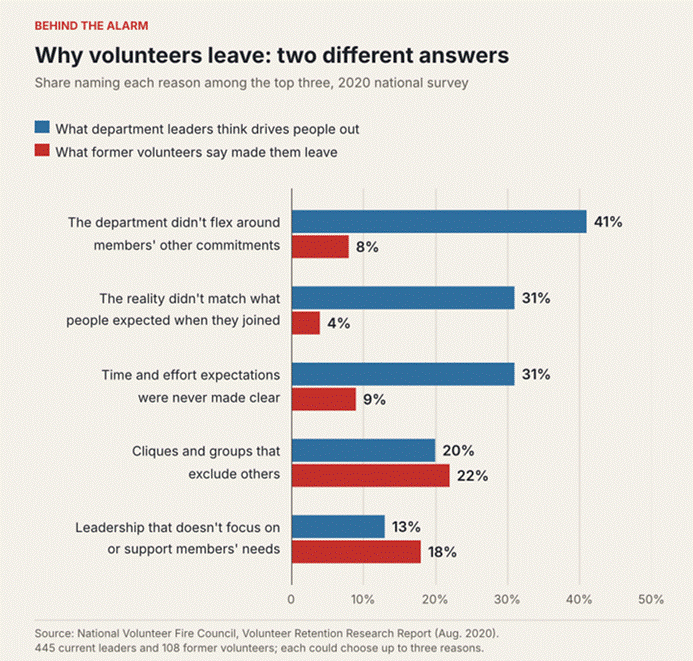
Share of each group naming the reason among its top three. Source: NVFC Volunteer Retention Research Report, August 2020.
Put plainly, chiefs tend to believe people leave because life got in the way. The people who left say the department got in the way.
The same survey asked former volunteers which steps by their department could have had a positive impact. Their top choice, picked by 57 percent, was conducting exit interviews. More than half of the people who walked out pointed to somebody asking them why. And among those still serving, 47 percent said they had thought about quitting.
Three reasons, and a department controls all three
Go back to the post with those numbers in mind.
Trust on the fireground isn’t a matter of personalities. It gets built out of training standards, accountability, and officers who hold their friends to the same rules as everyone else. When a firefighter says he didn’t trust the people beside him, it is possible he was wrong about them. It is also possible that nobody ever gave him a way to raise a safety concern that didn’t cost him something. Either way, an officer should have known about it long before year eight.
The hours tell the same story. Volunteer and paid-on-call departments run on a handful of people who say yes to everything, and it is easy for an officer to keep handing work to the member who never refuses. “Nothing was ever good enough” is what it sounds like when the reward for carrying the load is a heavier load. The Council’s newest research, released in June 2026, found that current volunteers want to serve where they feel valued and supported, and that programs built on social and emotional support, mentorship, and family engagement among them, help keep people. None of that requires a millage.
Then there is the part I take most seriously. I’m a paramedic, not a psychologist, and nobody should diagnose anyone from a Facebook post. But the research on what this work does to people agrees on the direction and differs only on the size. A 2012 meta-analysis put current PTSD prevalence among firefighters at about 7.3 percent, against roughly 1.3 to 3.5 percent in the general population. A 2020 study of 232 volunteer firefighters in Germany, built on self-report questionnaires, suggested a possible rate of 12.5 percent. Those numbers move depending on who is asked and how. Volunteers see the same wrecks and the same worst days as anyone else in this work. In a small community, the patient is often someone they know, and they still go to their regular job in the morning.
A department that sends people into that with no plan for afterward hasn’t finished the job. The plan can be modest: a peer support contact, a habit of checking on the crew after a bad call and again a week later, a phone number on the wall before anyone needs it. The Council’s Share the Load program, at nvfc.org/help, keeps a searchable directory of behavioral health professionals who work with responders. And 988, the Suicide and Crisis Lifeline, answers at any hour.
Where he’s wrong
His reasons hold up. His advice doesn’t.
“Don’t become a volunteer firefighter” takes the failures of one department and makes them a property of the work itself. They aren’t. I have more than 50 years in this business, and I have served with crews I would follow anywhere and in departments that looked after their own.
The arithmetic of his advice is also brutal. The National Fire Protection Association counted nearly 898,000 volunteer firefighters in 1984. The most recent figure, for 2023, is 635,100, the low point of the series. Over roughly the same 40 years, call volume more than tripled. Volunteers still make up 62 percent of the nation’s firefighters, and 18,873 of the country’s 29,452 fire departments are all-volunteer. In much of rural America, there is no paid department standing behind the volunteer one. If people take his advice, the call still comes in. Fewer people answer it, and the ones who do carry more, which is the very thing that wore him down.
That is why arguing with him in the comments is pointless and a little cruel. A man who isn’t sleeping doesn’t need a fire chief explaining that he’s wrong. The only real answer to a post like that is a department that would have produced a different one.
What I’d ask of every chief, starting with me
That June 2026 research also looked at people who are considering volunteering. They want a clear account of the time and the work, and they want assurance that the department will help them handle the emotional and physical demands. That is a recruit asking, before the first call, the same question this man answered after eight years.
So the work is ours. Call the last three people who left your department, ask them why, and then let them finish. Sit down with the members who are still here, especially the ones carrying the most, and ask what would make them leave. The Council calls that a stay interview, and it costs an hour and a pot of coffee. Look at your run reports and training rosters, see whose name is on everything, and take something off that person’s plate before they take themselves off your roster. Make it normal in your station for a firefighter to say “I’m not comfortable with how we did that” without paying for it. And decide now, on a quiet day, what your department does the morning after the call nobody wants to talk about.
I’m putting those questions to my own department too. I would rather hear the answers across a table than read them on Facebook.
To the man who wrote it, and to anyone standing where he is
Thank you for the eight years. Somebody in your community is alive, or had a house to go home to, or wasn’t alone on a terrible night, because you got out of bed. What it cost you was real, and you don’t owe anyone an apology for saying so. Please talk with someone who understands this work. You earned that.
And to anyone who read his post and is now thinking twice about walking into a fire station: think twice, then walk in anyway and ask hard questions. Ask how they train. Ask who checks on the crew after a bad call. Ask what happened to the last few people who left. A good department will be glad you asked. The answers will tell you whether to sign, and if enough people ask, they will change the departments that can’t answer.
SOURCES
National Volunteer Fire Council, Volunteer Retention Research Report, prepared by Marketing for Change, August 2020. Survey fielded April 10 to May 11, 2020; 1,030 respondents (922 current volunteers, of whom 445 were in leadership, and 108 former volunteers). Reasons for leaving, p. 6; exit interviews, p. 7; considered leaving, p. 10. portal.ct.gov/-/media/cfpc/files/ko/2020/20aug-nvfc-retention-research-report-final.pdf
National Volunteer Fire Council, “NVFC Releases New Report on Volunteer Fire Service Recruitment and Retention,” June 16, 2026. nvfc.org/?p=23737
National Volunteer Fire Council, Volunteer Fire Service Fact Sheet, 2026, citing National Fire Protection Association, “Number of Firefighters in the U.S.” (accessed January 19, 2026) and U.S. Fire Department Profile 2020. nvfc.org/wp-content/uploads/2026/02/volunteer-fire-service-fact-sheet.pdf
Firehouse, “The Greatest Threat Facing the Volunteer Fire Service Is Math, Not Recruitment,” for the NFPA’s 1984 count of nearly 898,000 volunteers. firehouse.com/55368324
Schnell, Suhr and Weierstall-Pust, “Post-traumatic stress disorder in volunteer firefighters: influence of specific risk and protective factors,” European Journal of Psychotraumatology, vol. 11, 2020, which also summarizes the 2012 meta-analysis by Berger and colleagues. doi.org/10.1080/20008198.2020.1764722
National Volunteer Fire Council, Share the Load program. nvfc.org/help
ABOUT THE AUTHOR
Fred R. LaPoint is Fire Chief and paramedic of Stronach Township Fire Department in Manistee County, Michigan, with over 50 years in emergency services. A Vietnam-era Coast Guard veteran and Team Rubicon disaster responder with more than three dozen deployments, he writes Behind The Alarm and Guardians of Truth.
HOW I WORK
I write two newsletters, and I write both of them with help.
Some of that help is human: firefighters, clerks, retired chiefs, neighbors who’ve noticed something and can’t get anyone to listen. Some of it is artificial. I use AI to dig through public records, to organize a year’s worth of meeting minutes into something I can actually see, to draft and redraft until a paragraph says what I mean, and to argue with me when my reasoning is thin.
What it does not do is decide what matters. Intelligence is the ability to solve problems; wisdom is knowing which ones are worth solving. The second part is the job, and no machine is going to do it for me. Choosing which story to chase, which official to press, which figure doesn’t add up — that comes from fifty years on fire scenes, in union halls, and at township board meetings, and it isn’t something I’d hand off if I could.
I hold this work to one standard: every figure sourced, no invented precision, no overclaiming, corrections published where the error ran. AI is fast and it is useful and it is sometimes confidently wrong, which is exactly why that standard exists and why I don’t relax it. Nothing appears here because a machine said so.
For a while I turned off the AI detection on my work, worried readers would take it as proof I hadn’t thought about what I wrote. I’ve stopped doing that. Tools are neither the virtue nor the vice — how we use them is. My name is on every piece. That means I chose it, I checked it, and I’ll answer for it.
This article first appeared in Behind The Alarm, the newsletter of Fred R. LaPoint, Fire Chief Paramedic of the Stronach Township Fire Department, on November 14, 2026. Read the original.