
For most of my life, the smoke alarm was the whole answer. Growing up, having one on the ceiling seemed like enough. When I started in emergency services in 1976, the message we carried into classrooms was simple: put one up, keep a battery in it, and it will save your life. We weren’t wrong. We just weren’t finished.
This week I put together a talk for the Manistee Family Child Care Network, a group of home child care providers I belong to. I called it “Two Minutes to Get Out.” Preparing it sent me back into research I thought I already knew, and it turns out I didn’t know it as well as I thought. That is a humbling thing to admit after more than 50 years in this business, but it is the honest reason for this piece. Some of the advice all of us have been giving, me included, was well-intended and true as far as it went. It has also lulled a lot of people into a false sense of security.
What the alarm number actually measures
Start with the part everyone knows, because it is still true. The National Fire Protection Association’s most recent analysis of smoke alarms in U.S. home fires found that the risk of dying in a reported home fire was 55 percent lower in homes with working smoke alarms than in homes with none, or none that worked. Nearly three of every five home fire deaths came from fires in homes with no smoke alarm at all (41 percent) or an alarm that didn’t operate (16 percent). If there is no working alarm in your house, stop reading and go fix that.
But look at what that number measures. It tells us whether an alarm sounded. It does not tell us whether anyone woke up. And the hours when nobody is awake are the hours that kill. NFPA’s home fire data has shown for years that only about one in five home fires is reported between 11 p.m. and 7 a.m., yet fires reported in those hours account for roughly half of all home fire deaths.
The other piece is time. NFPA tells families they may have as little as two minutes to get out once the alarm sounds, and that isn’t a slogan. UL’s Fire Safety Research Institute has burned two identical living rooms side by side, one furnished with older natural materials and one with today’s synthetic foam and engineered wood. Across four runs, the synthetic room reached flashover, the point where everything in the room ignites at once, in between 3 minutes 20 seconds and 4 minutes 50 seconds. The room with older furnishings took 29 and a half minutes once and went past 30 minutes the other three times. The houses most of us grew up in gave you time to wake up slowly. The houses we live in now don’t.
Most people have no idea. In NFPA’s survey work, a third of Americans who offered an estimate thought they would have at least six minutes before a fire in their home became life-threatening, and only 8 percent said their first thought on hearing a smoke alarm would be to get out.
The alarm was still sounding
I don’t tell many stories from calls, but one has stayed with me for a lot of years, and it belongs here. We were dispatched to a possible structure fire. The caller could see smoke coming from the house and could hear the smoke alarm going off inside. When we arrived, thick smoke was drifting out of the building, not being pushed out under pressure, and there was a vehicle parked outside. A vehicle at the house means someone may be home, so we went in.
We made entry through a side door that opened into the kitchen and dining area. The smoke was down to the floor. It was hot, though not nearly as hot as that much smoke would lead you to expect, and the smoke alarm was still sounding. We could barely see. We started our search and fairly quickly found a man on the floor near the passage that leads from the kitchen and dining area back toward the bedroom hallway. We got him outside and worked to revive him. We couldn’t.
What we learned after the fire was out is the part I still carry. The soot on the floors and carpet showed us exactly what he had done. It was clear the alarm had been sounding for some time before it woke him. He got out of bed and got down on his hands and knees, just as we teach, and started crawling for a way out. In the smoke and the dark, he lost his bearings and crawled into his bedroom closet, taking it for the exit. He found his way back out of the closet and into the hallway, and that is as far as he got.
It was later determined that he had been drinking, and that he had emptied an ashtray into a plastic kitchen trash can under a cabinet with what appears to have been a cigarette that wasn’t out. Smoking materials have long been the leading cause of home fire deaths in NFPA’s data.
Look at how much in that story went right by the usual measure. There was a smoke alarm. It worked. It was still going when we walked in. He woke up, and he did the first thing we teach: he got low. Every box on the old checklist was checked, and he still didn’t get out. Alcohol, age, a smoldering fire that filled the house with smoke long before it made much heat, and a bedroom he knew by daylight that he couldn’t find his way out of on his hands and knees in the dark. That is what this piece is about.
The kids who sleep through it
Here is where my own understanding came up short. Children sleep longer and deeper than adults, and the standard high-pitched beep is a poor match for a sleeping child. In a study published in the journal Fire and Materials in 2011, Dorothy Bruck and Ian Thomas of Victoria University in Melbourne, Australia, asked parents to set off the smoke alarm nearest their child’s bed for 30 seconds, one to three hours after the child had fallen asleep. Of 123 children between 5 and 15, 78 percent slept through it. Among the 5- to 10-year-olds, it was 87 percent. Of the children who did wake up, fewer than half knew they were supposed to leave the house.
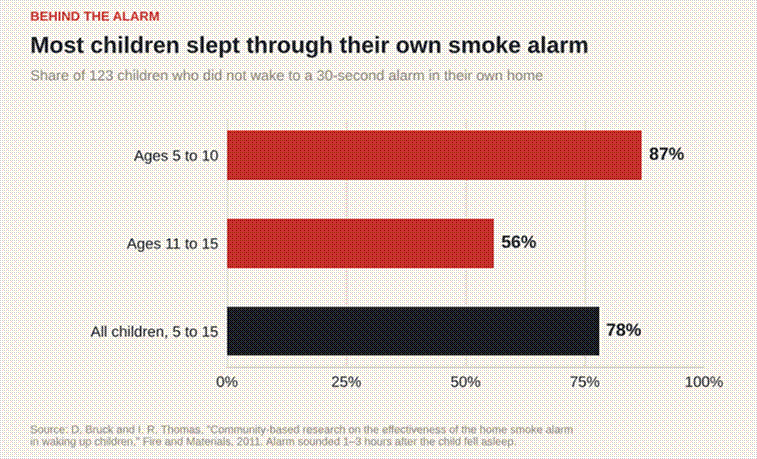
Children who slept through a 30-second smoke alarm in their own homes (Bruck and Thomas, 2011).
Researchers at Nationwide Children’s Hospital in Columbus, Ohio, have been working the same problem in a sleep lab since 2006. In a study they published in 2018, involving 176 children between 5 and 12, the conventional high-pitched tone woke 53 percent of the children. Alarms using a recording of the child’s mother’s voice woke 86 to 91 percent. The difference that matters most is the clock. The median time for children to get out of the bedroom with the tone alarm was 282 seconds, nearly five minutes. With the voice alarms, it was 18 to 28 seconds. Hold 282 seconds up against two minutes, and you have the whole problem in one number.
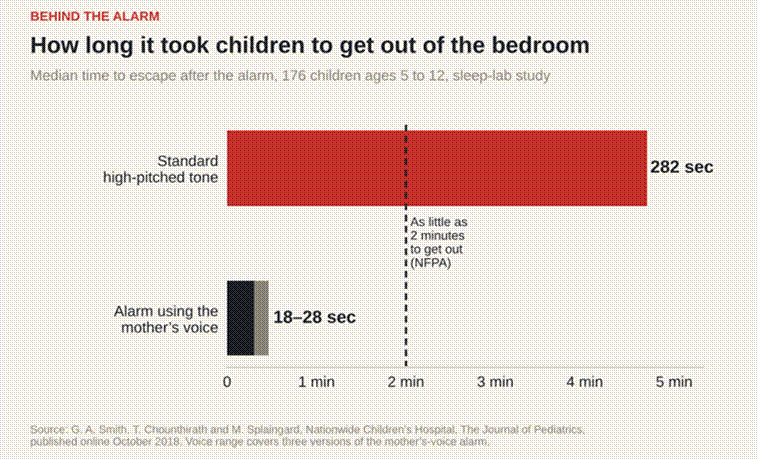
Median time for children to leave the bedroom after the alarm sounded (Nationwide Children’s Hospital, 2018).
Later work from the same team found that a stranger’s female voice worked as well as the mother’s, and that a low-pitched tone also clearly outperformed the standard high-pitched one. When they pooled 540 children from their studies, each additional year of age between 5 and 12 raised the share of children who woke, which squares with what Bruck found in Australia. The researchers are clear that families should keep their conventional alarms in place while that work continues. The point isn’t to rip anything off the ceiling. It’s to stop assuming the alarm is doing a job it often can’t do alone.
It is also why Michigan’s licensing rules require a licensed child care home to have a smoke detector in every room where children sleep, and why an evacuation plan for a home daycare has to start from the assumption that most of the children will not get themselves out. Your own house doesn’t have a licensing consultant walking through it. The same logic still applies.
We stop worrying too early
Most of this research stops at age 12, and the Nationwide team reports that adolescents in its work didn’t show the same trouble waking to a high-pitched alarm. I would be careful about reading that as an all-clear. In the Australian home study, more than half of the 11- to 15-year-olds, 56 percent, slept through the 30-second alarm. An earlier sleep-lab study by Bruck found that 30 percent of young adults between 18 and 24 did not reliably wake to an alarm at 60 decibels, roughly what reaches a pillow from a hallway alarm. And Victoria University research on young adults found that alcohol significantly blunted their response to a smoke alarm even at a blood alcohol level of .05.
Add what every parent of a teenager already knows. Teens stay up late, sleep hard, and plenty of them fall asleep with earbuds in. The young adults they grow into, 18 to 24, were the least likely of any age group in an NFPA survey to have even made an escape plan. And they are the ones we stopped teaching. For most teenagers, the last time anyone walked them through getting out of a burning house was in an elementary school classroom with a firefighter at the front of the room.
The other end of the age scale
Older adults carry the highest fire death risk of any group in the country. U.S. Fire Administration figures for 2023 put people 75 to 84 at 2.9 times the risk of the general population, and people 85 and older at 3.4 times. Hearing is part of it. The high pitch of a standard alarm sits in the range where many of us start losing our hearing first.
The fire protection world solved part of this problem years ago, just not in our houses. After a series of studies Bruck and her colleagues did for NFPA’s research foundation, the national fire alarm code began requiring a low-pitched 520-hertz signal in the sleeping rooms of new hotels, dorms, apartments and assisted living facilities, effective January 1, 2014. The same body of research found that strobe lights alone do a poor job of waking people with hearing loss, while a low-frequency sound or a bed shaker does far better. NFPA notes that accessories are available that listen for a standard smoke alarm and answer it with that low-frequency signal. If someone in your house has trouble hearing, that is the conversation to have this week.
Then there is the finding that stopped me cold. An NFPA survey conducted by Harris Interactive found that people over 65 were the most likely of any age group to have developed an escape plan, and the least likely to have practiced it. A University of Iowa survey of 691 rural households came at it from another direction and found that households with an elderly or disabled member were less likely to develop or practice a plan at all. That is rural Michigan. That is my township.
The plan we only teach to third graders
Now the part I own. Fire safety educators, me included, have aimed nearly everything we do at elementary school kids. It makes sense on paper. They’re a captive audience; they listen, and they go home and nag their parents. But it has left almost everyone else out of the drill. Teenagers age out of it. Parents never got it in the first place. Grandparents had it once, decades ago, in houses that burned slower.
The survey numbers bear that out. About 71 percent of American households say they have an escape plan, according to NFPA, but only 47 percent of those have ever practiced it. That works out to roughly one household in three. A plan nobody has walked is a piece of paper on the refrigerator.
Escape is a perishable skill. Every firefighter knows that in their bones. We don’t put on an air pack once in the academy and call it good for a career. We drill it until our hands do it in the dark, because under stress people don’t rise to the occasion. They fall back on whatever they’ve practiced. A family is no different. At three in the morning, in smoke, with the alarm screaming and your heart pounding, nobody reasons their way to the second exit. They either know it or they don’t. The man in that house got low, just like we teach. What he didn’t have was the way out of that bedroom already in his hands. That is what muscle memory means, and you don’t get it from a conversation.
Practice is also how you find out what’s wrong with the plan. The bedroom window that was painted shut years ago. The storm window nobody remembers how to release. The latch a six-year-old can’t work. The second-floor drop with no ladder. Grandpa’s walker parked across the room, his hearing aids on the nightstand and his glasses out of reach. The teenager who sleeps with the door locked. You won’t find any of that talking about it over supper. You find it by doing it, at least twice a year as NFPA recommends, and at least once at night, when it counts.
What to do this week
Start with the alarms you have. Push the test button on every one. Pull one down and look at the date on the back, because NFPA says any alarm 10 years old should be replaced, including hardwired units and the ones with sealed 10-year batteries. Make sure there is an alarm inside every bedroom, outside each sleeping area, and on every level of the house, and that they are interconnected, so that when one sounds, they all sound. That matters more than people realize once a bedroom door is closed, which is exactly what you want that door to be at night.
You no longer have to tear into walls to get there. NFPA notes that interconnection can be done with hard wiring or with wireless technology, and wireless alarms now link to each other by radio, so when one goes off, they all go off. In an older house, running new wire from room to room usually means an electrician and opened-up walls. Skipping that is what puts interconnected alarms within reach for a lot of households that would never have done it otherwise. One caution: wireless alarms generally talk only to other alarms in the same manufacturer’s product line, so buy them as a set and follow the pairing instructions in the box.
Then decide, out loud and ahead of time, who wakes whom. Every young child gets a named adult. So does anyone who sleeps hard, anyone with hearing loss, anyone on medication that leaves them groggy, and anyone who can’t get out of bed quickly on their own. If there is an older adult or someone hard of hearing in the house, look into a low-frequency alarm accessory, or a bed shaker paired with a sound alarm rather than a strobe by itself. If you shop for a voice or low-tone alarm for a child’s room, read the package carefully, because the research tested specific signals and not everything marketed for kids is the same thing.
Then walk it. Two ways out of every room. A meeting place out front, at something that won’t move. The 9-1-1 call gets made from outside. Nobody goes back in. Bring the teenagers into it and don’t let them roll their eyes their way out of it. Bring the grandparents into it. Do it once at night.
None of this means the old advice was wrong. It means it was incomplete. A smoke alarm is a promise that there will be a warning. It isn’t a promise that everyone will hear it in time, and it isn’t a plan. The number we all quote is two minutes. I’ve started saying it differently: two minutes, if you hear it. The rest is on us.
I’ll be posting the family version of the “Two Minutes to Get Out” escape plan worksheet on the Stronach Township Fire Department website, stronachfiredept.com. If you live in the township and have questions about your alarms or your plan, call us at 231-454-2184.
How I work
I write two newsletters, and I write both of them with help.
Some of that help is human: firefighters, clerks, retired chiefs, neighbors who’ve noticed something and can’t get anyone to listen. Some of it is artificial. I use AI to dig through public records, to organize a year’s worth of meeting minutes into something I can actually see, to draft and redraft until a paragraph says what I mean, and to argue with me when my reasoning is thin.
What it does not do is decide what matters. Intelligence is the ability to solve problems; wisdom is knowing which ones are worth solving. The second part is the job, and no machine is going to do it for me. Choosing which story to chase, which official to press, which figure doesn’t add up — that comes from fifty years on fire scenes, in union halls, and at township board meetings, and it isn’t something I’d hand off if I could.
I hold this work to one standard: every figure sourced, no invented precision, no overclaiming, corrections published where the error ran. AI is fast, and it is useful, and it is sometimes confidently wrong, which is exactly why that standard exists and why I don’t relax it. Nothing appears here because a machine said so.
For a while I turned off the AI detection on my work, worried readers would take it as proof I hadn’t thought about what I wrote. I’ve stopped doing that. Tools are neither the virtue nor the vice — how we use them is. My name is on every piece. That means I chose it, I checked it, and I’ll answer for it.
Fred R. LaPoint is Fire Chief and paramedic of Stronach Township Fire Department in Manistee County, Michigan, with over 50 years in emergency services. A Vietnam-era Coast Guard veteran and Team Rubicon disaster responder with more than three dozen deployments, he writes Behind The Alarm and Guardians of Truth.
Sources
National Fire Protection Association, “Smoke Alarms in U.S. Home Fires,” NFPA Research, 2021 (home fires of 2014–2018).
National Fire Protection Association, “Home Structure Fires” analyses: share of home fires and home fire deaths reported between 11 p.m. and 7 a.m.; smoking materials as the leading cause of home fire deaths.
National Fire Protection Association, home escape planning guidance (as little as two minutes to get out; two ways out; outside meeting place; practice twice a year) and NFPA escape planning surveys conducted by Harris Interactive (six-minute estimate, 8 percent first thought to get out, older adults most likely to plan and least likely to practice, 18- to 24-year-olds least likely to plan).
Washington State Patrol, Office of the State Fire Marshal, “Home Fire Escape and Smoke Alarms” media release, March 2026, citing NFPA survey: 71 percent of households have an escape plan; 47 percent of those have practiced it.
National Fire Protection Association, smoke alarm safety guidance: interconnect all alarms so that when one sounds, they all sound; interconnection can be done using hard wiring or wireless technology. nfpa.org
Kidde, “How wireless smoke alarms work,” support article: wireless alarms communicate by radio frequency and link with other alarms in the same model series. kidde.com
UL Fire Safety Research Institute, “New Comparison of Natural and Synthetic Home Furnishings,” September 30, 2020. fsri.org
D. Bruck and I. R. Thomas, “Community-based research on the effectiveness of the home smoke alarm in waking up children,” Fire and Materials 36 (5/6), 339–348, published online 2011.
G. A. Smith, T. Chounthirath and M. Splaingard, “Effectiveness of a Voice Smoke Alarm Using the Child’s Name for Sleeping Children: A Randomized Trial,” The Journal of Pediatrics, published online October 25, 2018; Nationwide Children’s Hospital news release of the same date.
Nationwide Children’s Hospital, “Sound the Alarm: Researchers Determine More Effective Ways to Awaken Children and Their Families During a House Fire,” October 12, 2020.
G. A. Smith, S. Kistamgari and M. Splaingard, “Age-Dependent Responsiveness to Smoke Alarm Signals Among Children,” Pediatrics, May 2022.
D. Bruck and M. Horasan, “Non-Arousal and Non-Action of Normal Sleepers in Response to a Smoke Detector Alarm,” Fire Safety Journal 25 (2), 125–139, 1995.
M. Ball, “Cognitive processing during sleep: the role of signal significance and participant characteristics,” PhD thesis, Victoria University, 2007.
U.S. Fire Administration, fire death and injury risk for older adults, 2014–2023 data. usfa.fema.gov
NFPA 72, National Fire Alarm and Signaling Code: 520 Hz low-frequency signal requirement for sleeping areas, effective January 1, 2014, and annex material on waking effectiveness of low-frequency, tactile and visual signals.
University of Iowa, “Perceived Risk of Home Fire and Escape Plans in Rural Households,” survey of 691 rural households, 2003–2004.
Michigan Department of Lifelong Education, Advancement, and Potential, Child Care Licensing Bureau, Licensing Rules for Family and Group Child Care Homes, R 400.1948(1).
This article first appeared in Behind The Alarm, the newsletter of Fred R. LaPoint, Fire Chief Paramedic of the Stronach Township Fire Department, on October 28, 2026. Read the original.