A Nebraska city turned away a licensed EMT because he was homeschooled, then rewrote its job posting to fit the decision. In a fire service that can’t fill its seats, every chief should study what happened in Fremont.
Andrew Coates is 22 years old. He volunteers with Cedar Bluffs Fire in eastern Nebraska; he holds a state license as an Emergency Medical Technician, and he wants to do this work for a living. He applied to become a paid firefighter with the City of Fremont, and in April the city turned him down.
He didn’t fail an exam. Nothing turned up in a background check, and nobody questioned his physical ability or anything he had done on a call. The City of Fremont rejected Andrew Coates because his high school diploma shows he was homeschooled.
I came across that story over my morning coffee and read it twice. I have spent more than 50 years in this service, and I have watched departments of every size, career and volunteer, fight to fill seats that once filled themselves. Here was a qualified young man standing at the station door with a license in his hand, and a city closed the door on him over a piece of paper. Then it did something that bothered me even more.
The word that wasn’t there
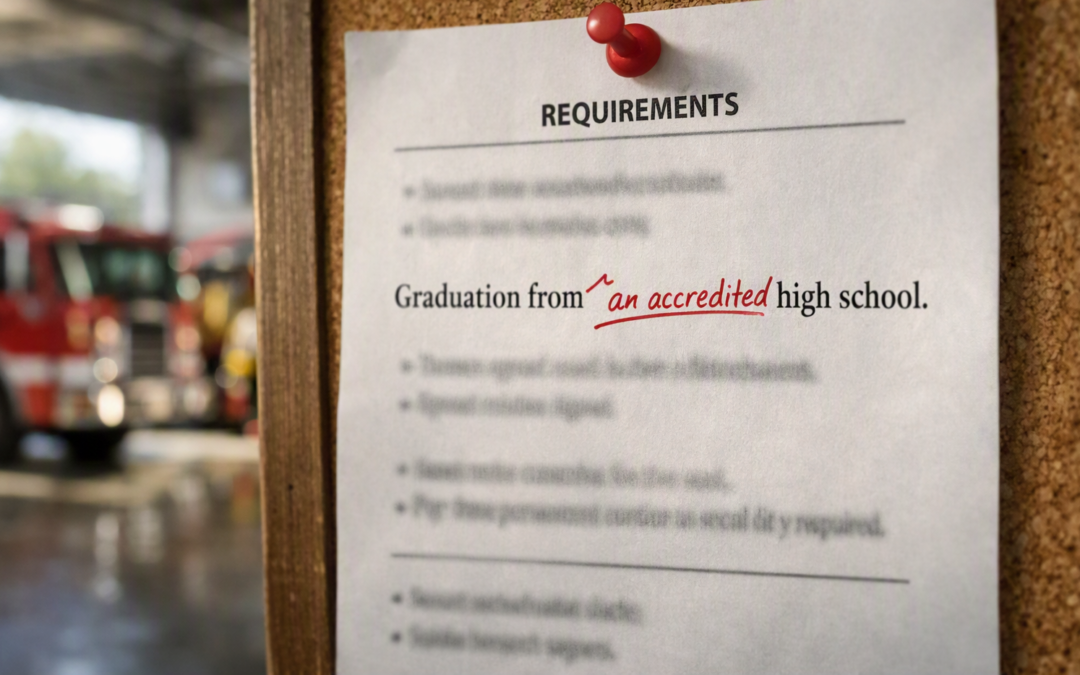
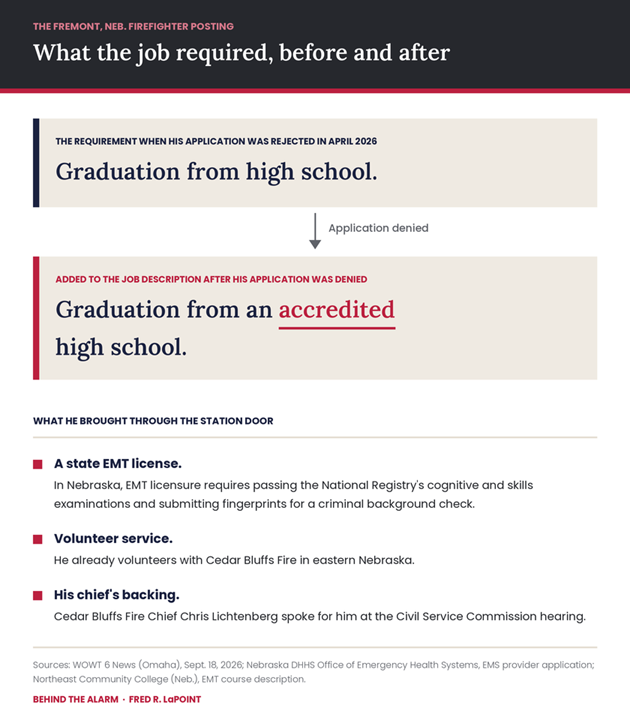
WOWT 6 News in Omaha reported the story on September 18. According to that report, the posting Andrew was judged under asked for “graduation from high school,” and nothing more. Fremont’s human resources director told the station that an accredited school was implied, describing it as a standard understanding that anyone asking for a diploma or a GED means an accredited one.
Perhaps that is how HR reads it. But after denying Andrew’s application, the city added the words “graduation from an accredited high school” to the job description.
Stop and think about that. If the requirement had truly been understood, there would have been no need to rewrite it. The rewrite tells you the city knew the posting Andrew answered did not say what the city now says it meant. That isn’t clarifying a policy. That is fitting the policy to a decision already made, and anyone who reads the file in order will notice.
Andrew appealed to Fremont’s Civil Service Commission with about 30 homeschool supporters behind him and an attorney beside him, in a hearing that ran roughly five hours. His own chief, Chris Lichtenberg of Cedar Bluffs, told the commission that Fremont was missing out and called the decision discrimination. One commissioner answered that he didn’t care to hear that word. The commission’s chairman did voice concern about the original posting and about the ambiguity of what counts as a diploma. Then the commission ruled that it can’t address city policy, and it took no action. Andrew’s father says the family has 30 days to go to court.
The commission’s own page on the city’s website describes it as the body that adopts the rules, regulations and examinations for Fremont’s firefighters and police officers. Whether minimum qualifications fall inside that authority is a fair question, and if the family files, a court may be the one to answer it.
I’ll leave the legal question to the lawyers. Call it discrimination or call it something else; the outcome doesn’t change. A licensed EMT with volunteer fire experience was turned away from a paid department over the word “accredited,” and that word appeared in the job description only after he was rejected.
Nobody made Fremont do this
It would be easy to blame the state. The WOWT report notes that homeschooling is an unaccredited education in Nebraska, and that is accurate as far as it goes. Nebraska calls home schools exempt schools and treats them as private schools that have chosen not to meet state approval or accreditation requirements. They are fully legal, and parents file with the Nebraska Department of Education to operate them.
The state does not issue diplomas to exempt school students. But the Department of Education’s own guidance answers the question at the center of this case: it says it is up to the receiving entity whether a homeschool diploma is acceptable.
Nebraska left the decision to Fremont, and Fremont made it.
The national firefighter qualification standard doesn’t force the issue either. The 2019 edition of NFPA 1001, the Firefighter I and II standard since folded into NFPA 1010, sets the entry-level educational requirement as whatever minimum the authority having jurisdiction establishes. That means the local department and the government it answers to. The standard trusts us to set the bar. What we do with that trust is on us.
What he carried through the door
Consider what Andrew already brought with him. In Nebraska, the road to an EMT license runs through the National Registry of Emergency Medical Technicians. A candidate has to pass the Registry’s cognitive and practical skills examinations before applying for a state license, and the state requires fingerprints for a criminal background check before it will issue an EMT license. Somebody has already tested this young man’s knowledge, tested his hands, and checked his record, and the State of Nebraska has trusted him with patients.
He has also been serving as a volunteer, and his chief was willing to stand up at a public hearing and put his own name behind him. Anyone who has worn a white helmet knows what that means. We don’t spend our credibility on people we have doubts about.
Now look at what Fremont said it would accept. In the HR director’s own framing, the city asks for a high school diploma or a GED. The GED is a respectable credential, and I respect everyone who has earned one. But under Fremont’s reading, passing that battery of tests clears the bar, while a completed homeschool education plus a Registry-tested, state-issued medical license does not. Andrew could probably sit for the GED and make the problem go away for himself. That would do nothing for the next homeschooled applicant, and Andrew has made clear that the next applicant is the point. He told WOWT this is no longer about his own application, but about making sure every homeschooler gets an equal opportunity.
The fair question, and the answers we already have
I want to be fair to the city, because there is a real question inside this, and it deserves a straight answer. A diploma from an accredited school is vouched for by someone outside the student’s family. A parent-issued diploma is not. An HR office screening a stack of applications wants a simple standard it can check, and I understand that.
But the fire service has spent generations building better ways to find out whether a candidate can do this job than asking who signed his diploma. We have written entrance exams and physical ability tests. We have oral boards, background investigations and medical evaluations to NFPA 1582. We have conditional offers of employment, recruit academies that wash out people who can’t keep up, and probationary periods measured in months. Every one of those tests the person. A diploma tests only the paper, and a department has many chances to verify qualifications and fitness to serve long after a conditional offer is made.
Other institutions have already worked this out. Ohio’s rules for chartered firefighter training programs let a candidate demonstrate cognitive readiness through a pre-admission test such as the ACT, SAT, WorkKeys or Accuplacer, or through a minimum grade-point average the program sets. That standard measures the thing a training program actually cares about.
The military settled the question more than a decade ago, and it has as much riding on a recruit’s reliability as any employer in the country. For years, homeschool graduates were sorted in with dropouts when the services ranked enlistees, and had to score higher on the entrance test to get in. Congress wrote a fix into the National Defense Authorization Act that became law in early 2012. When the Pentagon’s policy still made homeschoolers clear a higher bar, Congress went back and closed that gap in the defense bill signed on December 26, 2013. If the armed forces can figure out how to evaluate a homeschool graduate, a city fire department can too.
It has already happened in our own service. The Home School Legal Defense Association, an advocacy group for homeschool families, reported this spring on a Maryland homeschool graduate who applied to a large county fire department in the fall of 2024 and was told his parent-issued diploma didn’t qualify him for the county’s fire and EMS academy. After the group sent the county a letter laying out Maryland law, the county’s law office reversed course and accepted the diploma. He went through the academy, did well in both the physical and academic work, and was sworn in as a career firefighter. That account comes from an advocate, so weigh it accordingly. But the ending is the lesson: the county found a way to say yes, and it got a firefighter.
The math we can’t argue with
This matters far beyond one young man in Nebraska.
When the NFPA began tracking volunteer firefighters in 1984, there were 897,750 of them. NFPA’s count for 2023 was 635,100, the lowest on record, according to the National Volunteer Fire Council’s February 2026 fact sheet. Over the past 40 years, call volume has more than tripled, driven largely by emergency medical calls. That is more than a quarter of the volunteer fire service gone while the work tripled.
Career departments are not immune. In Connecticut, the president of the state’s professional firefighters’ union told reporters in 2025 that when he joined his department in 1997, about 1,000 people applied, and that departments now see 100 to 200. An East Hartford assistant chief said his department was drawing half the applicants it once did, something he had never seen in 30 years.
When the City of Manistee hired me in 1979, I was one of 62 applicants. Today the question in a lot of departments isn’t how to choose among the people who apply. It is how to get enough of them to apply at all.
The pool Fremont just fenced off is not small. The National Center for Education Statistics found that about 3.4 percent of K-12 students were homeschooled in the 2022–23 school year, roughly one student in thirty. Those young people are going to graduate and go looking for work. A department that writes them off before the first exam is choosing to recruit from a smaller pool at the very moment volunteer numbers sit at the lowest level ever recorded.
What every chief should take from Fremont
First, read your own postings. Know exactly what your minimum qualifications say, and put what you mean in writing before an applicant walks in, not after. If accreditation matters to your department, it belongs in the posting on day one, along with the reason for it. If it doesn’t matter, don’t let anyone treat it as implied.
Second, know who screens your applicants. In many cities, human resources applies the minimum qualifications before a file ever reaches the fire department. In WOWT’s report, the voices speaking for Fremont are its HR director and its Civil Service Commission. Nobody from the Fremont Fire Department is quoted. I don’t know whether Fremont’s fire leadership had a say in this decision, and I won’t guess. But every chief should know whether a candidate like Andrew could be screened out of their department without the chief ever seeing his name.
Third, build a second road in. A homeschool diploma paired with a transcript, a standardized test score or a professional license is a reasonable path. So is simply letting your entrance exam do its job. The goal is to test the candidate, not to sort him by where he sat when he learned algebra.
The station door
I understand some people have honest concerns about homeschooling, and that debate has its place in education policy. It doesn’t belong at the station door. By the time a young man like Andrew gets there, the questions that matter are whether he can learn the job, do the job, and be trusted with the public. The fire service has good tools for answering all three. Fremont didn’t use them.
Andrew told WOWT he hopes another paid department will give him credit for his volunteer experience. I hope so too, and I expect one will. Somewhere a chief is going to open his application, see a licensed EMT who already serves his community without being paid for it, and hold the door open. That department will get the firefighter. Every one of us should want to be that department.
Sources
1. Mike McKnight, “Homeschooled firefighter applicant’s rejection sparks Fremont dispute,” WOWT 6 News (Omaha), September 18, 2026. https://www.wowt.com/2026/09/18/homeschooled-firefighter-applicants-rejection-sparks-fremont-dispute/
2. City of Fremont, Nebraska, Civil Service Commission page. https://www.fremontne.gov/213/Civil-Service-Commission
3. Nebraska Department of Education, “Exempt School [Home School] Program.” https://www.education.ne.gov/fos/exempt-schools/
4. Nebraska Department of Education, “Exempt (Home) School Frequently Asked Questions, 2025/26 School Year,” June 2025. https://www.education.ne.gov/wp-content/uploads/2025/06/2526_ESP_FAQs.pdf
5. NFPA 1001, Standard for Fire Fighter Professional Qualifications, 2019 edition, section 1.3.11.1, as reproduced in Nevada State Fire Marshal Division board materials. https://fire.nv.gov/uploadedFiles/firenvgov/content/Boards/BFS/Agenda%20Item%206%20Changes%20to%20the%202019%20edition%20of%20the%201001.pdf
6. National Fire Protection Association, NFPA 1010 product page (consolidation of NFPA 1001, 1002, 1003 and 1005). https://www.nfpa.org/product/nfpa-1010-standard/p1010code
7. Nebraska DHHS Office of Emergency Health Systems, Emergency Care Provider Application (fingerprint requirement for EMT licensure). https://dhhs.ne.gov/OEHS%20Program%20Documents/EMS%20Provider%20Application.pdf
8. Northeast Community College (Norfolk, Neb.), EMT Part I course description (NREMT examinations required before Nebraska EMT licensure). https://northeast.edu/classes/1345
9. Ohio Administrative Code 4765-24-11, firefighter training program admission requirements. https://codes.ohio.gov/ohio-administrative-code/rule-4765-24-11
10. HSLDA, “New Changes to Military Enlistment for Homeschool Graduates,” May 1, 2013 (via Crosswalk). https://www.crosswalk.com/newsletters-only/crosswalk-home-school-news/new-changes-to-military-enlistment-for-homeschool-graduates.html
11. William A. Estrada, HSLDA, “Pentagon Changes Homeschool Enlistment,” September 5, 2012 (republished by Nevada Homeschool Network).
12. William A. Estrada, HSLDA, “Major Victory for Homeschool Military Enlistees,” January 8, 2014 (via Crosswalk). https://www.crosswalk.com/newsletters-only/crosswalk-home-school-news/major-victory-for-homeschool-military-enlistees.html
13. Will Estrada, HSLDA, “Quenching a Dream: Firefighter Academy Refuses to Enroll Grad,” April 13, 2026. https://hslda.org/post/quenching-a-dream-firefighter-academy-refuses-to-enroll-grad
14. National Volunteer Fire Council, “Volunteer Fire Service Fact Sheet,” February 2026 (citing NFPA). https://www.nvfc.org/wp-content/uploads/2026/02/volunteer-fire-service-fact-sheet.pdf
15. National Volunteer Fire Council, “Is Volunteerism Dying Or Has Your Marketing Flatlined?” March 28, 2025 (NFPA 1984 baseline). https://www.nvfc.org/is-volunteerism-dying-or-has-your-marketing-flatlined/
16. FireRescue1, “Conn. FF shortages hit crisis point as recruitment drops and overtime soars,” April 2025. https://www.firerescue1.com/recruitment/conn-ff-shortages-hit-crisis-point-as-recruitment-drops-and-overtime-soars
17. Pew Research Center, “A look at homeschooling in the U.S.” (analysis of NCES 2023 Parent and Family Involvement in Education survey data).
18. National Center for Education Statistics, Homeschooling (NHES Parent and Family Involvement in Education survey). https://nces.ed.gov/nhes/homeschooling.asp
Fred R. LaPoint is Fire Chief and paramedic of the Stronach Township Fire Department in Manistee County, Michigan, with over 50 years in emergency services. A Vietnam-era Coast Guard veteran and Team Rubicon disaster responder with more than three dozen deployments, he writes Behind The Alarm and Guardians of Truth.
This article first appeared in Behind The Alarm, the newsletter of Fred R. LaPoint, Fire Chief Paramedic of the Stronach Township Fire Department, on September 19, 2026. Read the original.