This week Fire Engineering ran an editor’s opinion by David Rhodes under a headline every company officer should read twice: “Flammable Refrigerants Are Here.” He is right. They are. The air conditioner going into a new house this year, the refrigerator from last spring’s kitchen remodel, the reach-in cooler at the gas station, the cooling unit on the box behind the semi parked at the truck stop: a lot of that equipment now holds a gas that will burn, and most of the people who live and work around it have no idea.
I read the piece the way most of us would, with my stomach tightening. Then I did what this newsletter tries to do every time, which is go to the primary sources before saying anything out loud. What I found is both less alarming and more alarming than the headline. Less, because the gas going into new home air conditioners is not propane, and the fire research on it is better than you might guess. More, because propane is already sitting in a great many kitchens, and because the line-of-duty death most often pulled into this conversation teaches a lesson that has very little to do with refrigerant. That lesson applies to every department with a highway running through its district, which is nearly all of us.
Two different gases, two different problems
Refrigerants carry a safety class assigned under ASHRAE Standard 34. The letter is toxicity and the number is flammability. The R-22 and R-410A that most of us grew up around are A1, meaning they don’t propagate a flame. The new home air conditioning refrigerants, R-454B and R-32, are A2L, the “L” standing for lower flammability. Propane, sold as refrigerant under the name R-290, is A3, the top of the scale.
The switch in home cooling is federal. Under EPA’s Technology Transitions rule, new residential and light commercial air conditioners and heat pumps could no longer be manufactured or imported with high global-warming refrigerants as of January 1, 2025, and the industry landed on R-454B and R-32. In May of this year EPA dropped the separate deadline for installing leftover R-410A equipment built before 2025, so you will keep seeing the old gas go into houses until that stock runs out. The manufacturing cutoff did not move, though. Everything new coming off the line for the residential market is A2L.
Here is where precision matters. You will hear it said that the new stuff is basically propane. That is true of the refrigerator and not true of the air conditioner, and the difference changes what you should worry about in each. Propane will light off with about a quarter of a millijoule of energy, little enough that the spark from an ordinary light switch can do it, once it reaches 2.1 percent of the air in a room. R-32 needs something like 30 to 100 millijoules and a concentration near 14 percent. R-454B needs 100 to 300 millijoules and close to 12 percent. Once lit, propane’s flame front moves at about 46 centimeters per second; the two A2L gases burn at roughly a seventh to a ninth of that. A2L gas burns. It is simply much harder to light and much slower to spread.
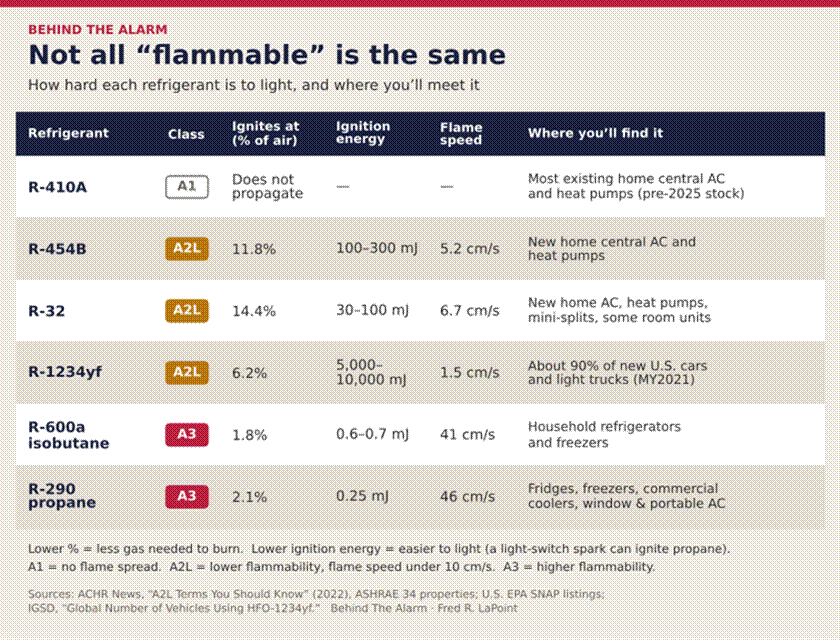
Not all “flammable” is the same: how hard each refrigerant is to ignite, and where you’ll find it.
The propane is somewhere else: the kitchen. Household refrigerators and freezers have used isobutane and propane for years. In 2018, EPA raised the amount of hydrocarbon refrigerant allowed in a household unit from 57 grams to 150 grams, about five and a quarter ounces, after modeling a worst-case leak into a conservatively small kitchen and concluding it did not present a significant flammability risk. Commercial stand-alone cases, the glass-door beverage coolers and open grab-and-go cases, can now hold more: the UL product standard was revised to allow up to 300 grams of propane in closed cases and 500 grams in open ones, and EPA folded that standard into its 2024 rules. EPA has also accepted propane in window and portable room air conditioners since 2015.
One more place we have been operating around A2L refrigerant for years without much discussion is the vehicle. Car and light-truck air conditioning moved to R-1234yf, also an A2L, and by model year 2021 about 90 percent of new U.S. passenger vehicles used it. A good share of the vehicle fires your crews have worked in recent years involved a mildly flammable refrigerant, mostly without anyone noticing. That is worth knowing, both as reassurance and as a reminder.
What the fire tests actually showed
The fire service asked for data before this transition, and to the industry’s credit it got some. In March 2021, the Air-Conditioning, Heating, and Refrigeration Institute published AHRI Report 8028, testing done by UL with the Fire Safety Research Institute and fire service members who helped design the scenarios. Crews compared the old A1 refrigerants, R-410A and R-466A, against the A2L gases R-32 and R-454B in fires built around how we actually operate.
Most of the results were reassuring. Refrigerant jetting into an open flame, into a ventilation-limited room fire during a hallway advance, and out of a broken line during overhaul produced no flash fire and no deflagration with either class. In the hallway test, the hot gas layer passed 600 degrees Celsius, but the refrigerant release did not raise temperatures in the hallway. A line cut during overhaul added roughly 50 to 100 kilowatts to the fire, which the researchers compared to a small plastic trash can burning.
Two findings were not reassuring, and both belong in your size-up. First, air handler temperatures in the fire room got high enough to fail brazed joints, which means the unit can dump its whole charge into the room you are working. Second, in the one scenario built around a leak pooled in a below-grade room with no air moving, the old R-410A flamed only at the igniters and went no further. The R-32 pool caught and spread. The fire grew over about 40 seconds, flames rolled out the doorway, and heat at three feet reached 15 kilowatts per square meter, enough to cause second-degree burns in about seven seconds. There was no fireball, but you would not want to be standing in that doorway. Read that one again if your district is full of basements with the furnace and air handler in them. In northern Michigan, that is most of us.
Then there is hydrogen fluoride. Every refrigerant tested, old and new, produced it at levels the report calls hazardous without protective equipment. In the open-flame test, measured six feet from the fire, the old R-410A actually produced more than the new gases: 156 parts per million, against 33 for R-32 and 32 for R-454B. NIOSH puts the immediately dangerous to life or health level for hydrogen fluoride at 30 parts per million. The report also warns that turnout gear contaminated with these combustion products can cause skin and inhalation exposure if it isn’t cleaned.
Let me be plain about what that means. The hydrogen fluoride hazard is not new. We have been breathing it in overhaul for as long as we have let crews pull their facepieces in a room with a burned-up air handler. The transition doesn’t create that problem. It should end the habit.
The box in the basement that is trying to tell you something
The new systems come with a safety feature most firefighters have never heard of. Under the UL 60335-2-40 product standard, ducted systems holding more than 3.91 pounds of A2L refrigerant need a refrigerant detection system. When the sensor sees gas at 25 percent of the lower flammability limit, the system shuts down the compressor and runs the indoor blower to dilute the leak, and many units also signal it with a light or an audible alarm.
So picture the call: a mild day, a furnace blower that won’t shut off, maybe a chirp or a fault light the homeowner can’t explain. That may be the house telling you it has a refrigerant leak. Ask what kind of system it is and when it was installed, read the label on the unit, and treat the low spots, where heavier-than-air gas collects, accordingly. Michigan has written the A2L requirements into the state mechanical code; a rule effective March 12, 2024, requires systems using A2L refrigerants to comply with ASHRAE Standard 15. The equipment is in our houses now, installed under our code.
What happened in Greene County
On September 4, 2024, Greene County Fire Rescue Battalion Chief Chris Eddy was killed at a tractor-trailer fire on Georgia Route 15 near Greensboro. He was 35. According to the NIOSH investigation, he arrived at 9:28 that morning, established command, and reported heavy fire at the rear of the tractor with unknown cargo. A minute later, he reported off-gassing from an unknown source. At 9:32, he reported that the trailer appeared to be refrigerated. At 9:33, while he was trying to open the rear doors to identify the cargo, the trailer exploded. The cargo turned out to be frozen chicken.
Chief Eddy’s death has been pulled into the flammable-refrigerant discussion from the start, and the Rhodes editorial places it there again. I understand why. Frozen chicken doesn’t explode, and refrigerated containers have a real history with bad refrigerant. In 2011, counterfeit gas sold as R-134a and laced with methyl chloride reacted with the aluminum inside reefer compressors and formed a compound that ignites on contact with air. Explosions killed two men in Vietnam and one in Brazil, and Maersk pulled roughly 800 containers out of service while it investigated.
But that is not what NIOSH found in Georgia. Its report, F2024-05, published in March 2025, concluded the explosion was consistent with a smoke explosion: a ventilation-limited fire inside the container producing an explosive mix of fuel and air. The fuel was the box itself. The walls, floor, and roof of a refrigerated container are filled with polyisocyanurate foam insulation, and when UL’s researchers tested that foam, its peak heat release rate was about twice that of wood and its heat of combustion about 30 percent higher. In the report’s words, “The source of the fuel for the fire is mainly the trailer and not the cargo.” Investigators did not believe it was a BLEVE, and found that the refrigeration system’s overpressure protection appeared to vent as designed. NIOSH did not pin down the exact ignition source or sequence.
I am not a certified fire investigator, and I don’t make cause determinations in my own department. NIOSH’s investigators made this one, and unless someone produces evidence that overturns it, the honest position is that Chief Eddy was not killed by refrigerant. I say that carefully, because the wrong lesson can kill the next officer. If we file this death under flammable refrigerants, we teach crews that a reefer is dangerous because of the gas in the cooling unit. NIOSH says it was dangerous because of what the box is made of. That is true of every refrigerated trailer on every road in your district, loaded or empty, old refrigerant or new.
The report’s lessons are worth a drill night of their own. The warning signs before the blast were pulsating smoke and flame. The department’s vehicle-fire guideline kept the incident commander in investigation mode, which put him in the hot zone repeatedly trying to identify cargo, and that guideline was overdue for review. The driver had left the scene, so nobody could tell him what was inside. NIOSH recommends training on the fire behavior of refrigerated trailers and on intermodal containers as unrecognized pressure vessels, real risk-benefit thinking at vehicle fires, and control zones wherever conditions are immediately dangerous. Departments in Georgia and Alabama have since built reefer awareness classes around his final alarm.
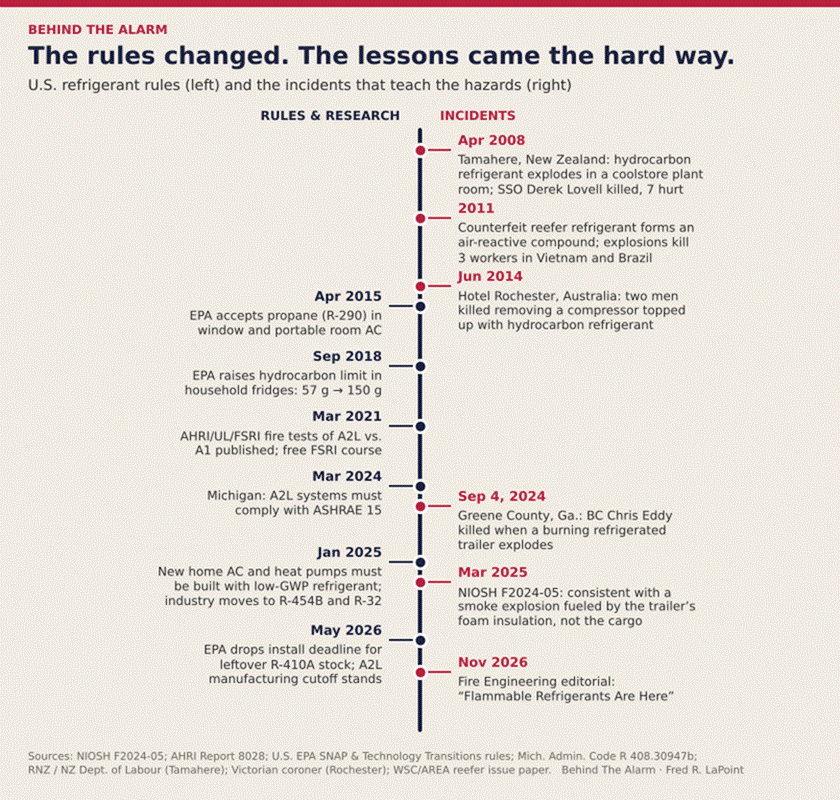
The rules changed on paper; the lessons came from incidents.
Where refrigerant has killed a firefighter
If you want the case history for flammable refrigerant and the fire service, it exists, and it is on the other side of the world. On April 5, 2008, eight Hamilton, New Zealand firefighters went to the Icepak coolstore in Tamahere to check on a sounding smoke alarm. They entered the plant room, saw what looked like leaking refrigerant, and were on their way out when the room exploded. Senior Station Officer Derek Lovell was killed, and seven of his crew were injured. The plant was running a hydrocarbon refrigerant. A Department of Labour report found the installation did not meet the required standards and had a history of leaks, and there were no signs anywhere to warn the crew what was in that room.
Six years later, in June 2014, two men helping close down the Hotel Rochester in Victoria, Australia, were killed in the cellar while removing a refrigeration compressor that had been topped up with a hydrocarbon refrigerant. Neither was a qualified refrigeration mechanic, and there was no sign they had recovered the gas first. The coroner called the deaths preventable through correct maintenance, correct use and labeling of refrigerants, and correct removal procedures.
Rhodes also describes an FDNY kitchen fire in which a lieutenant was burned after a loud pop and a flash of blue flame overhead; he believes the refrigerator held A3 refrigerant. That is his read rather than a published finding, but it is the scenario worth thinking through. EPA’s 150-gram math was built around a leak in a kitchen. A refrigerator that is itself burning is a different problem.
The thread running through Tamahere and the Hotel Rochester is not the chemistry. It is that nobody on scene knew the gas was there. Rhodes argues for an odorant in A3 refrigerants, placarding tied to NFPA 704, and limits on quantities. Those deserve a serious hearing from people who know the engineering better than I do. I would put marking first. Eight firefighters walked into that plant room in Tamahere with nothing on the building to tell them what was in it.
What changes on the next call
None of this calls for new heroics. It calls for discipline we already claim to have. Keep facepieces on through overhaul and fire investigation in any room with a burned air handler, condensing unit, refrigerator or cooler, because hydrogen fluoride is a product of the old refrigerants and the new ones alike, and the research says hazardous levels show up without the right protective equipment. Decon your gear afterward instead of riding home in it.
Make the refrigerant part of size-up. The rating plate on a refrigerator, cooler, window unit, or furnace generally lists the refrigerant and the charge, and newer equipment with flammable refrigerant carries warning markings. Know that both the A2L gases and propane are heavier than air and will find the basement, the crawlspace, and the low corner of a utility room. Don’t cut or open refrigerant lines to see what happens; recovery belongs to certified technicians, and the Hotel Rochester is what it looks like when people skip that step.
At a vehicle fire involving a refrigerated trailer, treat the box as the fuel load, not as a cargo question. Watch for pulsating smoke and flame. Set your zones before anyone approaches the doors, and ask honestly whether identifying the cargo is worth putting a person at the rear of that trailer. Chief Eddy’s department had a guideline that told him to find out. Review yours.
And get the training, because it costs nothing. UL’s Fire Safety Research Institute offers a free online course, “Firefighter Safety and Flammable Refrigerants,” built from the AHRI test videos, on its Fire Safety Academy at training.fsri.org. NFPA and its Fire Protection Research Foundation offer free Flammable Refrigerant Training for the Fire Service, developed with FEMA funding, at nfpa.org/refrigerants. NIOSH’s report F2024-05 and its slide deck are free as well and would anchor a good company drill.
When I started in this work more than 50 years ago, the gas in a refrigerator was the least interesting thing in the kitchen. It isn’t anymore. That is not a reason to panic, and it is not a reason to shrug. It is a reason to know what is in the box before we open it, and to learn the right lessons from the people who paid for them.
Sources
1. David Rhodes, “Flammable Refrigerants Are Here,” Fire Engineering, November 16, 2026. fireengineering.com/fire-safety/flammable-refrigerants-are-here/
2. NIOSH Fire Fighter Fatality Investigation and Prevention Program, Report F2024-05, “Career Battalion Chief Dies from Explosion while Fighting Tractor Trailer Fire – Georgia,” March 2025. cdc.gov/niosh/firefighters/programs/pdfs/face202405.pdf
3. AHRI Report No. 8028, “A2L Refrigerants and Firefighter Tactical Considerations,” UL LLC for AHRI, March 2021. ahrinet.org
4. NIOSH Pocket Guide to Chemical Hazards, Hydrogen fluoride (IDLH 30 ppm). cdc.gov/niosh/npg/npgd0334.html
5. ACHR News, “A2L Terms You Should Know,” June 4, 2022 (LFL, minimum ignition energy and burning velocity figures).
6. U.S. EPA, Technology Transitions rule (88 FR 88825, Dec. 26, 2023) and May 2026 amendments, as reported by ServiceMag, “EPA Delays HFC Refrigeration Deadlines, Scraps R-410A Installation Cutoff,” and HARDI.
7. ACHR News, “EPA Allows Increased Hydrocarbon Charge in Household Refrigerators” (57 g to 150 g, effective Sept. 7, 2018).
8. ACHR News, “UL Approves Increased R-290 Charge Limits”; U.S. EPA SNAP Final Rule 26 fact sheet (2024).
9. U.S. EPA SNAP listing, R-290 acceptable with use conditions in self-contained room air conditioning, April 10, 2015.
10. Institute for Governance & Sustainable Development, “Global Number of Vehicles Using HFO-1234yf” (90% of new U.S. passenger vehicles by MY2021).
11. UL, “Inspecting Refrigerant Detection Systems in HVAC Equipment”; ACHR News, “OEM Unveils Refrigerant Detection Systems”; Trane, REFR-SLB008-EN (3.91 lb threshold).
12. Michigan Administrative Code R 408.30947b, “Refrigerants other than ammonia,” effective March 12, 2024.
13. World Shipping Council / AREA issue paper, “Refrigerated Container (Reefer) Explosion” (2011); Climate Control News, “Reefer Madness.”
14. RNZ, “Coroner recommends tighter coolstore rules,” March 22, 2012; Otago Daily Times, “Firefighters had no warning coolstore was death trap”; NZ Herald coverage of the Department of Labour report.
15. HVACR News (Australia), “Rochester coronial investigation releases findings”; CIBSE Journal, “Refrigeration deaths were preventable, says coroner.”
16. Chatham County (Ga.) Fire Rescue, “Remembering Battalion Chief Chris Eddy”; Huntsville Fire & Rescue reefer awareness training announcement.
17. UL FSRI Fire Safety Academy, “Firefighter Safety and Flammable Refrigerants” (training.fsri.org); NFPA Flammable Refrigerant Training (nfpa.org/refrigerants).
How I Work
I write two newsletters, and I write both of them with help.
Some of that help is human: firefighters, clerks, retired chiefs, neighbors who’ve noticed something and can’t get anyone to listen. Some of it is artificial. I use AI to dig through public records, to organize a year’s worth of meeting minutes into something I can actually see, to draft and redraft until a paragraph says what I mean, and to argue with me when my reasoning is thin.
What it does not do is decide what matters. Intelligence is the ability to solve problems; wisdom is knowing which ones are worth solving. The second part is the job, and no machine is going to do it for me. Choosing which story to chase, which official to press, which figure doesn’t add up — that comes from fifty years on fire scenes, in union halls, and at township board meetings, and it isn’t something I’d hand off if I could.
I hold this work to one standard: every figure sourced, no invented precision, no overclaiming, corrections published where the error ran. AI is fast, and it is useful, and it is sometimes confidently wrong, which is exactly why that standard exists and why I don’t relax it. Nothing appears here because a machine said so.
For a while I turned off the AI detection on my work, worried readers would take it as proof I hadn’t thought about what I wrote. I’ve stopped doing that. Tools are neither the virtue nor the vice — how we use them is. My name is on every piece. That means I chose it, I checked it, and I’ll answer for it.
Fred R. LaPoint is Fire Chief and paramedic of Stronach Township Fire Department in Manistee County, Michigan, with over 50 years in emergency services. A Vietnam-era Coast Guard veteran and Team Rubicon disaster responder with more than three dozen deployments, he writes Behind The Alarm and Guardians of Truth.
This article first appeared in Behind The Alarm, the newsletter of Fred R. LaPoint, Fire Chief Paramedic of the Stronach Township Fire Department, on November 17, 2026. Read the original.