
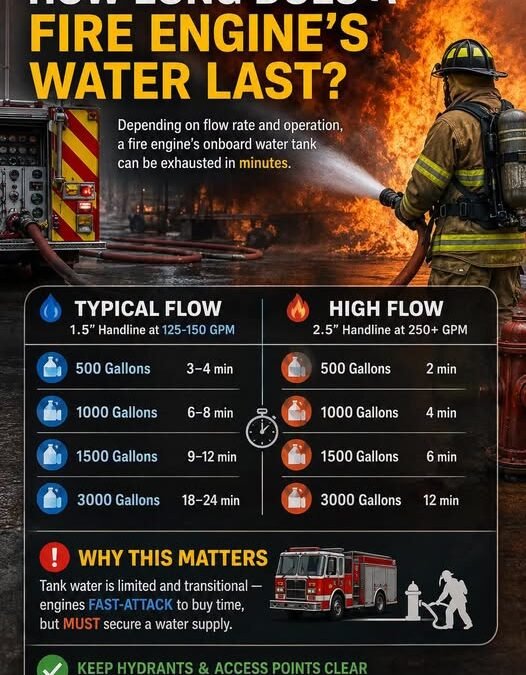
Image Credit to Firenuzzle
A fellow firefighter page, FireNuzzle, put out a post this week that stopped me cold with how simple and how true it was. It answered a question the public asks at nearly every fire: “Why did the fire truck run out of water?”
The honest answer is that a fire engine was never meant to be an unlimited water supply. That tank on the truck is designed for one thing — to start the attack while a crew works to secure a continuous source behind it. FireNuzzle laid out the math better than I could, so let me give them the credit and pass it along.
The Water Math Doesn’t Care Where You Live
A typical engine carries somewhere between 500 and 1,500 gallons of water. That sounds like a lot until you put a nozzle on it. Open up an inch-and-a-half handline flowing 125 to 150 gallons a minute and a full 500-gallon tank is gone in three to four minutes. Pull a two-and-a-half-inch line moving 250-plus gallons a minute, and that same 500 gallons is spent in about two. Even a 1,500-gallon tank empties in six to twelve minutes of steady flow.
Read that again. Minutes. That is why you see multiple trucks roll in on a working fire — not just for the hands, but to keep water coming. In a hydrant district, we hook to a hydrant, and the problem is largely solved. Out where most of you reading this actually live, there is no hydrant. The water has to be hauled in by tanker shuttle or drafted out of a pond, a river, or a dry hydrant. And all of that takes time and takes access.
Here is the part I want to carry across the whole country, because I have seen it from the mountains to the coast: the water math is identical everywhere. Jack pine in northern Michigan, chaparral in California, ponderosa in Colorado, the piney woods of the Southeast — the tank runs dry just as fast. What changes from place to place is not the physics. It is whether the homeowner did their part before we ever got the call.
The Half of the Equation That’s Yours
I have deployed to disasters of every kind with Team Rubicon — wildfires, hurricanes, floods, tornadoes — across this country and overseas. And I keep seeing the same heartbreak. Not homes that couldn’t be saved by more water, but homes we couldn’t reach, or couldn’t defend, because the decisions that mattered were never made. Those decisions are yours, and every one of them is free or close to it:
● Defensible space is not landscaping — it is a firebreak. Every foot of cleared, hardened space around your structure is time. Time for a tanker shuttle to get established. Time for a crew to make a stand instead of driving past and writing your house off as a loss. Embers travel far ahead of a fire front; a clean thirty to a hundred feet is often the difference between a saved home and a foundation.
● If we can’t get in, we can’t help you. A narrow two-track, low-hanging branches, a soft or washed-out driveway, no room to turn a truck around, a locked gate, an address no one can read from the road at night in smoke — any one of these can stop an engine cold. And a tanker shuttle is a cycle: trucks in, trucks out, over and over. Break that cycle at a tight driveway, and the water stops for everyone.
● Know your water before you need it. No hydrants means somebody has to haul it or draft it. A maintained pond with a solid draft site, a dry hydrant, a cistern — these are force multipliers on your property. Call your local fire department and ask what water sources exist near you. If there aren’t any, that is a conversation worth starting now, not during the fire.
● Make the plan before the first ember. Know your two ways out. Know where your family meets. Know what you grab and what you leave. Sign up for your county’s emergency alerts today, while you’re thinking about it.
A plan made after it is a 20,000-acre monster is not a plan. It is a prayer.
The number of large wildfires burning across the United States and Canada right now is not slowing down, and more and more of us have chosen to live in the beautiful, remote, hard-to-reach places these fires love. That choice is a good one — I wouldn’t trade where I live for anything. But it comes with a responsibility that no fire department can carry for you.
We will come. We will bring every gallon we can, and we will fight for your home like it was our own. But the truck’s tank runs out in minutes, and the outcome is very often decided before we ever turn onto your road — by the space you cleared, the access you kept open, and the plan you made while there was still time.
So here is my ask. Read this. Then share it. Send it to the folks you know who live down the long dirt road, up the mountain, out past the last hydrant. Send it to the ones who think it can’t happen where they are. Getting this in front of one family that clears their brush or fixes their driveway this weekend is worth more than any fire I’ll ever put out. Don’t wait for the ember. Make the plan today.
Stay safe out there,
Fred R. LaPoint — Fire Chief, Stronach Township Fire Department
U.S. Coast Guard Veteran, TT2 | Team Rubicon Disaster Responder, 3+ dozen deployments
Water-duration breakdown credit: FireNuzzle. Reprinted and expanded with thanks.
This article first appeared in Behind The Alarm, the newsletter of Fred R. LaPoint, Fire Chief Paramedic of the Stronach Township Fire Department, on July 5, 2026. Read the original.