

Before the Order Comes | Part 6
Home Hardening on a Budget
Most of what saves a house is free, takes a Saturday, and nobody ever tells you about it.
By Fred R. LaPoint, Fire Chief & Paramedic | Behind The Alarm
Share this one.
Part 5 was about getting your family out. This one is about what the house does after you go — and whether we can get to it. Almost nothing in here costs money. Send it to somebody with pine trees close to the siding.
The full series lives here: Before the Order Comes — series folder
Last time we got your family out the door. Now let us talk about the house they left behind — because the two are more connected than most people realize.
Here is what a wildfire actually does to a neighborhood, and it is not what the movies show you. Houses do not usually burn because a wall of flame arrives and consumes them. Houses burn because embers — burning debris carried on the wind, sometimes a mile or more ahead of the fire itself — land somewhere on or near the structure and find something willing to catch. A gutter packed with dry needles. A woodpile against the siding. A patch of bark mulch under a window. A vent screen with holes big enough to let one in.
That is the whole mechanism. And the good news buried in it is this: every one of those failure points is something you can fix with your own hands, on a Saturday, for nearly nothing.
A house does not usually lose to the fire. It loses to a handful of small decisions made years earlier, and never revisited.
There is a second reason this matters, and it is the part that ties directly back to Part 5. When conditions are bad, and resources are thin, fire crews triage. We look at a row of houses, and we make fast calls about which ones are defensible — which ones give us a place to stand, a way in, a way out, and a reasonable chance of success. A house with thirty feet of clean space and a driveway we can turn a truck around in is a house we can fight for. A house with brush to the foundation and a quarter-mile of overgrown two-track is a house we may have to drive past.
Nobody wants to say that out loud. I am saying it because you can do something about it.
Defensible space: the three zones
Defensible space is not about clear-cutting your property. It is about interrupting the path fire uses to travel — breaking up fuel so that a fire arriving at your property line has to work for every foot, and so that crews have somewhere safe to operate.
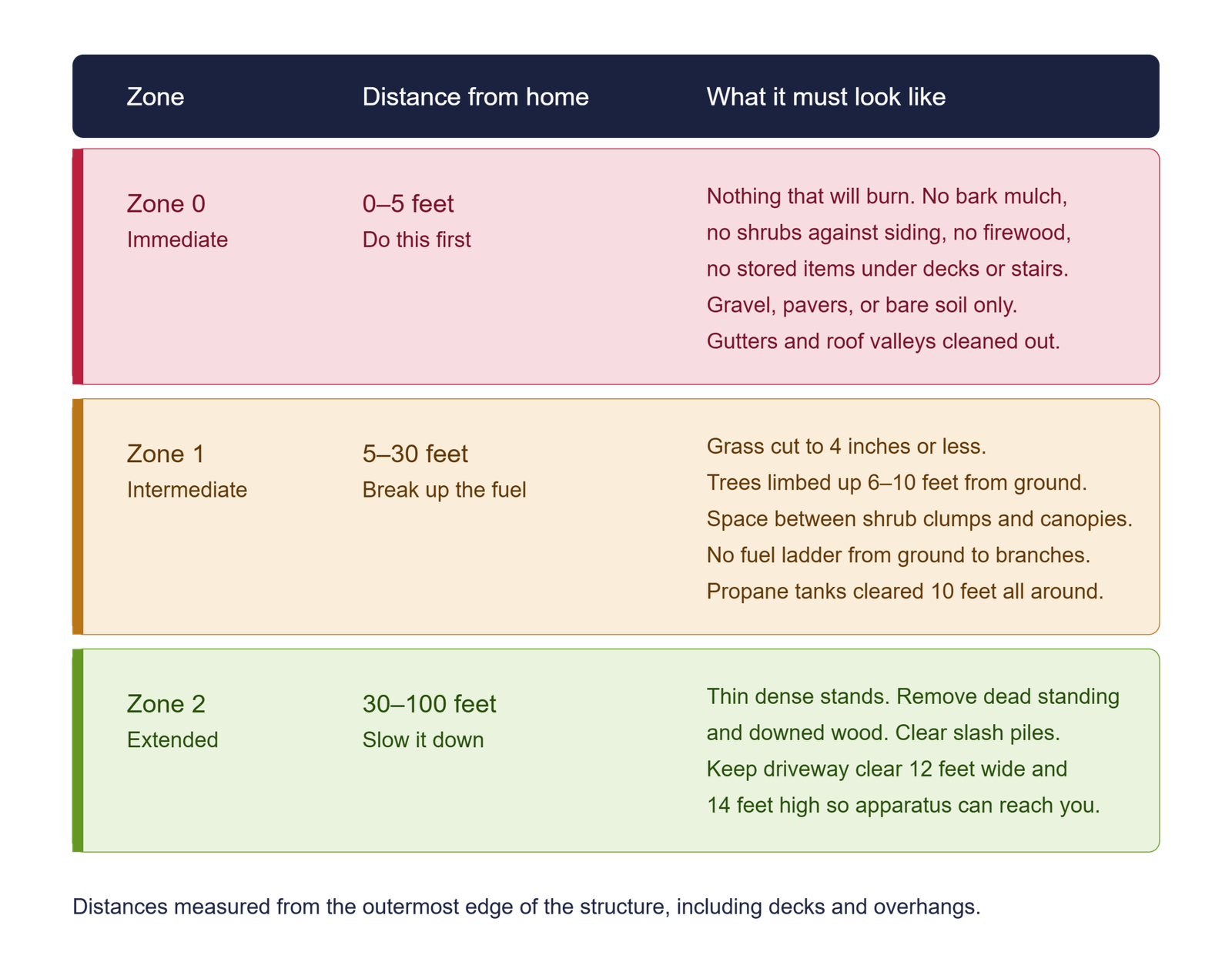
Zone
Distance
What it needs
Immediate
0–5 feet
Nothing that burns. No mulch, no shrubs, no woodpile, no stacked anything against the wall. This is the highest-value five feet on your property.
Intermediate
5–30 feet
Break up the fuel. Space plantings, mow, keep grass short, no ladder fuels letting fire climb from ground into tree crowns.
Extended
30–100+ feet
Thin and clean. Remove dead material, limb up trees, break the continuous path a fire would use to reach the house.
If you do nothing else in this entire article, do the first five feet. That narrow band against your foundation is where embers collect and where most structure ignitions begin. It costs nothing to clear, takes an afternoon, and returns more protection per hour of work than anything else on this list.
The mulch problem
Bark mulch and shredded-wood landscaping against a foundation is one of the most reliable ways to lose a house, and it is on almost every home in America because it looks tidy and the garden center sells it by the bag. An ember lands in it, it smolders, and it burns quietly at the base of your siding for a long time before anyone would notice.
In that first five feet, replace it with gravel, stone, or bare soil. Keep the mulch if you like it — just move it past the five-foot line.
The free work — do this first
None of this requires a contractor, a permit, or a purchase. Most of it is a ladder, a pair of gloves, and a Saturday.
Clean the gutters and the roof
Dry needles and leaves in a gutter are a ready-made ember trap sitting directly against your roofline. Same for the debris that collects in roof valleys and behind chimneys. Clean them, and then clean them again after every heavy needle drop — this is not a once-a-year job in pine country.
Clear the first five feet
Woodpile moved away from the house. Propane tank cleared of vegetation. Nothing stored against the siding. No shrubs touching the wall. Look under the deck too — people store things under decks and forget them for a decade, and a deck with dry storage underneath is a chimney waiting for a match.
Limb up and thin
Cut the lower branches off trees near the house so fire cannot climb from the grass into the crown. Those low limbs are called ladder fuels, and the name says everything. Remove dead limbs, dead trees, and anything overhanging the roof.
Mow, and keep mowing
Tall dry grass carries fire fast and low, right up to the foundation. Keep it short in the intermediate zone. Mow early in the morning when there is still dew on it — a mower blade striking a rock in dry afternoon grass has started more fires than most people would believe.
Look at your vents
This one is free to check and cheap to fix, and almost nobody does it. Embers get into attics and crawlspaces through vent openings, and once one is in the attic, the house is gone before anyone sees smoke. Walk the perimeter and look at every vent — gable, soffit, foundation, crawlspace. Note which ones have coarse screen or none at all.
The cheap fixes — under a hundred dollars
• 1/8-inch metal mesh. Replace or back coarse vent screening with 1/8-inch metal mesh. Fine enough to stop embers, coarse enough to keep airflow. Never use fiberglass or plastic screen — it melts. A roll costs less than a tank of gas, and this is the highest-value purchase in this article.
• Fire-rated caulk. Fill gaps where the roof meets the walls, around pipe penetrations, and anywhere else an ember could work its way into a cavity. A few tubes of caulk covers most houses.
• Vent covers that actually close. If your dryer vent, foundation vents, or crawlspace openings have flaps that no longer close, replace them. An open vent is an open door.
• Metal gutter guards. Metal, not plastic. Plastic gutter guards fail exactly when you need them.
• A reflective address sign. Blue reflective address markers, or whatever your county uses. If we cannot find your driveway at three in the morning in heavy smoke, everything else in this article stops mattering. This is the single cheapest thing you can do for us.
An ember does not need a door. It needs a gap, and it will find the one you have not looked at in twenty years.
If you have money to spend
Readers asked the fair question: what if I can afford more than a Saturday and a roll of mesh? There is real work worth paying for. But it comes with one rule, and I mean it —
No dollar moves to the next tier until the first five feet are clear and the vents are screened. Nothing you buy outperforms the work you can do for free.
With that said, here is roughly the order I would spend in. Prices vary widely by region and by house, so treat these as scale rather than quotes — get local numbers before you plan around any of them.
Tier one — a few hundred dollars
• Ember-resistant vents, WUI-rated and either baffled or 1/8-inch screened, are the best dollar-for-dollar hardening purchase there is. Vents remain the most common ember entry path into a structure, and a rated vent does the job better than mesh retrofitted over an old one.
• Metal drip edge and metal gutter guards where you have not already done them.
• A meter key and a labeled water shutoff. Almost free, and Part 7 explains why it matters to your whole neighborhood.
Tier two — hundreds to a few thousand
• A noncombustible zero-to-five-foot zone done properly: gravel, stone, or pavers replacing the mulch and plantings against the foundation. This is where the free advice above becomes a real project, and it is still the highest-value money on this list.
• Tempered or multi-pane glass on the exposure side. Radiant heat cracks single-pane glass, and once the glass is gone, the opening is the failure point. You do not have to do the whole house — do the side facing the fuel.
• Enclosing open eaves and boxing in soffits, which removes a place where heat and embers collect under the roof edge.
• Replacing a combustible deck surface, or at minimum sealing the gaps and clearing everything stored beneath it.
Tier three — remodel and replacement scale
These are expensive as standalone projects and sensible as upgrades when the work is already happening. If the roof is due, if you are re-siding, if you are building — this is when they cost almost nothing extra.
• A Class A rated roof assembly.
• Noncombustible siding — fiber cement, stucco, or metal.
• Noncombustible decking and enclosed foundations.
A straight answer about sprinklers
This comes up every time, so let me address it directly, because it is the one place in this field where the marketing has gotten well out ahead of the evidence.
Exterior and roof sprinkler systems are heavily advertised and intuitively appealing. The honest state of the research is that it is thin. In its 2024 white paper on external sprinkler systems, the Insurance Institute for Business & Home Safety concluded that limited methodical research exists on their real-world effectiveness, that no installation standard yet defines minimum performance, and that these systems depend on water and electrical infrastructure that may be unavailable or overtaxed at exactly the moment they are needed. IBHS also identifies high wind, radiant heat, water drift, and evaporation as conditions that degrade performance. Those are precisely the conditions a conflagration brings.
Fire Safe Marin puts the practical version more bluntly: ordinary exterior garden sprinklers are ineffective, and when many of them are running at once, they pull down water pressure for the entire neighborhood. Their guidance is to complete defensible space and home hardening first, to consult local fire and building officials before installing any system, and to be skeptical of manufacturers overselling what their product can do.
That is my position too. If you have hardened the house and you want to add a properly engineered system with an independent water supply and its own power, that is a defensible choice as a supplement. It is never a substitute. A house with unscreened vents and a wood fence running to the siding does not get saved by a sprinkler.
One more distinction worth making, because the marketing blurs it. Interior residential sprinklers under NFPA 13D are excellent life-safety systems and I recommend them on their own merits — but they are designed for fire that starts inside. They do very little about a wildfire that enters through a vent or ignites the deck. Two different systems, two different problems.
Access — the part that decides whether we come in
Part 5 covered your driveway in detail — width, vertical clearance, turnarounds, gates, bridge ratings, and why decorative lighting ends up tangled in a hose line. I am not going to repeat all of it here. But it belongs in a home hardening article too, because access is hardening. A house we cannot reach is a house we cannot defend, no matter how clean the space around it is.
The short version, as a checklist:
• Unobstructed width and 13 feet 6 inches of vertical clearance. Look up.
• A turnaround at the end — circle, hammerhead, or Y. We will not back a quarter mile out with fire behind us.
• Gates at least as wide as the drive, manually operable, with a way in if the power is out.
• Known weight rating on any private bridge or culvert.
• Nothing in the clear envelope — no landscaping, posts, walls, or path lighting.
• An address sign we can read from the road, at night, in smoke.
If you are building or rebuilding, all of that belongs in the site plan. It costs almost nothing at design and real money afterward. See Part 5 for the full treatment.
Field note — what triage actually looks like
On a bad day with a fast fire and not enough resources, an incident commander is making rapid decisions about where crews can do the most good. It is not personal and there is no list with your name on it. It is a fast read of what is defensible with the people and water available.
Clean space around the structure, safe access in and out, and a place to work are what put a house on the right side of that read. Every item in this article is you making that decision easier for the person who has to make it.
If you live where there are no hydrants
Most of the people reading this do. In a rural district, the water we have is the water we brought and whatever we can find nearby, and knowing what is on your property is worth real time when it counts.
• A pond, creek, cistern, or pool is a potential draft source. Tell your fire department it exists and whether an engine can physically reach it. Most departments will happily come look and note it before there is ever a fire.
• If you have a well pump, know that it stops with the power. If your plan depends on your own water, it depends on a generator too — and that is a plan you should test before you need it.
• Garden hoses are for spot fires and embers, not for structure fire. Have them, know where they are, and know their limit. Nobody should be standing on a roof with a garden hose while a fire runs at the property.
And the most important one: leaving is always the plan. Nothing in this article is preparation for staying to fight. Home hardening is what you do so that the house has a chance after you have already gone — exactly as Part 5 laid out.
If you only have one weekend
In order. Stop wherever your time or money runs out — the list is built so the highest-value work comes first.
1. Clear the first five feet. Everything combustible moved.
2. Clean the gutters and the roof.
3. Screen the vents with 1/8-inch metal mesh.
4. Clear under the deck and move the woodpile.
5. Cut the driveway back — full width, and 13 feet 6 inches up.
6. Put up an address sign we can read in smoke.
7. Limb up the trees near the house.
That is one weekend and roughly the cost of dinner out. It will not make your house fireproof — nothing does. It moves you from the group we drive past to the group we stop for, and on a bad day that is the entire difference.
A note on the series. When I started this, seven parts looked like enough. It was not. Readers kept raising things that deserved their own treatment, and a subject this important is worth adapting to rather than forcing into an outline I drew up in advance.
Next in the series — Part 7: The Last Five Minutes. What to do on the way out the door once the order comes, including the one thing almost nobody thinks of — shutting your water off, and why your neighbor’s house may depend on it. Recovery Starts Before the Fire moves to Part 8.
About the author. Fred R. LaPoint is Fire Chief of Stronach Township Fire Department in Manistee County, Michigan, and a licensed paramedic with over 50 years in emergency services. He is a U.S. Coast Guard veteran and an active Team Rubicon disaster responder with more than three dozen domestic and international deployments.
Sources for this article. Insurance Institute for Business & Home Safety, “External Sprinkler Systems for Wildfire Defense” white paper, 2024. Fire Safe Marin, exterior sprinklers and coatings guidance. NFPA Firewise USA wildfire research fact sheets, produced with the USDA Forest Service and the National Association of State Foresters.
Before the Order Comes is an eight-part preparedness series from Behind The Alarm.
This piece reflects general fire service perspective and is not a substitute for guidance from your local fire department. Defensible space standards, apparatus specifications, access requirements, and local ordinances vary by jurisdiction — check with your own department before undertaking major work.
This article first appeared in Behind The Alarm, the newsletter of Fred R. LaPoint, Fire Chief Paramedic of the Stronach Township Fire Department, on July 22, 2026. Read the original.