
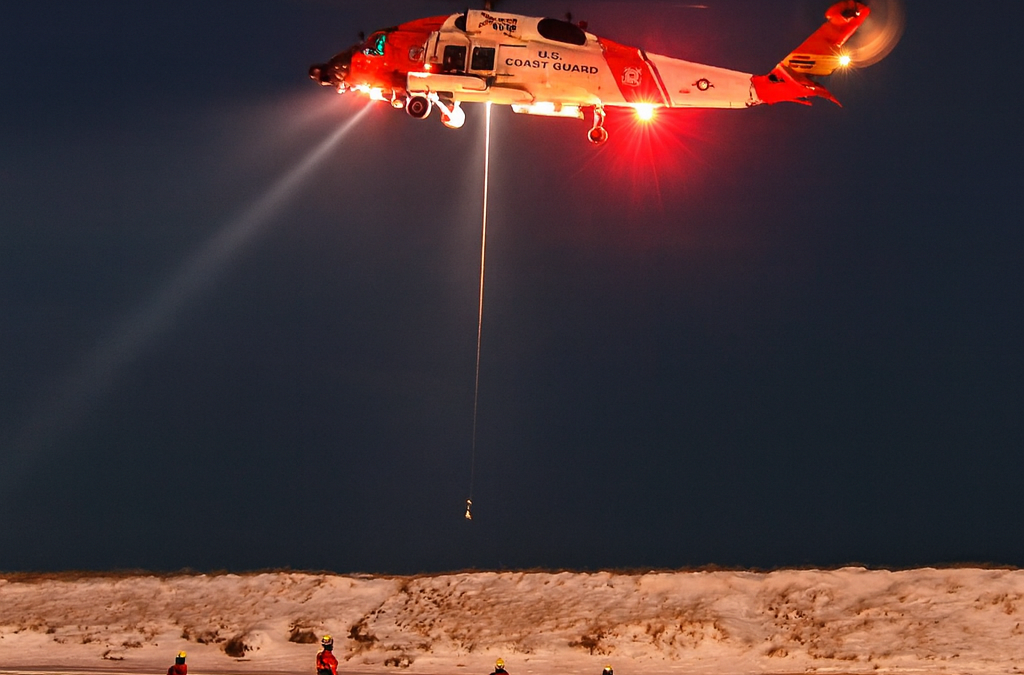
Photo Credit: Chris Franckowiak
On December 14th, two snowmobilers broke through the ice on a lake just south of us in Mason County, Michigan. Neither survived. Sadly, two families will have empty chairs this Christmas.
I’ve been in the fire service for over 49 years. I’ve worked ice rescues that ended well, and others that still haunt me. Every single one was preventable.
This isn’t about fear-mongering. It’s about understanding what you’re dealing with. Ice is complex – feeder streams, underwater currents, springs, how it forms, how snow and wind affects it, and what speed does to its integrity. Most people don’t know what they don’t know.
If you or anyone you know plans to venture onto frozen water this winter – for fishing, snowmobiling, skating, whatever – read this first and share it, please. It covers:
· How ice actually forms and fails
· What local conditions matter
· Essential safety equipment (including auto-inflating PFDs)
· Why you can’t travel in tight groups
· What to do if you go through
· What NOT to do when trying to rescue someone
The ice doesn’t care about your experience or confidence. It only responds to physics.
Understanding What You’re Standing On
Not all ice is created equal, and that frozen surface is far more complex than most people realize. Ice thickness alone is not a reliable indicator of overall integrity or safety.
The Anatomy of Dangerous Ice
Before you step onto any frozen body of water, understand what’s happening beneath that surface:
Feeder streams and tributaries create weak spots you can’t see from shore. That creek feeding into the lake? It’s bringing warmer water that thins the ice from below. Springs do the same thing—invisible weak points waiting to collapse.
Water currents under ice continue flowing all winter. Rivers and streams never truly freeze solid through their depth. The current weakens ice from underneath while the surface looks deceptively solid. Areas with current need dramatically thicker ice than still water.
How ice forms matters immensely. The best ice forms quickly during sustained cold periods—what we call “black ice” or “clear ice.” It’s dense, strong, and forms in uniform layers. The worst ice forms slowly with temperature fluctuations, creating a weak, porous structure. Partial melting and refreezing create layers that don’t bond properly—like a stack of paper instead of a solid block.
Snow: The Beautiful Hazard
Snow insulates ice, preventing it from thickening further. Worse, it hides the visual clues you need to assess ice conditions. You can’t see color, cracks, or wet spots under snow cover. Snow also adds weight, potentially pushing the ice below the waterline and flooding the surface—creating slush that weakens the structure further.
Heavy snow can actually cause ice to sink and flood, creating a hidden layer of slush beneath the snow. Step into that, and you’re soaked before you realize the danger.
Reading the Ice: What Color Tells You
Ice color is your first warning system:
· Clear blue or black ice: Strongest and safest—dense, well-formed ice
· White or opaque ice: Weaker—contains air bubbles and has less structural integrity
· Gray ice: Danger—indicates water saturation and imminent failure
· Slushy or dark patches: Stay away—these areas are actively failing
The Hard Truth: No Ice Is Ever Truly “Safe”
I need you to understand this: There is no such thing as 100% safe ice. Even the best conditions can hide localized weak spots. Variables you can’t control—underground springs, chemical composition, recent weather—all affect ice integrity in ways you cannot predict from the surface.
Before You Go: Essential Preparation
If you’re determined to go out on the ice, here’s what you must do:
Know Your Location:
· Research the specific body of water—is it spring-fed? Are there known current areas?
· Check with local authorities, bait shops, or experienced locals about current conditions
· Never assume ice conditions from previous years apply now
· Different parts of the same lake can have vastly different ice thickness
Check Thickness Guidelines (and understand they’re minimums for ideal conditions):
· 4 inches: Walking, ice fishing (alone)
· 5-7 inches: Snowmobiles, ATVs
· 8-12 inches: Small cars
· 12-15 inches: Medium trucks
These are for clear, solid ice only. White ice requires 2x these thicknesses. River ice requires 3x these thicknesses minimum.
Essential Safety Equipment:
Wear a Personal Flotation Device (PFD). Yes, even on the ice. I know what you’re thinking—bulky and uncomfortable under your snowmobile suit. Fine. Get an auto-inflating PFD. They’re slim, won’t restrict your movement, and will deploy when you hit the water. That buoyancy can be the difference between getting your torso onto the ice and exhausting yourself trying to stay afloat. If you go through, you’ll thank me.
Carry ice picks or awls worn around your neck – Keep them accessible outside your jacket. In the water, frozen hands can’t unzip pockets or dig through layers.
Bring a throw rope (at least 50 feet) – Even if you’re alone, someone on shore might be able to help.
Carry a whistle – A loud, pealess whistle that works when wet. When you’re in the water, you can’t yell for long. Three sharp blasts are the universal distress signal.
Pack dry clothes in a waterproof bag – Hypothermia is the real killer, even after you’re out of the water.
Charged cell phone in a waterproof case – For calling 911 or letting someone know your situation.
Don’t go alone—but don’t cluster together (spread out to distribute weight).
If You’re Crazy Enough to Go Out at Night:
Let me be blunt: Night ice activities multiply every risk factor. You can’t see color changes, cracks, or pressure ridges. But if you’re going out anyway:
You must have illumination on your person – Not just vehicle headlights. A headlamp or personal strobe that stays with you if you separate from your machine. If you go through the ice at night on an ATV, UTV, or snowmobile, that vehicle may sink or drift away from you. Rescuers need to find YOU, not your machine.
Wear a strobe light visible from 360 degrees if you’re operating vehicles at night. This isn’t optional—it’s how we find you in the dark when minutes matter. Clip it to your PFD or outer layer where it won’t get buried under other gear.
Reflective gear on your outer layer helps rescuers spot you against dark water or ice.
Night ice operations are exponentially more dangerous for everyone involved. Everything that can go wrong happens faster when you can’t see it coming.
Traveling Across the Ice: Spacing and Speed Matter
Here’s where I see people make dangerous assumptions. Just because the ice holds one vehicle or person doesn’t mean it’ll hold several in the same spot. It also doesn’t mean that because you made it out to your fishing spot safely, that following the same path back to shore later will produce the same results. Always check ice conditions both ways.
Never travel in tight convoys. Whether you’re on foot, snowmobile, ATV, or pulling an ice shanty—spread out. Maintain at least 50-100 feet between vehicles and people. The cumulative weight of multiple vehicles, shanties, or people concentrated in one area can overwhelm ice that would easily support individual loads. I’ve seen groups of snowmobilers traveling together break through ice that would have held each machine individually.
When heading to your fishing spot:
· Space vehicles and shanties at least 50 feet apart once you’re set up
· Don’t park multiple trucks or SUVs side by side
· If you’re drilling multiple holes for fishing, spread them out—don’t cluster them in a small area
· When multiple groups are ice fishing in the same general area, coordinate spacing
Speed kills—literally. When vehicles travel across ice, they create pressure waves in the water beneath. At certain speeds, these waves can resonate and dramatically weaken the ice structure. This is called the “critical speed” phenomenon, and it varies based on ice thickness and water depth.
For vehicle travel on ice:
· Keep speeds under 10 mph for maximum safety
· Avoid sudden acceleration or braking—smooth and steady wins
· Don’t spin your tires or do donuts—this concentrates stress on small areas
· If you feel the ice flexing or see water coming up around your vehicle, don’t stop—maintain steady speed toward shore or thicker ice
· Never assume the ice that held you on the way out will hold you on the way back—conditions change, and you may have weakened it on your first pass
The return trip is just as dangerous as going out. Fatigue, complacency, and the mindset of “we made it out here fine” cause people to let their guard down. Maintain the same spacing, the same speed discipline, and the same awareness on your way back to shore.
Remember: Ice is a dynamic structure. Temperature changes throughout the day, vehicle traffic weakens it, and what was safe at dawn may not be safe at dusk.
What to Do When Someone Goes Through
This is where people make fatal mistakes trying to help:
DO NOT rush out onto the ice to help. You’ll become a second victim. Most ice rescue deaths are would-be rescuers.
Instead:
1. Call 911 immediately – Professional ice rescue takes specialized training and equipment
2. Reach or throw, don’t go – Use a rope, ladder, branch—anything to extend your reach from safe ice or shore
3. Spread your weight if you must approach—lie flat and crawl, distributing your weight over the largest possible area
4. Talk to the victim—keep them calm and fighting. They have minutes before hypothermia sets in
If YOU Go Through the Ice:
1. Don’t panic (easier said than done, I know) – Control your breathing
2. Turn toward the direction you came from – That ice held you seconds ago
3. Get horizontal – Kick your legs to get your body flat with the surface
4. Use ice picks/awls to pull yourself up and forward
5. Don’t stand – Roll away from the hole, then crawl until you’re on solid ice
6. Get to shore and get warm immediately – Hypothermia kills quickly
What NOT to Do:
· Don’t try to climb out straight up—you’ll just break more ice
· Don’t remove your winter clothes in the water (they trap air and provide buoyancy)
· Don’t give up—people have survived 30+ minutes in ice water when they kept fighting
· Don’t assume you’re safe once out—hypothermia continues on land. Get warm NOW.
From the Perspective of Emergency Response
When we respond to ice rescue calls, we’re dealing with a clock that’s already running out. Water temperature just above freezing gives you roughly 10-15 minutes before you lose dexterity, 30-45 minutes before unconsciousness. We train extensively for these scenarios, but we’d rather never make that call.
The best ice rescue is the one that never happens.
I’m not telling you never to enjoy Michigan’s winter waters. I’m telling you to respect them. Understand what you’re dealing with. Prepare properly. Make informed decisions. And please, teach your children and grandchildren these principles—they’re the ones most likely to test the edges.
The ice doesn’t care about your experience, your confidence, or your plans. It only responds to physics and conditions. Respect that, and we won’t have to come get you.
Stay safe out there.
Chief Fred R. LaPoint
Stronach Township Fire Department
This article first appeared in Behind The Alarm, the newsletter of Fred R. LaPoint, Fire Chief Paramedic of the Stronach Township Fire Department, on December 16, 2025. Read the original.