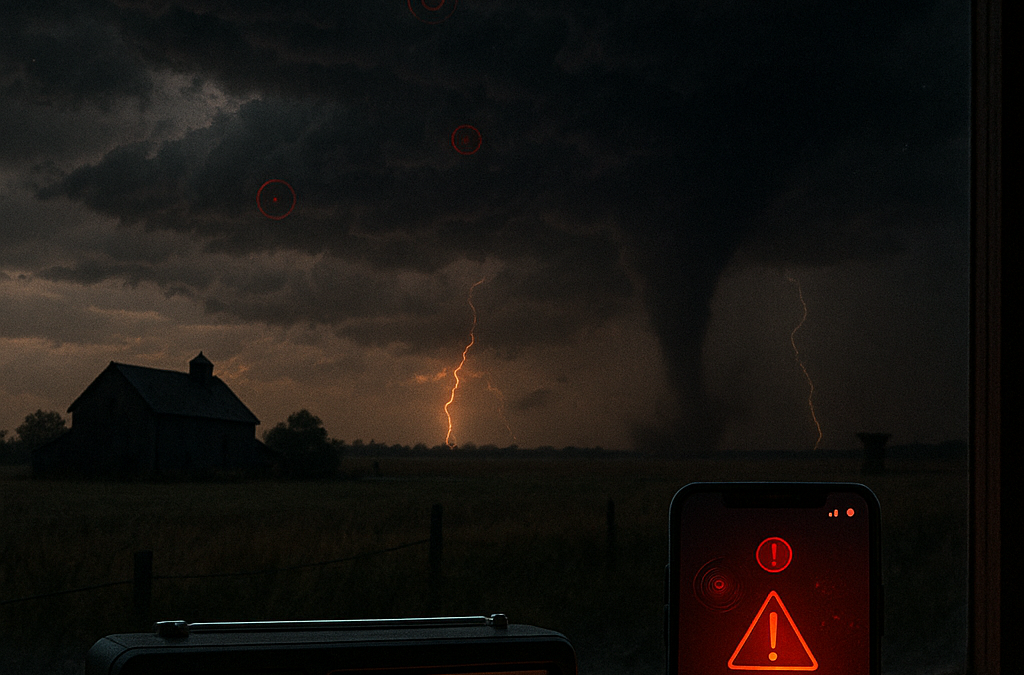
It’s storm season in America’s heartland. Tornadoes are already touching down. Flash floods are washing out roads. Hail, lightning, and high winds are becoming regular evening headlines. Now more than ever, reliable emergency alerts aren’t just helpful—they’re life-saving.
So what happens when one of the most trusted emergency alert systems—NOAA Weather Radio—goes silent?
That’s the question a growing number of people are asking this month. Across the country, NOAA Weather Radio (NWR) transmitters have been dropping offline, often for days at a time, without warning or clear explanation. If you’ve noticed your weather radio is eerily quiet, you’re not alone.
What’s Going On?
The National Weather Service is currently conducting a nationwide software upgrade to its radio transmitters—part of an effort to modernize the infrastructure behind the scenes. Unfortunately, that upgrade means each station may go offline for 2–3 days, and in some areas, outages are overlapping or recurring.
What’s worse? There’s been little public notice. Most people are only finding out when they realize the forecast has vanished or their radio says “no signal.” NOAA’s on-air messages typically cite a vague “software issue” or “technical difficulties,” giving no clear indication that this is part of a broader plan.
In a word: troubling.
Why It Matters
NOAA Weather Radio is often called the “Voice of the National Weather Service.” For millions of Americans, especially in rural areas or places with spotty cell service, it’s the first line of defense against deadly weather. Unlike smartphone apps or local TV, a NOAA Weather Radio doesn’t rely on Wi-Fi or cellular data. It just works—until it doesn’t.
The timing couldn’t be worse. We’re in the early weeks of what forecasters predict will be a particularly severe summer storm season. And while the upgrades are necessary, the silence is dangerous.
What You Can Do
Let’s be clear: emergency alerts will still be issued even if your NOAA station is offline. But it’s up to you to make sure you’re hearing them.
Here’s how to protect yourself and your loved ones:
-
Use Multiple Alert Systems
Don’t rely on just one source. Download emergency apps from NOAA, FEMA, or your local government. Enable Wireless Emergency Alerts (WEAs) on your phone. Follow local emergency management on social media. Keep a battery-powered AM/FM radio as backup. -
Check the Outage Map
NOAA publishes a list of current and upcoming outages by station. It’s buried a few clicks deep, but it’s there. Bookmark it. Check it. NOAA Outage Page -
Invest in a S.A.M.E. Radio
Many newer weather radios allow you to program your specific county and will alert you only for your area—reducing false alarms while making sure you get the real ones. -
Spread the Word
Most people have no idea this is happening. If your station is down, tell your neighbors. Tell your community. Share the outage map. Post it to local Facebook groups. Sometimes, the best alert system is still word-of-mouth. -
Report Persistent Outages
If your local station has been down for longer than expected—or if you can’t find any information about it—report it to NOAA directly at nwroutage@noaa.gov.
The Bigger Picture
This isn’t just about software or static on a frequency. It’s a symptom of a bigger issue. Federal agencies like NOAA are under increasing pressure—fewer staff, tighter budgets, and aging infrastructure. They’re trying to do more with less. And while we’re grateful for their hard work, gaps like this one put real people at risk.
As emergency responders, we train for what could happen, not just what we hope will happen. That means redundancy. That means backups. That means never assuming someone else will sound the alarm.
When the system fails, we don’t have the luxury of waiting for Washington to fix it. We fix it ourselves—by being informed, being proactive, and helping our neighbors do the same. Please share this with family, friends, coworkers, and anyone you may be concerned about.
Thank you for reading this week’s installment of Behind The Alarm!
Check back next week as we tackle another topic from behind the alarm.
Have questions or suggestions? We’d love to hear from you!
This article first appeared in Behind The Alarm, the newsletter of Fred R. LaPoint, Fire Chief Paramedic of the Stronach Township Fire Department, on June 8, 2025. Read the original.