Not long ago, I stopped at a service station outside my jurisdiction to fuel up my personal vehicle. I was in full uniform as I had just come from a function, when I noticed an older gentleman on the opposite side of the pump island fueling his large motorhome—with the engine running. I made sure he could see who I was, thinking my uniform would prompt him to shut off the engine. It didn’t faze him. I politely asked if he understood that fueling any vehicle, even a diesel, while the engine is running, isn’t safe. He kept pumping, uncomfortably trying to ignore the conversation. Finally, I had to tell him that Michigan law prohibits fueling with the engine running as evidenced by the sticker on the pump clearly within his eyesight. Only then did he reluctantly comply. What troubled me even more? The fuel station attendants seemed completely oblivious to the safety violation happening right in front of them.
This encounter perfectly captures what I see as a fire chief: Americans have somehow convinced themselves that safety is someone else’s responsibility. I’ve walked through homes where a working smoke detector or carbon monoxide detector might have saved lives, stood in buildings where better fire safety design could have prevented tragedy, and watched communities struggle through disasters they weren’t equipped to handle. But here’s what troubles me most: much of this is preventable, and other countries have already figured out how.
While we Americans pride ourselves on innovation and safety, we’ve somehow convinced ourselves that emergency preparedness is someone else’s job—usually ours in the fire service. Meanwhile, countries like Japan and much of Europe have woven disaster preparedness so deeply into daily life that their citizens instinctively know what to do when crisis strikes.
The difference isn’t just in their emergency response systems. It’s in how they think about risk, how they build their communities, and how they prepare their people. And frankly, it’s a difference that saves lives.
When Disaster Strikes: Two Different Worlds
Picture this: a 7.0 earthquake hits during the morning commute. In most American cities, chaos would ensue. Traffic would gridlock as people panic and try to reach family. Social media would explode with confusion about what to do next. Emergency services would be overwhelmed with calls from people who have no idea how to respond.
Now picture the same scenario in Japan. Children in schools immediately drop, cover, and hold—a response drilled into them since kindergarten, just like fire drills are here. Office workers calmly move away from windows and take cover under desks. Public transportation systems activate predetermined protocols. Citizens check on elderly neighbors according to community response plans they’ve practiced. Emergency supplies are already in place in homes and workplaces.
The difference? In Japan, emergency preparedness isn’t something you think about when disaster strikes—it’s something you live with every day.
The School Bell That Teaches Survival
Here’s something that might surprise you: Japanese students don’t just have fire drills. They have earthquake drills, tsunami drills, and disaster response training integrated into their regular curriculum. Every September 1st—the anniversary of the devastating 1923 Great Kanto Earthquake—the entire country participates in Disaster Prevention Day with coordinated drills.
Compare that to the United States, where we’ve mastered active shooter drills but somehow can’t get most adults to remember to change their smoke detector batteries twice a year. We teach our children to stop, drop, and roll for fires, but how many of them know what to do if the power goes out for a week? How many know where the family emergency supplies are kept, or have a communication plan if cell towers go down?
The Japanese approach recognizes a fundamental truth: disasters don’t wait for you to figure out how to respond. By the time you’re Googling “what to do in an earthquake,” it’s too late. The knowledge has to be instinctive, practiced, and culturally embedded.
Building Smart vs. Building Cheap
Walk through a modern European city and you’ll notice something: their buildings are designed differently. It’s not just aesthetics—it’s philosophy. European fire safety codes prioritize compartmentalization, meaning fires are designed to be contained within the space where they start. Stairwells are protected refuges, not just exit routes. Fire suppression systems are integrated into building design from the ground up, not added as afterthoughts.
In the United States, we’ve gotten very good at fighting fires after they start. Our equipment is world-class, our response times are impressive, and our firefighting techniques are constantly evolving. But we’ve been less successful at preventing fires from becoming catastrophic in the first place.
European building codes require fire-resistant materials and compartmentalization strategies that can buy precious time for evacuation and limit property damage. Their approach accepts that fires will happen, so they design buildings to fail gracefully. American codes, while improving, still often treat fire safety as a minimum compliance issue rather than an integral design philosophy.
The result? When I respond to structure fires in buildings designed to older American standards, I often see rapid fire spread that could have been slowed or contained with different materials and design approaches that are standard elsewhere.
The Emergency Kit That Actually Exists
Here’s a question for you: if the power went out in your neighborhood right now and stayed out for three days, how would you fare? No grocery stores, no gas stations, no ATMs. Just you, your family, and whatever you have on hand.
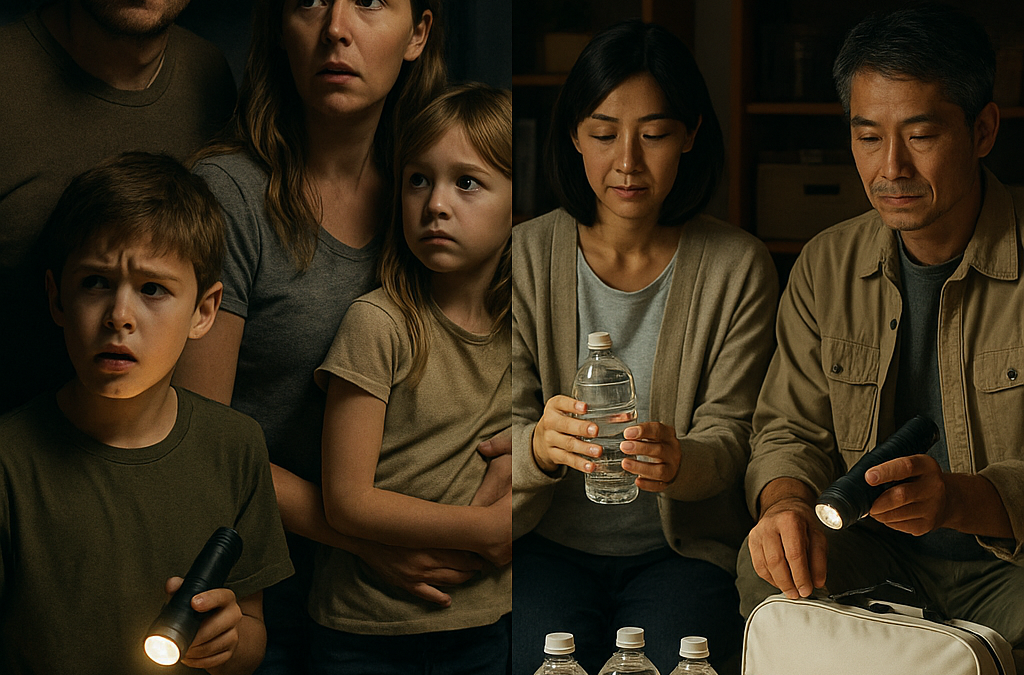
In Japan, this isn’t a theoretical question—it’s a regular consideration. Most Japanese households maintain disaster supply kits not because the government mandates it, but because the culture expects it. These aren’t survivalist bunkers; they’re practical supplies integrated into daily life. Water storage, non-perishable food, battery-powered radios, first aid supplies, important documents in waterproof containers.
When I tour American homes for fire safety inspections, I’m struck by how few families have even basic emergency supplies. We’ll spend hundreds of dollars on home security systems but won’t keep a week’s worth of water on hand. We’ll debate the best insurance coverage but won’t assemble a basic first aid kit.
The difference is cultural. In disaster-prone countries, personal preparedness isn’t seen as paranoia—it’s seen as civic responsibility. You prepare not just to protect yourself, but to avoid becoming a burden on emergency services and your community during a crisis.
The Warning System You Can Trust
Japan’s disaster warning system is something to behold. The J-Alert system can push emergency notifications to every cell phone, television, and radio in an affected area within seconds of detecting a threat. But here’s the key: people actually respond to these alerts because they’re part of a comprehensive, trusted system.
In the United States, we have warning systems too. But how many times have you ignored a weather alert on your phone, or been confused by the different types of emergency notifications? Our warning systems work technically, but they haven’t achieved the cultural trust and understanding that make them effective.
The difference lies in integration and education. Japanese citizens understand what each alert means, what they’re expected to do, and why the system works the way it does. They’ve practiced responding to these alerts in schools, workplaces, and communities. When the real thing happens, there’s no confusion about what the alert means or how to respond.
What We’re Missing: The Social Contract of Preparedness
The fundamental difference between American and international approaches to emergency preparedness comes down to social contract. In many other countries, personal preparedness is viewed as a civic duty—something you owe to your community and your emergency responders.
This creates a different relationship between citizens and their fire departments, police, and emergency medical services. Instead of being seen as the sole solution to every crisis, emergency services are viewed as part of a larger system that includes prepared, educated citizens.
When I respond to calls in communities where people understand basic emergency response, everything works better. People know to stay out of our way, they’ve taken initial first aid steps, they have essential information ready, and they don’t panic. This lets us focus on what we’re trained to do rather than managing chaos.
The Path Forward: Small Changes, Big Impact
I’m not suggesting we completely overhaul American society to match Japanese disaster culture or European building standards. But there are practical steps we could take that would dramatically improve our readiness:
In Schools: This is where I have seen some of the most troubling attitudes toward safety training. Too often, fire drills are treated as nuisances rather than vital, potentially life-saving practice. I’ve witnessed staff and, yes, even teachers, fail to immediately evacuate during drills when they think no one is watching. Even worse, I’ve seen schools stack all their state-required annual drills back-to-back—sometimes multiple drills on the same day—just to check boxes, rather than spacing them throughout the year in different weather conditions and situations where real emergencies might occur. This is not meant to single out, but rather illustrate the bigger problem, because the attitude isn’t limited to a single location or setting.
We need to expand emergency drills beyond fire and active shooter scenarios, but first, we need to take the drills we already have seriously. Children learn more from watching adult behavior than from any instruction manual. When adults treat emergency procedures as inconveniences, children absorb that attitude. We should be teaching basic disaster response, family communication planning, and emergency supply basics—but only after we’ve established that emergency preparedness is something adults take seriously.
In Building Codes: Adopt more aggressive compartmentalization standards and fire-resistant material requirements, especially in high-density housing.
In Communities: Develop neighborhood-level emergency response plans that assume professional responders may be delayed or overwhelmed.
In Homes: Normalize emergency preparedness the way we’ve normalized home security systems. Make basic supply kits and family emergency plans as common as smoke detectors.
More Than Equipment: A Different Mindset
The gap between American emergency preparedness and that of other countries isn’t primarily about technology or resources—it’s about mindset. We’ve created a system where emergency preparedness is someone else’s job, preferably someone in uniform with a badge and specialized equipment.
But disasters don’t wait for uniformed professionals to arrive. The first few minutes of any emergency are handled by whoever happens to be there: parents, teachers, coworkers, neighbors. In countries with strong preparedness cultures, these people aren’t helpless bystanders—they’re the first line of defense.
As a fire chief, I can tell you that the most important safety equipment in any building isn’t the sprinkler system or the fire alarm—it’s prepared, educated people who know how to respond when things go wrong.
Every smoke detector that goes unused because its battery died, every family without a communication plan, every community that assumes emergency services will handle everything—these represent opportunities we’re missing to build a more resilient society.
The rest of the world has figured out that emergency preparedness isn’t just about having good firefighters and paramedics. It’s about having good citizens who understand their role in keeping everyone safe.
Maybe it’s time we caught up.
What aspects of international emergency preparedness do you think would work best in your community? Have you experienced emergency response in other countries? Share your thoughts and experiences in the comments.
This article first appeared in Behind The Alarm, the newsletter of Fred R. LaPoint, Fire Chief Paramedic of the Stronach Township Fire Department, on September 23, 2025. Read the original.