Crews Will Disengage
What happened at Devil’s Elbow — and why the fire service owns half of it
The sentence that does not belong in a fire update
On the morning of Tuesday, August 4, the incident management team running the Tartar Fire in Washington County, Idaho, released its daily update. These are dry documents by design. Acres, containment percentage, weather, which division worked what overnight, where the dozers cut line. Nobody reads them for drama.
This one carried a paragraph that had nothing to do with any of that. The night before, firefighters had been pulled out of the Devil’s Elbow area and off other ground along the east flank of the fire, because they were being harassed and threatened. The team stated that the safety of its firefighters is paramount, and then it put in writing the sentence that ought to stop every one of us cold: crews will disengage if such actions continue.
Not “we ask for the public’s cooperation.” Not “law enforcement has been notified.” Disengage. Put the tools down, load the buggies, and leave the fire to do what fire does.
The Fox Fire, burning across the state line on the Oregon side, has reportedly run into the same thing. And when a reporter asked the Tartar Fire’s public information officer the obvious follow-up question — what happens if the fire then turns on the homes and the livestock belonging to somebody who ran the crews off — the answer was that they were not sure, because it had not happened yet.
It will happen. Somewhere, this season or the next one, a division supervisor is going to be standing on a two-track at two in the morning with that decision in his hands, and every option in front of him is going to be a bad one.
I have been in this business for over fifty years, and I have sat in an operations chief’s seat and a planning chief’s seat on disaster deployments. I want to be careful with what follows, because the easy version of this piece is a lecture aimed at ranchers, and a lecture will not fix anything. There are two failures sitting at Devil’s Elbow. They belong to two different sets of people. If we only talk about one of them, we have wasted the whole lesson.
What a burnout actually is
Start with the tactics, because most people have never had this explained to them in plain language — and that includes a fair number of people inside the fire service who have never worked a range fire in their lives.
When a wildfire is running through cured grass and sagebrush with a hard wind behind it, you do not get to choose where you fight it. The head of that fire can move faster than a man can run and faster than an engine can back out of a bad two-track. Putting people directly in front of it is not aggressive firefighting. It is how you fill caskets. Every hard lesson this profession has ever learned about burnovers was learned in exactly that country, in exactly those fuels.
So you go find the place you can actually hold. A gravel road. A ridgeline. A plowed field, a creek bottom, an old dozer scar from a fire ten years ago. Somewhere with an anchor point, an escape route, and a safety zone, where an engine can sit and a crew can work without gambling their lives on the wind holding steady. That line is almost never right up against the flames. It is a mile out, or three, or five.
Which leaves the ground in between. That ground is fuel, and the fire is coming to collect it. The only question is on whose terms. If you wait, the fire arrives at three in the afternoon with forty-mile-an-hour gusts pushing it, throwing embers a half mile ahead of itself, and it takes that fuel and your line with it. If instead you take that fuel out ahead of time — at nine at night, with the humidity recovering, on a night when the wind lies down, with an engine on the road and a burn boss watching a belt weather kit — the fire arrives at your line and finds nothing left to eat. That is a burnout. Backfiring is the same idea used more aggressively, firing into the oncoming fire so the two draw together and starve each other.
It is not, as it looks from a pickup truck two ridges over, the government setting the country on fire. It is spending fuel deliberately so the fire cannot spend it violently. Done right, it is the single most effective tool in the box for a wind-driven range fire, and it has saved more homes and more grass than any air tanker ever has.
Here is the part we say to each other, and it is true: that ground was going to burn either way.
What the black costs the man who owns the grass
And here is the part we need to sit with: “it was going to burn anyway” is a firefighter’s sentence. It is completely useless to the man who owns the grass.
The Tartar Fire started July 24 from a lightning strike, about twenty-one miles northwest of Weiser. By August 4 it had burned an estimated 138,223 acres at thirteen percent containment, and the three fires burning on both sides of that border had covered more than 238,960 acres between them. Those are not abstractions to the people who live there. That is somebody’s summer range.
One of them is a rancher named Cody Chandler, whose family has run that country for generations, and who told a Boise television station that his operation runs cattle, horses and sheep, and that they depend on the land and the grass to make a living. He said neighboring producers have lost haystacks, corrals and fencing — hundreds of thousands of dollars in fence alone. Hay was already expensive before the fire took what they had stored. He had not even had time to go assess his livestock, because he had spent the previous several days fighting fire and protecting houses. About twenty-five volunteers spent a Sunday helping fight fire on ground he leases. And he said, plainly, that communication during the response had been a source of frustration.
Read that last part again, because it is the whole story in one line.
From inside the black, a burnout is a tactic. From the other side of the fence, it is this year’s feed gone, next year’s grazing allotment gone, cattle that now have to be trucked and fed on purchased hay at a price that can end a marginal operation, and cheatgrass coming back next spring thicker and more flammable than whatever burned. They have also all seen a burnout that got bigger than the plan said it would, because those happen too, and we should be honest enough to say so out loud.
None of that makes the tactic wrong. All of it makes the silence around the tactic indefensible.
The Idaho–Oregon border fires, as reported August 4, 2026
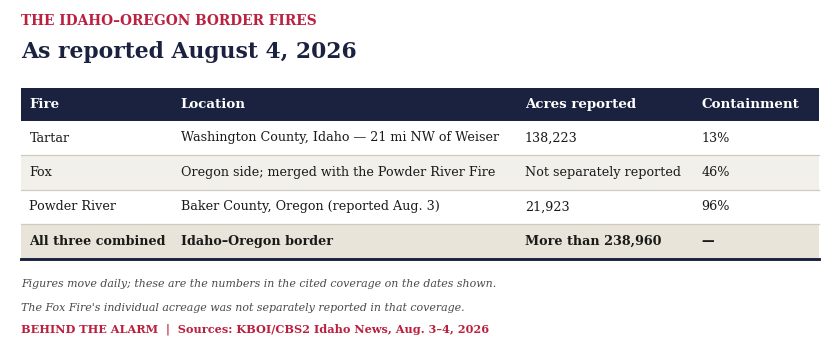
Figures move daily; these are the numbers in the cited coverage on the dates shown. The Fox Fire’s individual acreage was not separately reported in that coverage.
Dolores, Colorado: the same summer, the other outcome
If you want to know whether the problem is the tactic or the conversation, look at what happened this same season about five hundred miles east.
On the Ferris Fire near Dolores, Colorado, crews ran burnout operations in early July to clear fuel between the fire and the road they were using as their southern line. That fire went past 51,600 acres. Seven ranchers were running roughly 2,300 cow-calf pairs on grazing allotments inside it. By any measure, those permittees were getting hit as hard as anybody in Idaho is getting hit now.
What happened there was not a standoff. Forest Service officials, including a range liaison, sat down with the ranchers, and together they worked out that the cattle could stay on the land if everybody coordinated and kept moving them — pushing the herds off the active flanks and onto open flats where they could get out of the way. Same agency. Same impossible summer. Same fuels, more or less. Different outcome.
The difference between Dolores and Devil’s Elbow is not tactical doctrine. It is that somebody in Colorado whose actual job was talking to permittees was talking to permittees.
Idaho already built the answer
This is the part that should be genuinely frustrating to anyone who knows the history, because Idaho did not just stumble into this problem. Idaho solved a version of it fifteen years ago and then apparently forgot to apply the solution to large-fire operations.
Idaho has ten Rangeland Fire Protection Associations. They are nonprofit volunteer fire organizations made up of farmers, ranchers and landowners, formed to put fast initial attack on range fires in country that had essentially no fire protection at all. The first one stood up near Mountain Home in 2012; the legislature gave the model legal status in 2013. Together those ten associations cover something on the order of nine million acres of private, state and federal rangeland — more ground than the entire state of New Jersey — with roughly three hundred trained volunteers who answer around three hundred and thirty fires a year. Oregon has been running the same model since the 1960s. The idea, in both states, is simple: the ranchers are the fire department.
And researchers went and measured what that did to the relationship. A study led out of Oregon State found that the long-running friction between ranchers and the agencies has eased — quickly in Idaho, more gradually in Oregon — and it identified the mechanism plainly. What improved things was experience and time spent together, on the fireline and off it. Ranchers learned how fire behaves and how agencies operate. Agencies learned what the ranchers knew about that ground, especially the terrain. Nothing exotic. Just hours in each other’s company before the bad night, instead of a first introduction at midnight with a drip torch in one hand.
The men threatening crews at Devil’s Elbow and the men in an RFPA turnout on initial attack are, in a lot of cases, the same kind of men. Some of them may literally be the same men. Chandler’s twenty-five neighbors who turned out to fight fire on leased ground are not anti-firefighter. They are unpaid firefighters. Whatever went wrong on the east flank of the Tartar Fire did not go wrong because those people hate the fire service.
It went wrong because nobody told them what was about to happen on their grass, and because somebody decided that telling them was a nice-to-have.
Liaison is not a luxury position
Our side owns this half, and I am not going to soften it.
The interagency system already has the positions for exactly this. A Resource Advisor’s published duties include serving as liaison to the agency administrator, to resource users, and to other affected parties, and documenting the actual and potential resource impacts of suppression along with the rationale behind protecting what gets protected. Resource users. That is the grazing permittee. That is Cody Chandler. It is written into the position description.
Those are also the positions that get ordered late, filled by trainees, or quietly left off the order when a team is thin and the country is on fire from Canada to California. Nobody has ever been chewed out at a closeout for not having enough liaison capacity. Plenty of teams have been chewed out for acres.
So here is the standard I would hold us to, and it is not complicated. A firing operation that nobody warned the landowner about is a tactically sound decision executed as a public relations catastrophe. “We announced it at the community meeting” is not notification when the meeting was in a town ninety minutes away, and the burnout went off at midnight. A phone call to a permittee that says we are going to have to take the fuel out between the fire and Rock Creek Road tonight, here is why, here is where, here is who to call, is not a courtesy. It is a fireline safety measure, the same as scouting an escape route, because an angry landowner in a pickup on your division is a hazard on the size-up, whether or not we are willing to write it that way.
We are very good at explaining ourselves afterward, in the after-action review, to each other. We are bad at explaining ourselves beforehand, to the people it happens to. The bill for that gap is now being handed to twenty-two-year-olds on a hand crew, and they did not run it up.
The line that does not move
Everything above is the explanation. None of it is an excuse, and this is where I stop being evenhanded.
You do not get to threaten a firefighter.
Not over grass. Not over a fence. Not over a burnout you were never told about and would not have agreed to. Not because the agency has been wrong before, and not because you have four generations in that ground and the man on the drip torch has four weeks in that county. The grievance can be one hundred percent legitimate, and the conduct still be indefensible, and both of those things are true at Devil’s Elbow at the same time.
Understand what a threat actually accomplishes out there. It does not stop the burnout. It stops the firefighting. When a crew disengages, the fire does not disengage with them. It keeps running, unopposed, toward the next fence and the next haystack and the next house — including the ones belonging to people who never threatened anybody. Somebody made a unilateral decision to let a wildfire run across their neighbors’ country, and they made it with no authority to make it and no liability when the bill comes.
And then there is the question the public information officer could not answer, which is the one that keeps me up. If that fire turns and threatens a home on a property where crews were run off, what happens? I know what will happen, because I know this profession. They will go. Of course they will go. They will drive back into the place where they were threatened, for the people who threatened them, because that is the job and because that is who these people are. That is not a reason to take it for granted. It is the reason not to.
This is not a wildland problem in isolation, either. Structural crews and EMS have been absorbing a rising volume of assault, ambush, and abuse for two decades now, and the profession’s answer has mostly been to eat it and go to the next call. We should stop eating it. Threatening a firefighter to shut down a fire suppression operation is not a protest, and it should not be handled as a customer service issue. It is a crime; it endangers a whole county, and it should be named as such — by sheriffs, by prosecutors, by county commissioners, and by the ranchers’ own associations, whose members have more to lose from a fire running free than anyone.
Why this matters in Manistee County
Somebody is going to ask what any of this has to do with a small township department in northern Michigan, where our fuel model is more likely to be jack pine and marsh grass than sagebrush, and where a hundred and thirty-eight thousand acres is an unimaginable number.
Two things.
The first is that we run backfires too. Smaller, rarer, less dramatic — but any of us who have worked a wildland-urban interface fire in Manistee National Forest country have taken fuel out ahead of a fire on purpose, and we have done it on ground somebody owns, sometimes without the owner standing there. The scale changes. The obligation does not.
The second is the part that travels. Every relationship this fire service has with the public is built before the incident or it is not built at all. That is true of a range liaison on a Type 1 team and it is true of a township chief at a board meeting in February. If the first time your neighbors hear from you is the night you need to do something to their property that they will not like, you have already lost, and no amount of being tactically correct will get it back.
The men on the east flank of the Tartar Fire were right about the fire. That was never the problem. The problem is that being right is not the same as being trusted, and only one of those two things gets you a crew that can stay on the line.
Sources
— KBOI / CBS2 Idaho News, “Firefighters pulled from fires after threats, harassment along Idaho/Oregon border,” Aug. 4, 2026 — idahonews.com
— KBOI / CBS2 Idaho News, “Tartar Fire grows to more than 138,223 acres north of Weiser,” Aug. 4, 2026 — idahonews.com
— KBOI / CBS2 Idaho News, “Tartar Fire leaves lasting concerns for local ranchers,” Aug. 2026 — idahonews.com
— KBOI / CBS2 Idaho News, “Tartar Fire near Weiser burns over 107,825 acres” (Powder River Fire figures), Aug. 3, 2026 — idahonews.com
— The Colorado Sun, “Wildfires burning across Colorado are forcing ranchers to triage their herds,” July 8, 2026 — coloradosun.com
— Idaho Department of Lands, Rangeland Fire Protection Associations program pages — idl.idaho.gov
— Post Register / Ag Proud (Heather Smith Thomas), reporting on Idaho RFPA volunteer numbers, annual fire response, and program history
— Oregon State University Extension Service, “Rangeland Fire Protection Associations reduce wildfire tensions in Oregon and Idaho” (research led by Emily Jane Davis) — extension.oregonstate.edu
— Northwest Fire Science Consortium, “Rangeland Fire Protection Associations: An Alternative Model for Wildfire Response” — nwfirescience.org
— National Wildfire Coordinating Group, Resource Advisor position description — nwcg.gov
Fred R. LaPoint is Fire Chief and paramedic of Stronach Township Fire Department in Manistee County, Michigan, with over 50 years in emergency services. A Vietnam-era Coast Guard veteran and Team Rubicon disaster responder with more than three dozen deployments, he writes Behind The Alarm and Guardians of Truth.
This article first appeared in Behind The Alarm, the newsletter of Fred R. LaPoint, Fire Chief Paramedic of the Stronach Township Fire Department, on August 5, 2026. Read the original.