
By Fred R. LaPoint • Fire Chief, Stronach Township Fire Department • Team Rubicon Disaster Responder
As I write this, the Aspen Acres Fire southwest of Pueblo, Colorado has grown to roughly 87,000 acres — the eighth-largest wildfire in that state’s history — and it has forced the evacuation of about 3,800 homes across four counties. Photographs from the fire line show something I have seen too many times in my own deployments: cattle standing in an open field while the sky behind them glows orange. The people are gone. The animals are still there.
I have had the sad opportunity, as a disaster responder, to watch how floods and wildfires overrun our ability to move large animals — horses, cattle, sheep, hogs — out of fields and corrals before the danger arrives. The math is brutal, and it is simple. In a fast-moving evacuation, the animals almost always outnumber the trailers. When there is no time and no trailer left, good people do the only thing left to do: they cut the fence and try to give the animals a fighting chance to run.
If you are ever the one holding the cutters, there is one thing I want you to remember above all else, because it is the difference between an animal that lives and an animal that dies against its own fence.
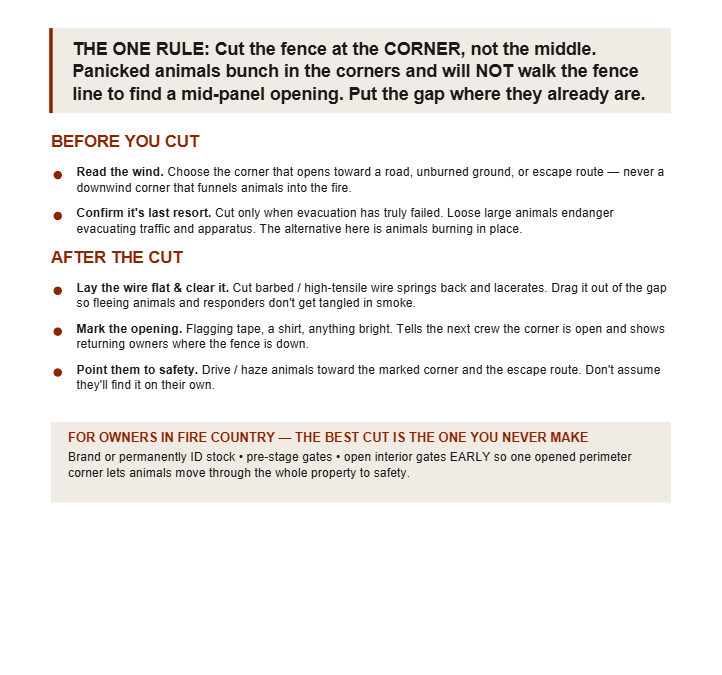
Cut at the corner, not the middle
Prey animals under stress do not calmly walk a fence line looking for a way out. They bunch. They gather in the corners of an enclosure and press together, and they stay there. That instinct is thousands of years old, and no amount of smoke and noise is going to talk them out of it.
So when you cut a fence in the middle of a run, you have opened a door the animals will never find. They are packed into the corner forty or a hundred feet away, and they will stand there until the fire reaches them. Cut the corner instead — put the opening exactly where the animals already are — and you have given them a way out they can actually use.
Five things that make the difference
Open toward safety, not into the fire. Pick the corner that pushes animals toward a road, unburned ground, or an escape route. A downwind corner can funnel them straight into the fire’s path. Read the wind before you cut.
Lay the wire down and clear it. Cut barbed or high-tensile wire springs back like a whip. It will lacerate and entangle panicked animals and the people moving among them in smoke and low light. Cut it, drag it flat, and get it out of the gap.
Mark what you cut. Tie flagging tape, a shirt, anything bright to the opening. It tells the next crew the corner is already open so they don’t burn time re-cutting it, and it tells returning owners where their fence is down.
Cut only when evacuation has truly failed. Loose large animals on a road become a hazard to evacuating traffic and to apparatus. This is a last-resort measure — the alternative being animals burning in place. Know the difference and make the call honestly.
Prevention beats reaction every time. If you keep large animals in fire country, brand or permanently ID them, pre-stage your gates, and open your interior gates early so a single opened perimeter corner lets stock move through the whole property to safety. The best fence cut is the one you never had to make.
Why I’m writing this now
In Colorado this week, neighbors have been organizing rides and offering pasture over social media — one man offered 80 acres in the San Luis Valley to anyone who needed a place for their livestock. That generosity is the best of us. But generosity needs a trailer, and there are never enough trailers. When the trailers run out, the fence cutters come out, and the people using them are almost never trained for it.
This is a small piece of knowledge. It costs nothing to learn, and it can be passed along in a single sentence: cut the corner, because that’s where the animals will be. If it saves one horse, one cow, one frightened group of sheep pressed into the wrong corner of a burning field, then it was worth writing down.
Stay ready. Watch the wind. And look out for the ones who can’t drive themselves out. Please consider sharing this vital information, not just for the folks impacted by the Aspen Acres fire but anywhere this or similar disasters may strike.
Fred R. LaPoint is Fire Chief of the Stronach Township Fire Department in Manistee County, Michigan, a U.S. Coast Guard veteran, and a Team Rubicon disaster responder with more than three dozen deployments across the U.S. and internationally. He writes Behind The Alarm.
This article first appeared in Behind The Alarm, the newsletter of Fred R. LaPoint, Fire Chief Paramedic of the Stronach Township Fire Department, on July 6, 2026. Read the original.