
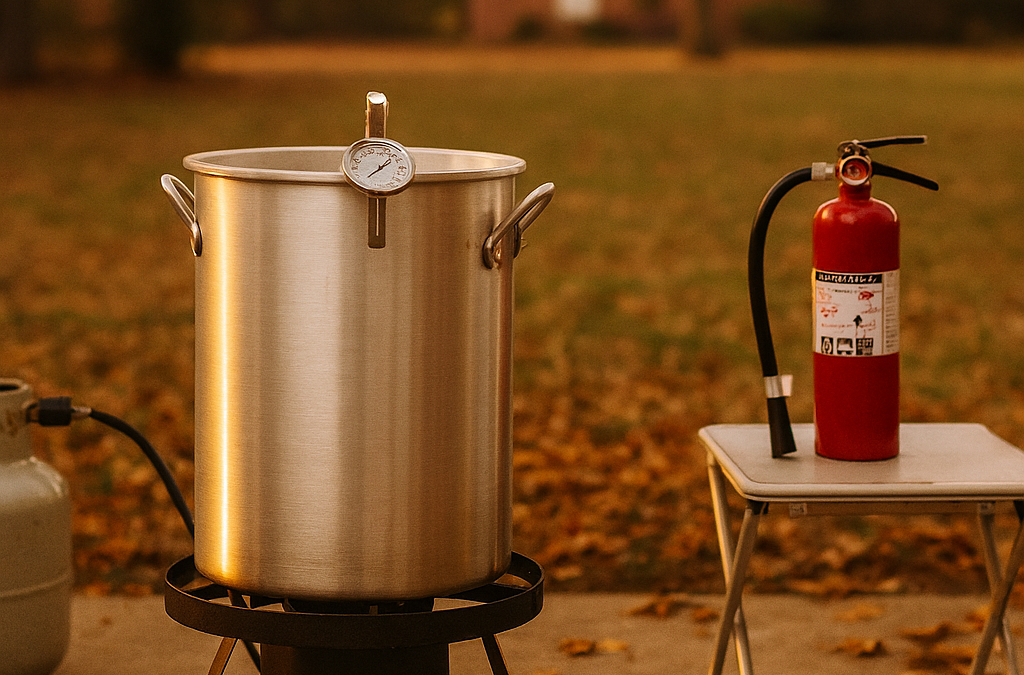
Thanksgiving is coming up fast, and maybe this is the year you’ve decided to join the deep-fried turkey club. You’ve tasted one before—crispy skin, juicy meat, done in a fraction of the time—but you’ve never made one yourself. As this year’s host, you’re ready to serve up a Thanksgiving dinner that’ll be talked about long after the last slice of pie.
Here’s my advice from over four decades in fire service: make sure the conversation isn’t about how the pot exploded and took half your garage with it.
The Numbers Don’t Lie
Every year, particularly around Thanksgiving, fire departments nationwide respond to deep fryer incidents that cause an estimated $15 million in property damage. I’ve seen these calls firsthand—the panicked homeowner, the destroyed deck or garage, the holiday gathering that turned into an insurance claim. What makes these incidents particularly frustrating is that every single one was preventable.
Yes, your homeowners’ insurance typically covers fire damage. But after a deep fryer fire, you’ll be dealing with more than just higher premiums—you’ll be explaining to your family why Thanksgiving dinner is now at a restaurant.
Before You Light That Burner
If you’re new to hosting or have never deep-fried a turkey, preparation is everything. Consider doing a trial run before the big day. This gives you a feel for setup time, oil quantities, and cooking duration. More importantly, it lets you work out the kinks when there isn’t a house full of hungry relatives watching.
The Critical DOs:
Read the entire instruction manual before you start. Not just the cooking times—the safety protocols, equipment specifications, and emergency procedures. If your fryer didn’t come with detailed safety instructions, that’s your first red flag.
Have the right fire extinguisher within arm’s reach. And I mean the right one. A standard ABC dry chemical extinguisher will work on a grease fire, but it creates a mess that’s nearly as bad as the fire itself. A Class K extinguisher is designed specifically for cooking oil fires and is your best bet. Never, ever use water on a grease fire—that’s how you turn a manageable situation into a full-blown disaster.
Choose your oil wisely. Use oils with high smoke points: peanut oil (if no one has allergies), canola oil, or refined vegetable oil. These oils can handle the 350°F temperatures you need without breaking down or producing toxic fumes. And check with your guests about food allergies before selecting your oil—an allergic reaction will ruin Thanksgiving faster than any fire.
The Absolute DON’Ts:
Never fry a frozen or partially thawed turkey. This is where most explosive disasters happen. When ice crystals meet 350°F oil, the water flash-boils and expands, causing the oil to overflow violently—often while igniting. The turkey must be completely thawed and thoroughly dried, inside and out. Pat it down with paper towels. This one step prevents the majority of turkey fryer catastrophes.
Never fry anywhere near your home. Not in the garage, not on the deck, not under the porch overhang. Set up on level ground at least 10 feet from any structure. This isn’t overcautious—it’s physics. Hot oil splatters, pots tip over, and propane flames reach up the sides of the pot. You need clearance on all sides and a clear escape route.
Keep spectators at a safe distance. I know Uncle Bob wants to supervise, and the kids are curious, but establish a safety perimeter. No one under 18 should be anywhere near the fryer, and adults should stay back at least 3 feet. That traditional Thanksgiving football game? Move it to the front yard.
Don’t overfill the oil or overheat it. Here’s a pro tip: before cooking day, do the water displacement test. Put your turkey in the empty pot, add water until the turkey is covered by about an inch, then remove the turkey and mark that water level. That’s your maximum oil level. As for temperature, cooking oil can auto-ignite at around 375°F. Use a proper deep-fry thermometer clipped to the pot, and maintain steady heat around 350°F. If you see smoke rising from the oil, it’s too hot—turn off the heat immediately.
A Fire Chief’s Perspective
In my years in the fire service, I’ve learned that most holiday fire emergencies share a common thread: someone knew better but got distracted, rushed, or overconfident. Deep-frying a turkey requires your complete attention for the entire process—usually 3 to 4 minutes per pound. That’s 45 minutes to an hour where you cannot walk away, take a phone call, or grab another beer.
If something does go wrong—if the oil ignites or the pot tips—don’t be a hero. Step back, grab your fire extinguisher, and if the fire spreads beyond the pot, get everyone away from the area and call 911. We’d much rather respond to a call where you’ve gotten everyone to safety than one where you’ve tried to move a flaming pot of oil and ended up in the burn unit.
Making Memories Worth Keeping
Thanksgiving is about gratitude, family, and creating memories that last a lifetime. A perfectly cooked deep-fried turkey can be the centerpiece of a wonderful celebration. Just make sure those memories are about the delicious meal you prepared, not the fire trucks that showed up.
Follow these guidelines, stay alert, and keep safety as your top priority. Your family will thank you—and so will your fire department.
Stay safe out there, and happy Thanksgiving.
This article first appeared in Behind The Alarm, the newsletter of Fred R. LaPoint, Fire Chief Paramedic of the Stronach Township Fire Department, on November 25, 2025. Read the original.