
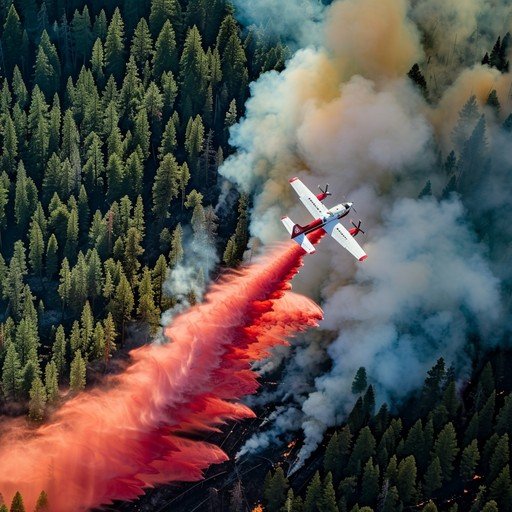
The sky over a wildfire looks empty. It is not. It is the most crowded and most dangerous piece of airspace in that county on that day, and everything in it is operating at the outer edge of what the machine and the human being can do.
Down low, a helicopter is holding a hover in mountain air, pulling water out of a stock pond with a snorkel or a bucket on a long line, and the margin between the load he is carrying and the lift that thin hot air will give him is measured in a few hundred pounds. Above him, an air tanker is running a drop line at a hundred and fifty knots, a hundred and fifty feet off the deck, in a canyon, with the pilot’s eyes locked outside on terrain and on the exact spot where the retardant has to land. Above both of them, an air attack platform is circling, holding the whole picture in his head, keeping aircraft from finding each other inside smoke that can cut visibility to nothing.
There is no radar service out there. There is no controller. Separation is maintained by radio discipline and human eyeballs, and it works because every single thing in that airspace is talking to every other thing.
Your drone is not talking to anybody.
You are not a small aircraft. You are an invisible object.
That is the first thing I want a drone operator to understand. You have no transponder, no radio, and no lights that mean anything out there, and you are a two-foot gray object against gray smoke. The tanker pilot cannot see you. He is not going to see you. See-and-avoid is a legal concept that assumes two pilots with a fighting chance of spotting one another, and at a closing speed near two hundred miles an hour, against a smoke column, in terrain, that concept does not exist. If you and he occupy the same cubic yard of sky, it will be an accident in the truest sense of the word, and he will never have known you were there.
It is not a bird
People tell themselves a drone is basically a bird, and aircraft hit birds all the time. A bird is mostly water and hollow bone and feather, and it deforms on impact. Your drone is a rigid frame of metal and hardened plastic wrapped around a lithium battery, and the FAA’s own work on this has found that drones do more damage to an aircraft than a bird of the same weight.
Put that into a main rotor blade turning at several hundred miles an hour at the tip, and you have an unbalanced rotor system on a helicopter already working at the edge of its available power. Put it into a tail rotor and the aircraft becomes uncontrollable in about a second and a half. Put it down a turbine intake and you have an engine failure at a hundred and fifty feet over rough country with nowhere to go. Put it through a windscreen, and you have an incapacitated pilot at low altitude.
And if that sounds theoretical, it is not. During the Palisades Fire in January of 2025, a hobby drone collided with a Canadair Super Scooper and tore a hole in the aircraft’s left wing roughly the size of a football, putting it out of service for days. The operator pleaded guilty to a federal charge. That happened in the middle of one of the worst fires California has ever had, at the exact moment they needed every airframe they could put their hands on, and it took one of the heaviest water-dropping aircraft in the fleet out of the fight.
One drone does not stop one aircraft. It stops all of them.
Here is the part most people never think about, and it is where the real damage gets done.
When a drone is spotted over an incident, they do not simply steer the nearest aircraft around it. Everything stops. Air attack calls it, and the entire air show shuts down — every helicopter, every tanker, every ship working that fire goes to a holding pattern or back to base, and they stay there until somebody on the ground can confirm the airspace is clear. That is not an overreaction. It is the only responsible call available, because the alternative is gambling a crew’s lives on an object nobody can see.
In Colorado this July, a single drone flight inside the restriction over the Aspen Acres Fire stopped every firefighting aircraft working a fire that had already burned more than a hundred thousand acres. Deputies found the operator without much trouble, because he had posted his own video. And as I write this, on the Spokane Complex in Washington state, forestry has tracked at least forty unauthorized drones inside the temporary flight restriction and grounded all aerial resources on a Monday evening. Forty. On one incident.
The clock you just ran out
Aerial windows are narrow. There is a stretch in the morning when humidity is up, and winds are down, and the drops actually hold, and there is a stretch in the afternoon when conditions turn, and the aircraft can no longer work safely at all. Lose an hour in the middle of that, and you have not inconvenienced anybody. You have lost the day.
The retardant line that was supposed to tie into the two-track does not get tied in. The flank that was going to get knocked down keeps running. The fire that would have ended at nine hundred acres ends somewhere else entirely, and everything that happens after that — the evacuations, the structures, the second and third operational periods, the cost — traces back to an hour nobody could buy back.
The people underneath it
There are crews on the ground under all of this. Hand crews cutting line in country a truck will never reach. Engine companies from four small towns who left their own coverage thin to come. Dozer operators. Volunteers who took a day off work they could not afford to lose.
Those people are not out there hoping for air support. They are counting on it. They have built the whole plan around a drop that is supposed to arrive at a certain point on that ridge at a certain time so they can hold what they just spent six hours cutting. When the aircraft stop coming, they have to disengage, back out to a safety zone, and hand the fire back to the ground they took. Sometimes there is nowhere good to back out to. That is how firefighters get hurt, and that is how firefighters get killed.
So understand what the actual trade is. It is not your footage against a rule. It is your footage against a crew’s escape route and somebody’s house.
The law has caught up, and hard
Congress raised the ceiling in 2024, and the FAA can now pursue a civil penalty of up to seventy-five thousand dollars against a drone operator who interferes with wildfire suppression inside a temporary flight restriction — up from twenty thousand. Separately, under federal criminal law, knowingly or recklessly interfering with wildfire suppression using an unmanned aircraft can bring up to two years in prison, and interference with an aircraft itself is a felony carrying considerably worse. Remote pilot certificates get suspended and revoked. On the Spokane fires, there is now an FBI counter-drone task force, and local officers have been deputized as federal officers specifically to enforce the flight restriction.
The thing that catches nearly all of them is their own posting. You film it because you want people to see it, and among the people who see it are the ones who write charging documents.
But fines are not the reason
Honestly, I do not think dollar figures stop this, and I am not much interested in scaring anybody with them. I want the person holding the controller to understand one simple thing.
That pilot is somebody’s husband. He has been on the road since May, sleeping in a motel near an airport in a town he had never heard of, flying an airframe worked harder in one season than most aircraft get worked in a decade. He is flying low and slow into the worst air on that mountain because there are men and women underneath it who need a minute. He does not get to swerve around you. He does not get to see you at all. He gets exactly one option, which is to stop flying and go home, and he will take it without complaint, because that is the discipline the job requires of him.
You will never know what it cost. Nobody is going to call you. There will be no headline connecting your afternoon with the ridge that got away, or the crew that had to pull back, or the house on the far side of it. You will just have your video, and somewhere out of frame a great many tired people will pay for it.
The National Interagency Fire Center says it in five words. If you fly, we can’t.
What to do instead
Check for a temporary flight restriction before you launch anywhere near an incident. The FAA publishes them, and the free B4UFLY app will tell you in about ten seconds. If a fire is burning in your county, assume the airspace is closed until you have confirmed that it is not.
If you see somebody else putting one up near a fire, call 911. That is not being a busybody. That is the fastest way to get aircraft back over a crew that needs them.
And if what you want is pictures of the fire, be patient. The people with authorization will document it, and more often than not some volunteer standing in the black with a phone will get a better shot than you were going to get anyway.
The sky over a fire belongs to the crews for a few hours. Let them have it.
Fred R. LaPoint is Fire Chief and paramedic of Stronach Township Fire Department in Manistee County, Michigan, with over 50 years in emergency services. A Vietnam-era Coast Guard veteran and Team Rubicon disaster responder with more than three dozen deployments, he writes Behind The Alarm and Guardians of Truth.
Sources
Civil penalty ceiling raised from $20,000 to $75,000 by the FAA Reauthorization Act of 2024; criminal exposure under 18 U.S.C. § 40A (up to two years) and 18 U.S.C. § 32: FAA guidance and DroneXL reporting on the Aspen Acres Fire, July 2026. Palisades Fire Super Scooper collision, January 2025, and the operator’s guilty plea in the Central District of California: contemporaneous reporting and DOJ filings. Spokane Complex drone incursions, aerial resources grounded, FBI counter-drone task force and federally deputized local officers: The Spokesman-Review and FireRescue1, August 2026. “If you fly, we can’t” public awareness campaign and the finding that drones cause greater damage than birds of equivalent weight: National Interagency Fire Center and FAA drones-and-wildfires materials.
This article first appeared in Behind The Alarm, the newsletter of Fred R. LaPoint, Fire Chief Paramedic of the Stronach Township Fire Department, on August 8, 2026. Read the original.