Leaving the Rayado Mesa
For Earl Watters, for the Lady Liberty, and for everyone who has ever heard those engines coming up the drainage.
Earl Watters
There is a photograph I have not been able to put down.
The frame is almost all sky. A rotating wall cloud sits over a New Mexico mesa, dragging gray curtains of rain down onto the grass. Along the right side, one bolt of lightning splits the whole picture from top to bottom, throwing off branches like the roots of a tree turned upside down. The horizon is a thin dark line of timber. And near the center, so small you could scroll right past it, there is a helicopter.
That is the photograph. An enormous, violent sky, and one aircraft in it, pointed away from the fire and toward whatever piece of ground would take it before the weather closed the door.
That photograph was not taken from the air. It was taken from the ground, by the Cimarron Volunteer Fire Department — by somebody standing in the black on that mesa, with fire still in it and a storm coming at them, who looked up, watched the ship go, and had the presence of mind to raise a camera.
My brother-in-fire, aerial firefighter and pilot, Earl Watters, was flying the Lady Liberty that day. He shared their picture with five words. Leaving the Rayado Mesa Fire.
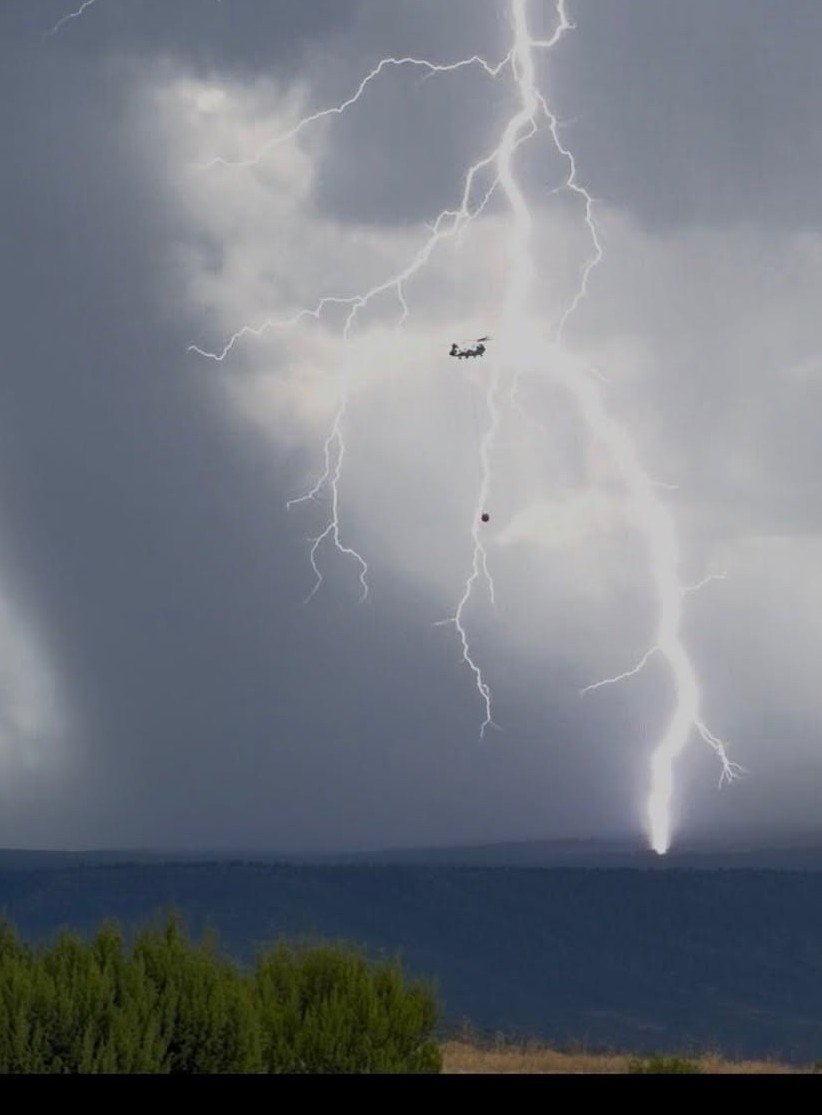
Not battling. Not heroic. Leaving. It was time to go, so he went, and the most dramatic sky I have seen in years got passed along the way the rest of us pass along a picture of the drive home.
The fire you never heard about
The Rayado Mesa Fire started on the afternoon of Monday, July 27, on the north slope of Rayado Mesa in Colfax County, New Mexico — a few miles from the little town of Miami, in the country just outside Philmont Scout Ranch. It ran in grass and brush and timber, torching and creeping and running as the wind kept shifting on it.
Nobody lit it on purpose. It was lightning, near as anybody could tell, and it was one of close to a dozen fires touched off around there in a matter of days. Departments from Cimarron, Philmont, Miami and Springer went at it. By the next morning there were around fifty-five people working that mesa, with two helicopters and an air tanker overhead. Another department was rolling to help and got turned around partway there, because a different fire needed them worse.
It finished at about 934 acres. Nobody was hurt. Houses were threatened and no houses burned.
You never heard about it, and you never were going to. Nine hundred acres of grass in Colfax County is not a story to anybody outside Colfax County. Sit with that a second, because it is the whole business in one sentence: when everything goes right in this work, nothing happens. Success is invisible. The only wildland fires most Americans can name are the ones where we lost.
The Lady Liberty (N406KT)
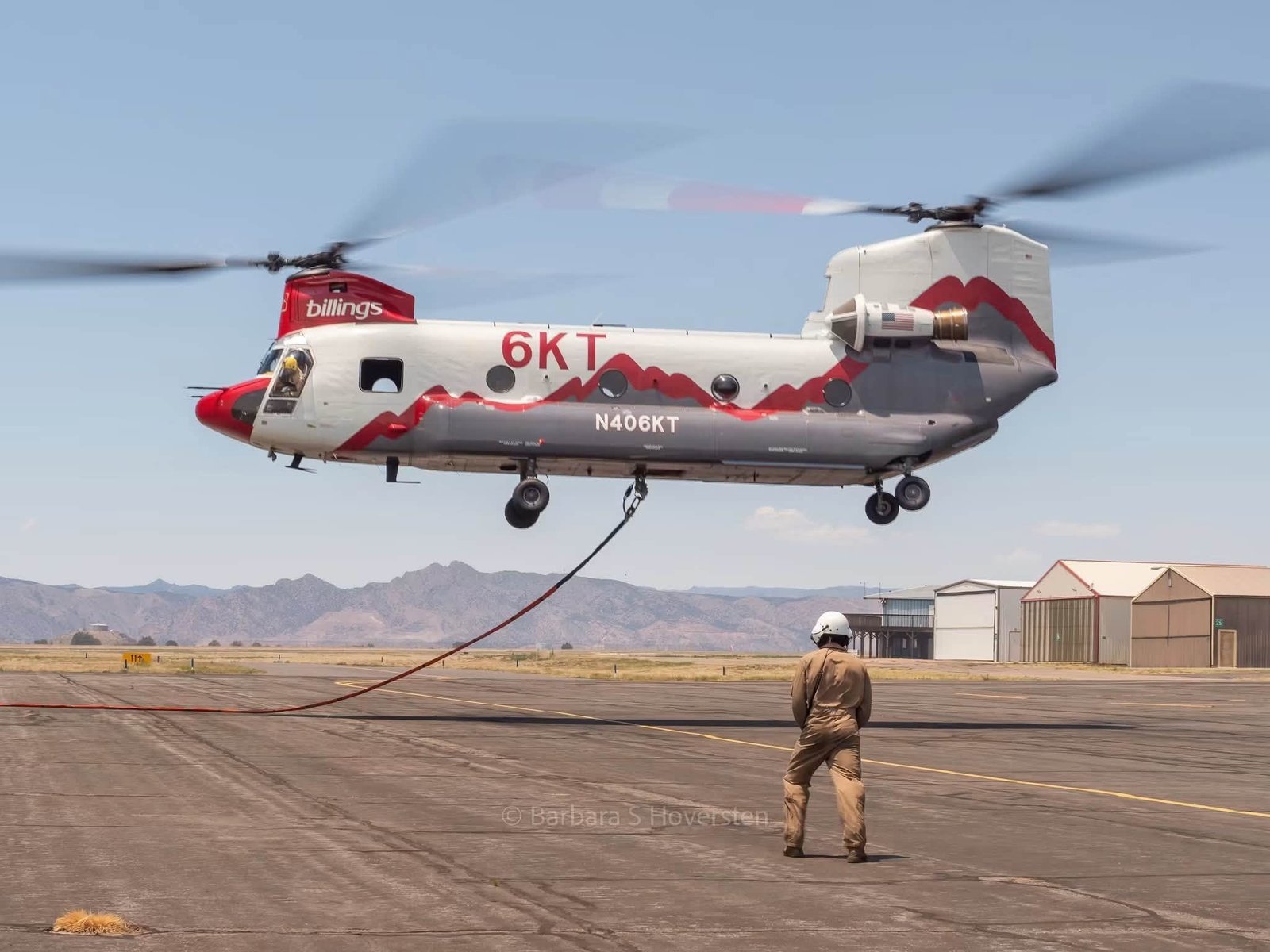
The aircraft in the picture is a Chinook helicopter, not just any Chinook; her name is Lady Liberty. If you have ever served, you knew the pressure sensation in your sternum and in your feet before your ears register anything. Then the rhythm resolves out of it, that percussive double beat, that is oddly hard to locate; it seems like it fills the whole sky rather than a point in it. Only last does the turbine whine ride in on top, thin and metallic over all that bass. Then the whole thing goes from ambient to overwhelming in seconds, and if it’s coming into a landing zone the beat spreads and flattens as the discs load up. The Chinook gives you two pulses stacked so close together they smear into that unmistakable wokka wokka, which is why nearly everyone who’s heard one reaches for that two-syllable onomatopoeia. Their shape is distinctively long. The two big rotors turning against each other, fore and aft, and no tail rotor anywhere, because counter-rotating discs cancel the torque themselves and every bit of power goes into lift and thrust instead of into fighting the airframe.
The Army took its first ones in 1962. They went to Vietnam, and they did everything over there — troops, artillery set down on mountaintops nothing else could reach, ammunition, fuel, water, wounded men. Over the course of that war they dragged something like eleven thousand five hundred downed aircraft back out of the country.
I was Coast Guard then, 1972 to 1976, a telephone technician, and regrettably I never rode in one. But being as I am the same vintage as those airframes, I will admit to a certain soft spot for machinery from my era that still gets up in the morning and goes to work.
For fifty years the Chinook belonged to the military and to nobody else. That started changing about a decade ago, when governments began surplusing them, and a handful of outfits took the risk of turning a heavy-lift war machine into a firefighting aircraft. There are maybe twenty or twenty-five of them working fires commercially now. They carry more water than anything else with a rotor on it. They hold their lift in heat and altitude, where lighter ships start handing it back. And those tandem rotors let a pilot put a load exactly where he wants it, in country that would run a single-rotor helicopter off.
Earl was flying Lady Liberty that day with the rest of his crew on board her. She is part of the fleet of Chinooks owned and operated by Billings Flying Service out of Montana. And while her name is nearly as old as this nation she flies above, she did not get that name from a firefighting company. She has been carrying it for thirty years.
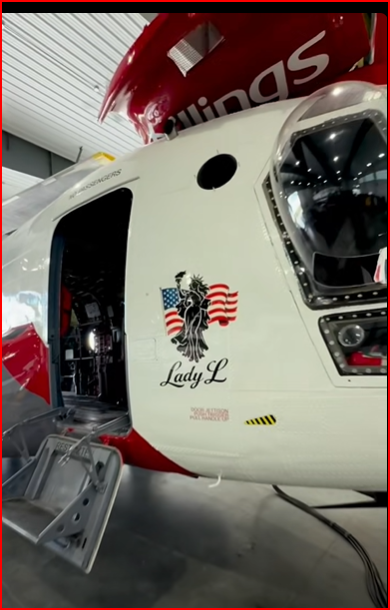
She came off the Boeing Vertol line as a CH-47C and went north to Canada in the mid-1970s, one of eight, wearing the Canadian designation CH-147 in a configuration their crews called the Super C. She flew for 447 and 450 Squadrons. Trucks and five-ton cargo on the sling, howitzers, paratroopers going out the back, rescue work in northern Quebec.
Canada retired the C-models in 1991 and sent them back to Boeing, where they were taken apart and rebuilt to D standard. In 1995 they went to the Dutch. And that is where she got the name — in Royal Netherlands Air Force service she was D-662, and somebody over there painted Lady Liberty on her nose. Her sisters got Red October, Blizzard, Sling King, Bigfoot, The Beast, and Rodney.
She served the Dutch the better part of thirty years. She carried Canadian soldiers in Afghanistan, years after Canada’s own Chinooks were gone. The registries put time on her under United Nations colors as well. The Dutch finally retired her two days before Christmas in 2021.
That is usually where the story ends. Some of her sisters went to a museum, to a gate guard at an air base, to a hangar floor to be taken apart by mechanics learning the type. Honorable enough. Static.
Instead, in June of 2023, the Netherlands sold six of them to Billings Flying Service in Montana. She is registered N406KT now. They put an internal tank and a snorkel in her, and they sent her back to work.
Run the arithmetic on that with me. That airframe went to Canada while I was still wearing a Coast Guard uniform. She has hauled artillery, paratroopers, soldiers in Afghanistan and relief cargo under a UN flag, on three continents, for two air forces and a civilian outfit, across fifty years — and this summer she was over a mesa in Colfax County, New Mexico, dropping water so that a Scout ranch and a few ranch houses and a town of a couple hundred people could go on having an ordinary July.
I do not know a better second act than that. Most of us never get offered one.
The same sky that starts it, ends it
There is a hard irony in that photograph that I don’t think shows up unless you have worked one of these.
The lightning that started the Rayado Mesa Fire is the same lightning that ran Earl and his crew off of it. A thunderstorm building over a going fire is not weather. It is a threat. The storm collapses, the outflow comes down and out, and all of a sudden you have fifty and sixty mile an hour winds arriving from a direction nobody planned for, on a fire that had been lying down nicely all afternoon. The flank becomes the head. Crews who were in a good place ten minutes ago are now in a bad one.
And that is exactly the moment the aircraft has to leave.
Think about what that asks of a pilot. The fire is about to do the worst thing it will do all day. Your people are underneath it. And the sky over your head is telling you that if you stay one more turn you will be a second emergency instead of a solution to the first one. There is no committee for that call. There is a man in a seat, watching a wall cloud rotate, doing arithmetic he cannot afford to get wrong, and then keying the mic and saying he is going home.
The discipline it takes to leave is a harder kind of courage than the kind that stays. I have watched a lot of people learn that the expensive way over fifty years. The good ones learn it early.
What it looks like from underneath
Every firefighter who has worked a line fire has had the same moment.
You are bent over a tool. Your hands have gone numb around it. The smoke has been in your throat so long you quit noticing it two hours ago, and the only thing in the world is the next foot of dirt. And then you hear it. Not the fire. Engines, low, coming up the drainage.
Heads come up all down the line. Somebody points. And for the length of one pass, thirty exhausted people stand still and watch a stranger fly straight into the ugliest air on that mountain, because there are men and women underneath it who need a minute.
Then they are gone. Nobody on the ground learns the pilot’s name. There is no handshake at the end of shift, no ride back to camp together, no cup of coffee. They bought us the minute and turned for the reload, and we put our heads back down and went to work.
I have been on the receiving end of that gift in more places than I can list, wearing more than one uniform, and I have never once gotten to say thank you to the person who gave it.
Which is why I cannot get past who actually made this photograph. Not a news crew. Not a storm chaser. A volunteer fire department out of Cimarron, New Mexico, on the fire, in the weather, doing the holding. That is the view from the dirt. That is thirty tired people watching their minute fly away ahead of a wall cloud — and one of them thought the rest of us ought to see it.
Everybody else in that picture
There is one aircraft in that photograph, and there are dozens of people in it, and one of them was holding the camera.
There is the other seat, and the crew chief. There is the mechanic who was underneath that ship at two in the morning with a light in his teeth so it could fly at seven. There is the fuel truck driver standing in a dirt lot. There is the helitack crew who cut and held the landing zone. There is air attack circling above all of it, keeping aircraft from finding each other in the smoke. There is the dispatcher who put the order out, and the helicopter manager on the ground running numbers against density altitude, because a helicopter at six thousand feet on a hundred-degree afternoon is not the same helicopter it was at sea level that morning.
And under everything, out of the frame entirely, there are the hand crews. The sawyers cutting line in country a truck will never see. The engine companies from four small towns who left their own coverage thin to come. The dozer operators. The volunteers who took a day off work they could not afford to lose. The ones who do the actual holding, hour after hour, long after the aircraft have gone home ahead of the storm.
Aircraft support the ground. That is the doctrine, and it is also the truth. Airplanes and helicopters do not put fires out. They buy the people on the ground the time and the odds to do it. Both halves of that sentence are owed something.
The bill that comes due
I want to say the next part plainly, because it is the part nobody puts on the recruiting posters.
This work kills people. Not often, and not for any lack of care, but often enough that everyone who does it for a living knows a name. Low altitude, high terrain, thin air, turbulence coming off a column of superheated smoke, mountains that appear right where the visibility ends, and an airframe worked harder in one season than most aircraft get worked in a decade. There is room on the wall at the memorials, and every few years we fill in a little more of it.
They know that. They go anyway, for a seasonal paycheck that would not impress you, months away from home and family, sleeping in tent cities in whatever town they find themselves near, or if they are fortunate, a motel near the airport.
So do the hand crews. So do the volunteers. That is the family. It always has been.
For Earl, and for all of them
Earl Watters is a friend, which is the only reason I know any of this closely enough to write it down. He flew out from under a rotating wall cloud and treated it like a commute. That is exactly the temperament this job selects for, and it is exactly why these people go unthanked. They will not tell you it was anything.
It was something.
If You Fly, We Can’t
The sky over a wildfire looks empty. It is not. It is the most crowded, most dangerous piece of airspace in the county that day, and everything in it is operating at the outer edge of what the machine and the human being can do.
Down low, a helicopter is working a hover in mountain air, pulling water out of a stock pond with a snorkel or a bucket on a long line, and the margin between the load he is carrying and the lift that thin hot air will give him is measured in a few hundred pounds. Above him, an air tanker is running a drop line at a hundred and fifty knots, a hundred and fifty feet off the deck, in a canyon, with the pilot’s eyes locked outside on terrain and on the exact spot where the retardant has to land. Above both of them, an air attack platform is circling, holding the whole picture in his head, keeping aircraft from finding each other inside smoke that cuts visibility to nothing. There is no radar service out there. There is no controller. It is separation by radio discipline and by human eyeballs, and it works because every single thing in that airspace is talking to every other thing.
Your drone is not talking to anybody.
That is the first thing I want a drone operator to understand. You are not a small aircraft in the pattern. You are an invisible object. You have no transponder, no radio, no lights that matter, and you are a two-foot gray thing against gray smoke. The tanker pilot cannot see you. He is not going to see you. See-and-avoid is a legal concept that assumes two pilots with a fighting chance of spotting each other, and at a closing speed near two hundred miles an hour, against a smoke column, that concept does not exist. If you and he occupy the same cubic yard of sky, it will be an accident in the truest sense of the word, and he will never have known you were there.
The second thing is the physics, because people tell themselves a drone is basically a bird and airplanes hit birds all the time. A bird is mostly water and hollow bone and feather, and it deforms on impact. Your drone is a rigid frame of metal and hardened plastic wrapped around a lithium battery, and the FAA’s own testing has found that drones do more damage to an aircraft than a bird of the same weight. Put that into a rotor blade turning at several hundred miles an hour at the tip, and you have an unbalanced rotor system on a helicopter that is already at the edge of its power. Put it into a tail rotor and the aircraft becomes uncontrollable in about a second and a half. Put it down a turbine intake, and you have an engine failure at a hundred and fifty feet over rough country with no place to go. Put it through a windscreen, and you have an incapacitated pilot.
And if you think that is theoretical, it is not. During the Palisades Fire in January 2025, a hobby drone collided with a Canadair Super Scooper, tore a hole in the aircraft’s left wing about the size of a football, and put it out of service for days. The operator pleaded guilty to a federal charge. That happened in the middle of one of the worst fires California has ever had, at the exact moment they needed every airframe they could get their hands on, and it took one of the biggest water-dropping aircraft in the fleet out of the fight. SkyTrade
Now here is the part that most people never think about at all, and it is the part that does the real damage.
When a drone is spotted over an incident, they do not just move the one aircraft out of the way. Everything stops. Air attack calls it and the whole air show shuts down — every helicopter, every tanker, every ship on that fire goes to a holding pattern or back to base, and they stay there until somebody on the ground can confirm the airspace is clear. That is not overreaction. It is the only responsible call available, because the alternative is gambling a crew’s lives on an object nobody can see. In Colorado this July, one drone flight inside the restriction over the Aspen Acres Fire stopped every firefighting aircraft on a fire that had already burned more than a hundred thousand acres. Deputies found the operator easily — he had posted his own video. And as of this week, on the Spokane Complex in Washington, state forestry tracked at least forty unauthorized drones inside the flight restriction and grounded all aerial resources on a Monday evening. Forty. On one fire. DroneXL
Aerial windows are narrow. There is a stretch in the morning when humidity is up, and winds are down, and the drops actually hold, and there is a stretch in the late afternoon when everything gets ugly, and the aircraft can no longer work safely at all. Lose an hour in the middle of that, and you have not inconvenienced anybody. You have lost the day. The retardant line that was supposed to tie into the road does not get tied in. The flank that was going to get knocked down keeps running. And the fire that would have ended at nine hundred acres ends somewhere else entirely.
Meanwhile, there are people on the ground underneath all of it. Hand crews cutting line in country a truck will never reach, engine companies from four small towns, volunteers who took a day off work they could not afford. They are not out there hoping for air support. They are counting on it. They have built their whole plan around a drop that is supposed to arrive at a certain point on that ridge at a certain time so they can hold what they have cut. When the aircraft stop coming, those people have to disengage, back out to a safety zone, and give the fire back the ground they just spent six hours taking. Sometimes there is nowhere good to back out to. That is how firefighters get hurt.
So understand what the actual trade is. It is not your footage against a rule. It is your footage against a crew’s escape route and somebody’s house.
The law has caught up with this, and hard. Congress raised the civil penalty ceiling in 2024, and the FAA can now come after a drone operator for up to seventy-five thousand dollars for interfering with wildfire suppression inside a flight restriction. Separately, under federal criminal law, knowingly or recklessly interfering with wildfire suppression with an unmanned aircraft can bring up to two years in prison. Interference with an aircraft itself is a felony carrying far worse. Certificates get suspended and revoked. On the Spokane fires, there is now an FBI counter-drone task force, and local officers have been deputized as federal officers specifically to enforce the flight restriction. And the thing that catches nearly all of them is their own posting. You film it because you want people to see it, and the people who see it are the ones who write the charging documents.
But honestly, I do not think fines are what stops this, and I am not much interested in scaring anybody with dollar figures. I want the person holding the controller to understand one simple thing.
That pilot is somebody’s husband. He has been on the road since May, sleeping in a motel near an airport in a town he had never heard of, flying an airframe worked harder in one season than most aircraft get worked in a decade. He is flying low and slow into the worst air on that mountain because there are men and women underneath it who need a minute. He does not get to swerve around you. He does not get to see you at all. He gets one option, and it is to stop flying and go home, and he will do it without complaint because that is the discipline the job requires.
You will never know what that cost. Nobody will call you. There will be no headline connecting your afternoon with the ridge that got away or the crew that had to pull back or the house on the other side. You will just get your video, and somewhere out of frame, a whole lot of tired people will pay for it.
The National Interagency Fire Center puts it in five words: if you fly, we can’t.
So don’t. Check for a temporary flight restriction before you launch anywhere near an incident — the FAA publishes them and the free B4UFLY app will tell you in ten seconds. If a fire is burning in your county, assume the airspace is closed until you have confirmed otherwise. If you see somebody else putting one up near a fire, call 911. And if you want pictures of the fire, be patient. The people with authorization will document it, and some volunteer standing in the black with a camera will get a better shot than you were going to get anyway.
The sky over a fire belongs to the crews for a few hours. Let them have it.
And the rest of it is simply this. To every pilot, every crew chief, every mechanic, every helitack and hotshot and engine slug and volunteer sawyer — and to the Cimarron volunteers who raised a camera on their worst afternoon — who spent this summer somewhere hot and far from home so a fire in a county most people could not find on a map would end at 934 acres instead of somewhere else entirely — thank you. From one old firefighter who has stood in the black and watched you come up the drainage, and never once got to say it out loud.
Fly safe, brother. And you tell that old lady she has earned every hour of it.
Photograph by the Cimarron Volunteer Fire Department, shared by Earl Watters. Fred R. LaPoint is Fire Chief and paramedic of Stronach Township Fire Department in Manistee County, Michigan, with over 50 years in emergency services. A Vietnam-era Coast Guard veteran and Team Rubicon disaster responder with more than three dozen deployments, he writes Behind The Alarm and Guardians of Truth.
This article first appeared in Behind The Alarm, the newsletter of Fred R. LaPoint, Fire Chief Paramedic of the Stronach Township Fire Department, on August 8, 2026. Read the original.