
A reader sent me a slick web page ad post the other day. They found it on Facebook. It was dressed up like a news article — retired RV service writer, a heartbreaking story, a countdown timer, and a plug-in gadget that would supposedly save your life for three easy payments. Down in the fine print, it admitted the truth: it was an advertisement, not a news article at all.
I’m not here to sell you anything. But that ad did something clever that’s worth talking about — it wrapped a real safety problem inside a pile of junk science to move product. After 50-plus years in this business, I’d rather you have the real thing without the markup or the scare tactics. So let’s separate what’s true from what’s snake oil.
What the ad got right
Here’s the uncomfortable part: your standard carbon monoxide alarm is designed on purpose not to sound at low levels.
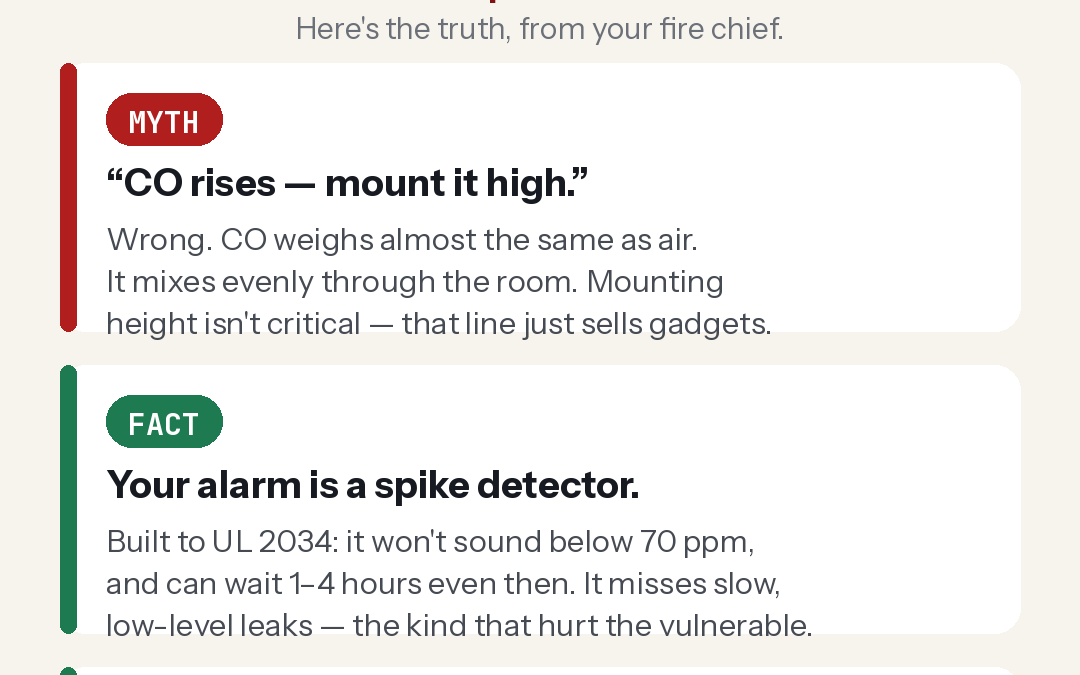
Home and RV alarms are built to a standard called UL 2034. That standard tells the alarm to ignore low, steady concentrations of CO so you don’t get nuisance trips every time you fire up the stove. In plain numbers, a compliant alarm won’t sound below 70 parts per million, and even at 70 ppm it’s allowed to wait anywhere from one to four hours before it goes off.
That’s fine for catching a fast, dangerous spike. It is not designed to catch a slow, low-level leak that sits at 30 or 40 ppm for hours — the kind that can quietly hurt the very people we worry about most: infants, the elderly, pregnant women, and anyone with a heart or lung condition. That gap is real, and it’s the one legitimate point buried in that ad.
Two more things the ad got right, and they matter:
● Sensors expire. Carbon monoxide sensors wear out. Most are only good for five to seven years — ten on some newer units. There’s a manufacture or replace-by date stamped on the housing. When that date passes, the alarm goes in the trash, working chirp or not.
● The test button can lie. On a lot of units, pressing the test button only checks the horn, the battery, and the electronics — not the sensor’s actual ability to smell gas. Read your manual. Some newer models run a fuller self-check, but plenty don’t.
What the ad got wrong
Now the snake oil. The ad’s big pitch was that carbon monoxide is lighter than air, so it rises to your pillow while your factory alarm sits uselessly down low — buy our high-mounted unit to catch it.
That’s bad physics. Carbon monoxide weighs almost exactly the same as air — it doesn’t rise or sink; it mixes evenly through the room. That’s precisely why UL and most manufacturers say mounting height isn’t critical for CO the way it is for a smoke detector. The “you’re watching the wrong height” line isn’t a safety tip — it’s a sales device invented to make your existing alarm look broken.
The dramatized death story and the glowing testimonials? Treat them as fiction until somebody proves otherwise. That’s the standard formula for these pages, and there’s not a single reference to NFPA, UL, NIOSH, or the CPSC anywhere on it.
What to actually do
You don’t need their gadget. You need good habits and, if you want extra protection, the right tool — not the one with the biggest markup and the loudest countdown clock.
● 1. Check the date on every CO alarm in your home and your RV. Anything past its replace-by date gets replaced now.
● 2. Read the manual to learn whether your test button checks the sensor or just the horn. If in doubt, replace on schedule and don’t rely on the button.
● 3. If you have vulnerable people in the house, or you run propane appliances and a generator in an RV, consider a low-level CO monitor. These display CO in real numbers and alert well below the UL 2034 threshold. That’s the honest version of what the ad was fumbling toward — and firefighters have used low-level monitors for years for exactly this reason.
● 4. Never run a generator, grill, or unvented combustion appliance in or near an enclosed space. No detector replaces that rule.
The bottom line
The people selling that RV “report” were counting on fear and a little bad science to close the sale. The real lesson underneath it is worth keeping: a standard CO alarm is a spike detector, not a low-level monitor, and it has an expiration date. Know the difference, replace on schedule, and add a low-level monitor if your situation calls for it.
Stay safe out there. Check your dates tonight.
Fred R. LaPoint is a U.S. Coast Guard veteran and the Fire Chief of Stronach Township Fire Department, with over 50 years in emergency services. Behind The Alarm is his frontline firefighter newsletter.
This article first appeared in Behind The Alarm, the newsletter of Fred R. LaPoint, Fire Chief Paramedic of the Stronach Township Fire Department, on July 4, 2026. Read the original.