
On Monday night, a post started moving through the weather corners of social media warning of a major NOAA outage. Radar data delayed. Alerts arriving forty minutes late, some of them showing up after the warning they described had already expired. Do not rely on your phone. The language was urgent enough that I went looking for confirmation before I passed any of it along.
What I found was narrower than the post claimed and more interesting than I expected. The alarm had originated with social media weather aggregators rather than with NOAA. The National Weather Service itself had posted no widespread outage notice; weather.gov was up and still serving forecasts and warnings. The plausible version of the story was a problem somewhere in the chain that feeds official alerts to commercial weather apps — real, worth knowing about, and a very different thing from the radar network going dark or the warning system failing. Your local forecast office can be issuing warnings dead on time while the app on somebody’s phone lags behind it.
That distinction is worth its own column. But it isn’t the one I ended up needing to write.
Because in the course of chasing down how a fire chief is supposed to get a straight answer out of his forecast office during something like that, I learned that a thing called NWSChat exists.
What that sentence actually means
I want to be precise here, because the point isn’t the tool.
I have been in the fire service for over fifty years. I am a licensed paramedic and the fire chief of Stronach Township. I hold ICS 100 through ICS 800. I have deployed with Team Rubicon more than three dozen times, domestically and internationally, in roles running from Operations Section Chief, Heavy Equipment Operator, and Paramedic to Sawyer. I have been a trained severe weather spotter for years.
And until Tuesday afternoon, I did not know that the National Weather Service operates a real-time messaging platform that puts emergency managers and public safety officials in direct contact with the meteorologists making watch and warning decisions. Free of charge. Open to exactly the kind of person I am.
It has been running since 2008. It moved onto Slack in 2023.
There is a companion service I also didn’t know about, called iNWS, which sends weather alerts by text and email for geographic areas you draw yourself. It is built specifically for emergency managers, first responders, transportation and safety managers, public officials, and the media. The National Weather Service is explicit that it does not provide direct email or text alerts to the general public — iNWS is the channel built for the rest of us. Approval takes a day or two. It costs nothing. Had I been on it Monday night, my situational awareness would not have depended on a phone app or a Facebook post.
Nobody hid this from me
Here is the part that stung, and the part that turned a note-to-self into a column.
None of this is secret. It is not classified, not restricted, not expensive. It is documented on public web pages, announced in public statements, and promoted in partner trainings held by the very offices I have sat in rooms with as a spotter. Nobody kept it from me. It simply never reached me.
That distinction matters, because the reflex is to find somebody to blame, and I don’t think blame is the useful frame. What happened is structural, and it fails in both directions at once.
Federal agencies push announcements to lists. If you are on the list, you hear everything. If you are not on the list, you hear nothing — forever, no matter how long you have been doing the work or how plainly you qualify. Outreach is built to reach the people already at the table. There is no mechanism anywhere in that chain that finds the chief who doesn’t know the table exists and taps him on the shoulder.
And the fire service half of the failure is just as real. Nobody at a township department is assigned to watch federal notification feeds. There is no such position and there is no hour in the day. We are a small department in a small township, and the same handful of people who run the calls also do the reporting, the maintenance, the grant applications, the training records, and the budget. A federal announcement landing in an inbox nobody has time to open is not a communication. It is a filing.
So the honest version is this: the tools are free and public, the outreach is real, and the two of them keep missing each other.
Why this isn’t a list of links
My first instinct was to publish a catalog. Here are ten free things, go get them. I’m not going to do that, and the reason is instructive.
While researching this piece, I chased a link out of a National Weather Service partner training document to a tool called the Enhanced Data Display — a mapping interface that let a decision maker layer weather data over his own jurisdiction. It shows up in partner slide decks. It shows up in county emergency management reference sheets. It shows up in PDFs still sitting on state government websites today.
It’s gone. The National Weather Service solicited public comment in May 2023 on decommissioning it, the comment window closed that July, and the address now returns a page-not-found error. Every one of those reference documents is still pointing at a dead link, and every chief who follows one wastes the afternoon I wasted.
That is the fate of any catalog I could publish. Within a year or two, part of it would be wrong.
So instead of the tools, here are the doors. There are about five of them, and unlike the tools, the doors don’t move.
The first door is a person
Every National Weather Service forecast office has a Warning Coordination Meteorologist. This is not an informal courtesy role. Congress wrote it into law in the Weather Research and Forecasting Innovation Act of 2017, codified at 15 U.S.C. § 8545, which requires the designation and defines the job as liaising with the users of National Weather Service products — the public, the media, aviation, marine and agricultural users, and forestry, land and water management interests — and collaborating with state, local and tribal government agencies.
Read that again as a fire chief. There is a federal employee whose statutory job is to make sure you know what is available and can use it. You can pick up the phone and ask for that person by title.
Here is the wrinkle that explains my own blind spot, and I suspect it explains a lot of other people’s. Spotter training and partner services run on separate tracks inside the same building. I came in through the spotter door, which is the public-facing volunteer program. The partner tools live behind a different door. I sat in those rooms for years as a volunteer and was never once introduced as a chief. That isn’t anybody’s fault in particular. It is two programs that were never wired together, and if you arrived the way I did, nobody thinks to walk you across the hall.
The second door is the announcement feed itself
Every change the National Weather Service makes — new tools, expanded eligibility, decommissioning’s like the one that killed the Enhanced Data Display — goes out first as a Public Information Statement or a Service Change Notice. They are published at weather.gov/notification and pushed over the NOAA Weather Wire Service, EMWIN, and NOAAPort, and there is a subscription list anyone can join.
This is the permanent fix for the staleness problem. Rather than chasing somebody’s published list of tools, you sit on the feed where the changes originate, and the list maintains itself. It is the least glamorous thing in this column and very likely the most valuable.
The third door is your county, and behind it, the state
A great deal of what a local department can reach depends on designations the county already holds or could hold. The clearest example is IPAWS, the federal system that unifies the Emergency Alert System, the National Warning System, Wireless Emergency Alerts, and NOAA Weather Radio under a single architecture.
Access to IPAWS is free. Becoming an alerting authority is a four-step process: execute a memorandum of agreement with FEMA, apply for public alerting permissions, complete the required training, and run compatible alert origination software — that last piece being the part that is not free, since FEMA does not supply it. The application must be reviewed and signed by the state IPAWS representative, who in Michigan sits at the Michigan State Police Emergency Management and Homeland Security Division. There are now more than 1,600 alerting authorities nationwide, with over a hundred more working through the process, and each one carries an ongoing monthly proficiency requirement.
Whether your jurisdiction is one of them, and whether it ought to be, is a question worth raising out loud at your next county meeting.
The fourth door is the mailing list attached to a tool
The CAMEO suite is the one I would point any chief toward. It is hazardous materials software developed jointly by the EPA and NOAA: CAMEO Chemicals for the reference data, ALOHA for modeling how a release disperses and what the threat zones look like, MARPLOT for putting those zones on a map, and CAMEO Data Manager for facility records. It is free, it runs on Windows and Mac, and ALOHA models toxic gas clouds, flammable clouds, BLEVEs, jet fires, pool fires, and vapor cloud explosions.
For a rural department with no hazmat budget, that is real capability sitting on a laptop at the command post — the same modeling backbone that some expensive commercial products wrap a nicer interface around.
And the CAMEO team runs a news service mailing list whose entire purpose is telling users when new versions of those programs are released. Nearly every serious federal tool has something equivalent. Sign up for it the day you adopt the tool, not two years later when something breaks.
The fifth door is your software vendor
Whoever runs your computer-aided dispatch and records management system had to build against federal systems, which means they know which integrations exist and which have been certified. NERIS is the current example — the platform that replaced NFIRS as the nation’s fire and all-hazards incident data system on the first of February this year, provided to local fire departments at no cost. Vendors who successfully tested against it carry a compatibility badge.
Ask yours what else they are certified against. They will know things that nobody else in this chain is going to tell you.
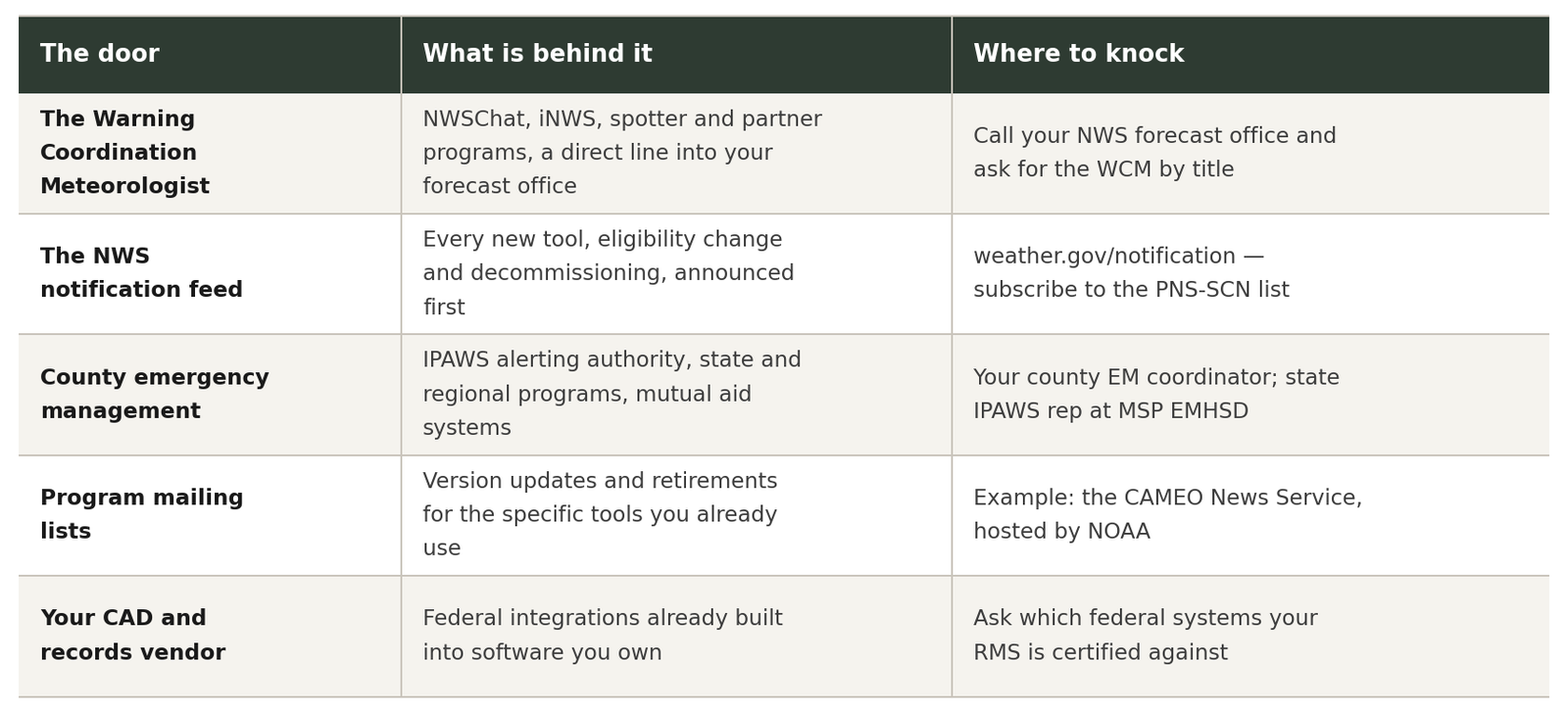
The doors don’t move, even when the tools behind them do.
What a department can actually do about it
The fix is smaller than the problem, which is usually how these things go.
Assign it. Not to yourself — you are already carrying too much — but to somebody. An officer, a records clerk, an interested firefighter who likes this sort of thing. Fifteen minutes a month watching one announcement feed and one professional mailing list is the whole remedy. It costs nothing but the fifteen minutes, and it means the next NWSChat does not take fifty years to find your station.
Then make one phone call. Ask for the Warning Coordination Meteorologist at your forecast office. Introduce yourself as a chief rather than as a spotter, and ask plainly what partner tools your department qualifies for. Based on my Tuesday, I expect you will be surprised by the answer.
And if you are a warning coordination meteorologist, or a county emergency manager, or anybody else who sits on the inside of one of these doors reading this: the people you are trying to reach are not being stubborn. Most of us do not know you are there. A cold email to every fire chief in your county forecast area would take an afternoon and would probably do more good than the next ten outreach events.
Where I started
I want to end on the specifics rather than a lesson, because the specifics are the whole argument.
Over fifty years. Paramedic. Fire chief. ICS 100 through 800. More than three dozen disaster deployments across four countries and most of this one. Years as a trained weather spotter, sitting in rooms run by the very offices that operate these programs.
And I learned about a free federal tool built for people exactly like me from a chat window on a Tuesday afternoon in August.
If that is the résumé it takes to fall through the gap, then it isn’t a gap. It’s most of the floor.
A note on method, in keeping with how this newsletter works. Every tool named above was checked against its current official page on August 12, 2026. The Enhanced Data Display is included precisely because it failed that check — I had it in the draft, from a National Weather Service training document, before I opened the link and found it dead. If another one of these has gone the same way by the time you read this, that is the column’s point rather than an exception to it, and I would like to hear about it so I can publish the correction.
Sources
NWSChat 2.0 registration and eligibility — National Weather Service, partnerservices.nws.noaa.gov/registration; NWSChat partner fact sheets, weather.gov.
iNWS — Interactive NWS, inws.ncep.noaa.gov; NWS Enterprise Resources page on core-partner alerting, weather.gov/enterprise.
Warning Coordination Meteorologist — 15 U.S.C. § 8545, enacted by the Weather Research and Forecasting Innovation Act of 2017 (Pub. L. 115–25, Title IV, § 405); NWS position description, U.S. Department of Commerce.
Public Information Statements and Service Change Notices — weather.gov/notification.
Enhanced Data Display decommissioning — NWS Public Information Statement 23-31, soliciting comments through July 30, 2023; preview.weather.gov/edd verified returning HTTP 404 on August 12, 2026.
IPAWS — FEMA, “Sign Up to Use IPAWS to Send Public Alerts and Warnings” and “Alerting Authorities,” fema.gov.
CAMEO suite — U.S. EPA, ALOHA and MARPLOT software pages, epa.gov/cameo; NOAA Office of Response and Restoration, response.restoration.noaa.gov.
NERIS — U.S. Fire Administration, usfa.fema.gov; NFIRS sunset guidance, final date January 31, 2026.
National Fire Academy tuition and travel reimbursement — U.S. Fire Administration, usfa.fema.gov/nfa/admissions/training-costs.html.
Behind The Alarm is written by Fred R. LaPoint, Fire Chief of the Stronach Township Fire Department in Manistee County, Michigan. Corrections are published, not quietly edited.
This article first appeared in Behind The Alarm, the newsletter of Fred R. LaPoint, Fire Chief Paramedic of the Stronach Township Fire Department, on August 12, 2026. Read the original.