
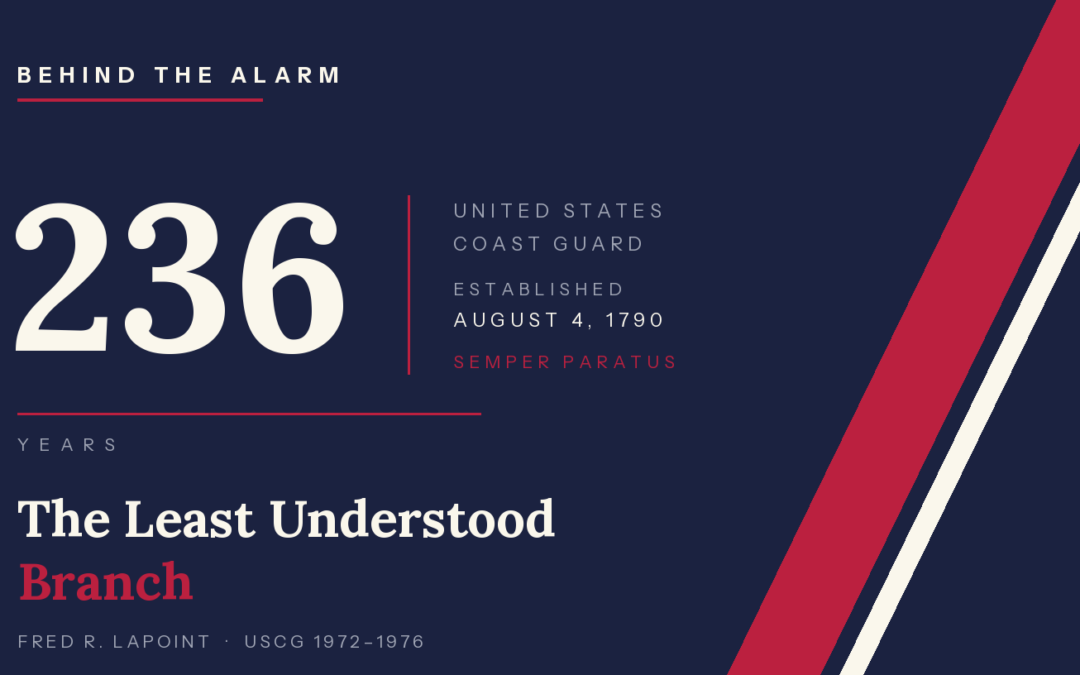
BEHIND THE ALARM – THE LEAST UNDERSTOOD BRANCH
Fred R. LaPoint | August 4, 2026
The Least Understood Branch
The United States Coast Guard turns 236 today. A chef talking about firefighters in Detroit explained the service better than any recruiting poster ever has.
Ten Boats and No Navy
On August 4, 1790, Alexander Hamilton talked a broke Congress into buying ten boats.
They were small, single-masted cutters, crewed by a handful of men apiece, and their job was to chase smugglers who were cheating the young republic out of tariff revenue — which at that point was very nearly the entire federal budget. Hamilton got his appropriation and the Revenue Cutter Service went to sea. What most Americans have never stopped to consider is what else was afloat under a United States flag at that moment. Nothing. The Continental Navy had been sold off ship by ship after the Revolution to pay down debt, the last hull gone in 1785. Congress would not authorize the frigates that became the modern Navy until 1794, and none of them would touch salt water until 1797. The Marine Corps as a permanent standing force did not exist either; the Continental Marines were disbanded in 1783 and were not re-established until 1798.
So for eight years, Hamilton’s ten cutters were not merely the country’s first line at sea. They were the only line. They were the entire armed maritime force of the United States of America.
That service turns 236 today. It is older than the Navy in its present organizational form, older than the Marine Corps as a permanent standing force, and older than the federal income tax by 123 years. It is also, by a wide margin, the least understood branch of the American military — and not in the ordinary way, where people simply don’t know the details. People don’t know the category. Stand at a boat launch and ask ten strangers what the Coast Guard is. Most will describe a rescue outfit. Several will tell you it isn’t really military. Somebody will ask, in complete sincerity, whether you have to go to boot camp.
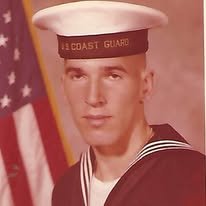
I did. I went in 1972 and came out in 1976, a Telephone Technician Second Class, and I have spent the fifty years since in a trade that gets misunderstood in exactly the same way.
The Bourdain Rule
In November of 2013, Anthony Bourdain took his camera crew to Detroit and spent part of an hour with the city’s firefighters. He found a department working in a city with tens of thousands of abandoned structures and something on the order of fourteen arsons a day, on gear that was falling apart, and he said out loud the thing the crews themselves would not say on camera: that the department was underfunded, badly equipped, and poorly led, and that the war it was fighting had no visible end.
Then he said the sentence that has been taped inside firehouse lockers ever since. Firefighters, he said, reminded him of the Marines he’d known over the years — that no matter how badly led, how ridiculously under-equipped and unappreciated, how hopeless the mission looked, they took what he called “a bizarre and quite beautiful pride” in being worse off than everybody else and doing the job anyway, with style.
He was describing the trade I’ve spent my life in. He could have been describing the one I started in without changing a word. That instinct — the almost perverse satisfaction in being outnumbered, out-funded, out-equipped, and getting it done regardless — is not a Detroit thing or a fire service thing. It is the operating system of every outfit that has more mission than money, and no branch of the United States military has run on it longer or harder than the Coast Guard.
What the Least Understood Branch Actually Does
Start with where it lives. The Coast Guard is not in the Department of Defense. It sat under the Treasury Department for most of its existence, moved to Transportation in 1967, and has been part of the Department of Homeland Security since 2003. It is a full branch of the armed forces and a federal law enforcement agency at the same time — the only branch that routinely boards, searches, arrests, and prosecutes on its own domestic authority. A Coast Guard boarding officer in the Great Lakes and a Coast Guard boarding officer 300 miles off Colombia are doing legally different work under the same flag on the same day.
Congress has assigned it eleven statutory missions, and they do not sit in one lane. Search and rescue. Drug interdiction. Migrant interdiction. Aids to navigation. Ports, waterways, and coastal security. Defense readiness. Marine safety and marine environmental protection. Living marine resources enforcement. Ice operations. That is a fire department, a police department, a public works department, an environmental agency, and a combat service, all funded as one line item.
Now the arithmetic that ought to stop people cold. The active-duty Coast Guard runs somewhere around 41,000 to 42,000 people. The New York City Police Department’s uniformed strength is roughly 33,500 sworn officers against a budgeted 35,000. Which means the entire active-duty United States Coast Guard is about the size of the police force of one American city — and its beat is more than 95,000 miles of coastline and 4.5 million square miles of exclusive economic zone, plus the Great Lakes, plus the inland river system, plus whatever ocean the nation happens to need covered that week.
What that force produced in 2025: 5,220 lives saved, another 19,437 people assisted, and more than $1.02 billion in property saved or assisted. In the same year, it seized more than 511,000 pounds of narcotics worth better than $3.8 billion, a service record. It also had its best recruiting year since 1991. Nobody threw a parade.
The War Nobody Remembers They Fought
Ask around about Coast Guard combat service, and you will mostly get blank looks, which is its own small injustice. Roughly 8,000 Coast Guardsmen served in Vietnam. Squadron One put 26 eighty-two-foot Point-class cutters — boats designed for search and rescue and law enforcement, not for war — into the shallow coastal water off An Thoi and Da Nang for Operation Market Time, interdicting the arms flow from the sea. Over five years those boats logged more than four million miles and inspected more than 280,000 vessels. Squadron Three followed in 1967 with five 378-foot high-endurance cutters, one of which fired the first Coast Guard naval gunfire support mission of the war that May.
Fifty-nine Coast Guardsmen were wounded in action, and seven were killed. Small numbers next to the other services, until you notice that the Coast Guard’s casualty rate in Vietnam ran more than twice the Navy’s — a consequence of the boarding and interdiction work, which requires you to close with an enemy you cannot identify until you are alongside him.
And then there is the part that never appears in anybody’s war footage, which happens to be the part I understand best. Under Operation Tight Reign, the Coast Guard built and manned the LORAN stations that let every mariner and aviator in the theater know where he actually was — Con Son Island and Tan My in Vietnam, Lampang and Sattahip and Udorn in Thailand. The Con Son station kept transmitting until April 29, 1975, one day before Saigon fell. The last cutter had left three years earlier. The signal outlasted the fleet.
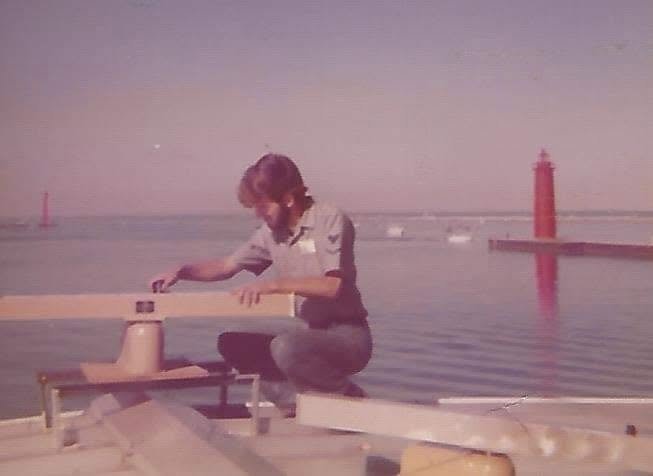
Muskegon, Michigan, mid-1970s. The author installing a shipboard surface and air search radar antenna on the roof of the Coast Guard electronics shop, with the channel and the pierhead light behind him.
Here is what that kind of work actually looks like. Somewhere in the middle of my enlistment, I spent my days on the roof of the Coast Guard electronics shop in Muskegon, Michigan, bolting down a surface and air search radar antenna. That is a shipboard set. It belongs on a mast, over water, on something that moves. A new radar was coming into the fleet, headed for cutters and small boats across the Great Lakes and well beyond, and there was no honest way to prove it out except to run it against real weather for as long as it took before anybody bet a crew on it. So a sea radar went up on a building, and we bench tested it against the actual sky.
Nobody takes a picture of that. Somebody happened to take one of me doing it, which is the only reason I can show you. But the principle is the entire trade: the gear a crew’s life depends on at two in the morning in a following sea got proven months earlier by somebody on a roof, in the cold, with nobody watching and nobody keeping score.
I was a Telephone Technician Second Class, which in plain English means I was one of the people who kept the wire up and the radios talking. It is invisible work. No one has ever made a movie about it. But every rescue swimmer who ever went out a door on a cable, every cutter that ever got a position fix in weather, every distress call that ever reached a human being on the other end, got there because somebody in a rating nobody has heard of kept the circuit alive. Fifty years later, I am doing the same job with a radio and a pump on a township fire ground in Manistee County, and I promise you the principle has not changed.
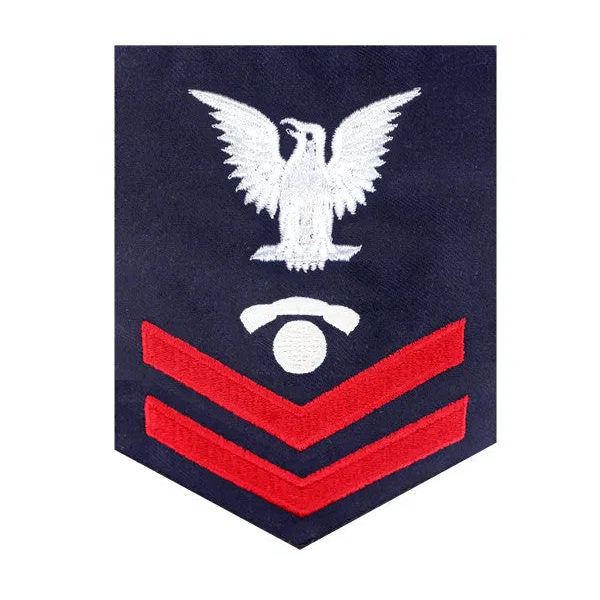
Telephone Technician Second Class — the eagle, the handset, and two chevrons.
Pride Is Not a Procurement Strategy
Here is where I have to be honest, because a birthday is not a reason to lie.
Bourdain’s beautiful pride is real, and it is also dangerous, because it lets everyone else off the hook. An organization that takes satisfaction in being under-resourced will keep performing right up until the day it can’t, and by then the shortfall has been normalized for so long that nobody upstream remembers agreeing to it. I have watched that happen to fire departments. It is happening to the Coast Guard right now, in slow motion, in an era when the service is actually getting money.
The Coast Guard is in the middle of the largest modernization push in its history — nearly $25 billion in the 2025 reconciliation bill on top of roughly $13.5 billion appropriated for fiscal 2026, aimed at an initiative called Force Design 2028. On June 30 of this year, the Government Accountability Office testified before the House Coast Guard and Maritime Transportation Subcommittee that the effort is still falling short, and the reason it gave should be familiar to anyone who has ever run a budget: the service’s own foundational documents do not explain how it will measure the reforms or how it will know when it has achieved them, and there is no performance plan to assess results. GAO also noted that in three of the four prior Coast Guard reform efforts it has reviewed since 2018, leadership attention simply faded.
That is a genuine problem, and it deserves a full accounting, which it is going to get from me in a separate piece. I am not going to run that ledger today. But I am also not going to spend a birthday column pretending the service is fine and leave a reader thinking pride is a substitute for hulls, people, and a plan. It never has been. Not at sea and not on the fire ground.
Two Hundred Thirty-Six
There is an old line in the service, usually said with a shrug, that the Coast Guard is small enough that everybody knows everybody. That is roughly true and it explains a lot — the informality, the improvisation, the willingness of a thirty-year-old chief to make a decision that would take three staff meetings anywhere else. It is a small outfit doing an enormous job in bad weather, largely unwatched, and it has been doing it since before the country had a navy to be the junior service to.
Semper Paratus means always ready. It is not a boast. It is a job description, and for 236 years the smallest branch has met it with fewer boats than the mission required and a stubborn, unreasonable, quite beautiful pride in doing it anyway.
Happy birthday to the United States Coast Guard, from a Telephone Technician Second Class who has never once regretted the four years, and who has spent the fifty since trying to live up to them.
Fred R. LaPoint is Fire Chief and paramedic of Stronach Township Fire Department in Manistee County, Michigan, with over 50 years in emergency services. A Vietnam-era Coast Guard veteran and Team Rubicon disaster responder with more than three dozen deployments, he writes Behind The Alarm and Guardians of Truth.
Sources
Founding and early history: Act of August 4, 1790 (Revenue Cutter Service); Naval Act of 1794; Act of July 11, 1798 (re-establishment of the Marine Corps); Sixteenth Amendment, ratified 1913.
Bourdain remarks: “Anthony Bourdain: Parts Unknown,” Detroit episode, CNN, first aired November 10, 2013 (broadcast transcript).
Coast Guard organization and missions: 6 U.S.C. § 468 (eleven statutory missions); Homeland Security Act of 2002 (transfer to DHS, 2003).
Force size, coastline, and EEZ: U.S. Coast Guard and DHS budget documentation, FY 2025–FY 2027; GAO-25-107224, “Coast Guard: Progress Made to Address Recruiting Challenges but Additional Actions Needed.”
NYPD uniformed strength: New York City Police Department FY 2026 budgeted and actual headcount.
2025 operational results: U.S. Coast Guard year-in-review release, January 2026 (lives saved, assists, property, narcotics interdiction, recruiting).
Vietnam service: U.S. Coast Guard History Program, “The United States Coast Guard in Vietnam” and USCG Vietnam Chronology; National Coast Guard Museum, “The Coast Guard Joins the Fight in Vietnam”; Naval History Magazine, December 2017.
Modernization oversight: GAO-26-109215, testimony before the House Subcommittee on Coast Guard and Maritime Transportation, June 30, 2026.
This article first appeared in Behind The Alarm, the newsletter of Fred R. LaPoint, Fire Chief Paramedic of the Stronach Township Fire Department, on August 4, 2026. Read the original.