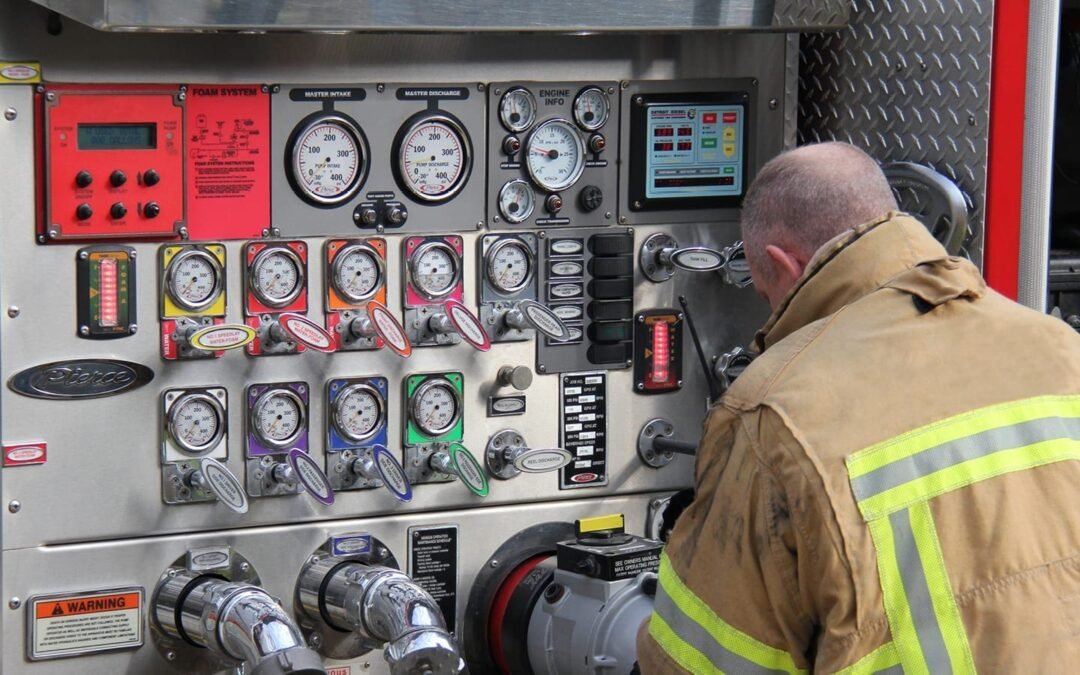
Long before the tones drop, the driver engineer is already two steps ahead. While the rest of the crew is checking gear or catching a prepping for the next training, the engineer is reviewing weather conditions, road closures, hydrant maps, and mental notes from yesterday’s inspection. When the call comes in, they don’t just drive the apparatus— they deliver the mission. They carry the crew. They manage the risks. And when the scene is chaotic, they become the calm at the pump panel.
In this week’s Behind The Alarm, we shine the spotlight on perhaps one of the most misunderstood roles in the fire service: the Driver Engineer — sometimes called Engineer, Apparatus Operator, or Chauffeur, depending on the region. No matter the name, the responsibility is immense, and it doesn’t stop at the gas pedal.
The Engineer Is the Anchor of Every Call
Driving to the scene is only the beginning. The engineer is responsible for safely delivering the apparatus and crew to unpredictable and often hazardous locations, navigating at speed through congested roads, tight alleys, snow-covered driveways, or construction zones. A single misjudgment can result in critical delays and interventions or endanger lives.
But that’s just the trip en route.
Once on the scene, the engineer’s role shifts from chauffeur to a pressure-juggling, line-managing, water-balancing operations hub. They must:
-
Position the rig correctly for water access both for their own rig and aerial reach (if applicable).
-
Size up the initial water supply plan,
-
Begin pump operations instantly if the situation demands it.
Seconds count. The engineer has to know their rig inside and out — and be ready to act before orders are even given. They become so atuned to their rigs that they can often spot trouble with the rig before it becomes a crisis merely by listening to the sounds of the engine and pump during operations.
The Math, the Mechanics, the Mission
Operating a fire pump is not a “set-it-and-forget-it” task. It’s a thinking person’s job performed under immense pressure. Every decision an engineer makes affects the safety of firefighters inside the structure, on the roof, or pulling a line in the yard.
A competent engineer must:
-
Calculate friction loss for every hose line deployed: Friction loss is the pressure that’s lost as water moves through a fire hose. Just like when you rub your hands together and feel resistance — water moving through a hose rubs against the inside walls of the hose and slows down, sometimes a little sometimes alot. That rubbing, or resistance, causes a drop in pressure.
The longer the hose is, or the more twists and turns it has, the more couplings (ends that attach lengths of hose together) or the more appliances (devices for adding multiple lays of hose or adapters for reducing or splitting lays) the more pressure gets lost along the way. Smaller hoses lose pressure faster than bigger ones, especially when a lot of water is flowing through them.
So, firefighters have to calculate how much pressure they’ll lose based on how long the hose is, what size it is, and how much water they’re pushing through it — to make sure the nozzle at the end still has enough force to be effective. If they don’t account for that, the water might just dribble out instead of hitting the fire with the power it needs.
-
Understand nozzle pressures and flow rates for different tools and the different tactics being used to fight the fire.
-
They must be able to activate and maintain the pressure relief valve. The pressure relief valve on a fire engine acts like a safety buffer to protect firefighters using hose lines.
When multiple hoses are deployed, each one might be opened or shut at different times. That causes sudden changes in water flow and pressure. If one crew shuts off their nozzle, the pressure inside the pump can spike — and that spike could send a dangerous surge of pressure down the other lines still in use, possibly injuring firefighters or damaging equipment. Especially critical if you have firefighters operating on a roof or ladders, because the sudden pressure surge could cause a loss of control of the line or for the firefighter to fall from a great height.
The pressure relief valve prevents that.
It senses when the pressure goes above a safe level and automatically opens to redirect some of the water back into the intake or recirculate it inside the pump. That reduces the pressure spike and keeps everything stable — so the water pressure at each line stays safe and consistent, even if other crews are adjusting their flows.
-
Account for elevation changes both in height or below grade, multiple lines, appliances, and any kinks or distances in the layout,
-
Manage intake and discharge pressures without starving the pump or overpressurizing a line.
They need to know how many lines they can flow at once and how to balance them depending on the available water supply. They must watch for pressure drops, pressure increases, thermal expansion, pump cavitation, or sudden changes that may indicate a burst hose or an injured firefighter.
They must master:
-
Relay pumping, when engines are spaced out to move water over long distances,
-
Drafting, when no hydrant is available and the water source is a pond, river, or portable tank,
-
Emergency operations like switching water sources from the tank on the apparatus, getting water from a hydrant or drafting from a portable tank or performing pump-and-roll in wildland incidents.
And all of this while still maintaining radio contact with other firefighters, monitoring for Maydays, and backing up any command requests.
At the Station: Guardian of the Apparatus
The engineer’s job doesn’t stop when the wheels stop rolling. They are the mechanic, the caretaker, the one who ensures the rig is mission-ready at all times. That means:
-
Daily inspections of every system — from tires to lights to pump valves,
-
Routine engine checks, fluid levels, brakes, and electrical systems,
-
Ensuring tools are clean, charged, and stowed properly,
-
Managing inventory and maintenance logs.
An engine company doesn’t run because the engine is new. It runs because the engineer has made it their responsibility to keep it in top condition. That kind of ownership isn’t just about pride — it’s about life safety.
Adaptable, Skilled, and Always Thinking Ahead
Whether responding to a structure fire, a medical call, a hazmat incident, or a mutual aid wildfire deployment, the engineer adapts their role. They might:
-
Deploy portable lighting or generators,
-
Set up rehab areas or assist with triage support,
-
Operate compressed air foam systems or SCBA fill stations,
-
Serve as the incident’s second set of eyes for command.
In many departments, the most experienced firefighters are promoted or selected for the engineer position — not because it’s easy, but because it demands a full-spectrum understanding of firefighting operations, apparatus, and risk management. In full-time, career fire departments, the role of the driver engineer is often assigned to a specific, dedicated individual on each shift — someone who specializes in the apparatus, pump operations, and vehicle maintenance. But in volunteer departments, where response staffing is unpredictable by nature, that luxury rarely exists. Instead, multiple members must be trained and capable of performing the engineer’s duties at a moment’s notice. That means a deeper bench of operational knowledge across the department — and a greater emphasis on cross-training, repetition, and muscle memory. Any member might be the first to the station, the one who gets the rig rolling, and the one who’s suddenly responsible for delivering water to multiple handlines. In these environments, the importance of a well-trained, adaptable team of potential engineers can’t be overstated — it’s the backbone of safe, effective response in communities that rely on volunteers.
More Than a Driver — The Crew’s Lifeline
A great engineer is a stabilizing force for the crew. Their calm, steady presence on the scene provides the confidence firefighters need to charge into unknown conditions. They are often the last to leave, ensuring every hose is loaded, every compartment is restocked, and the engine is ready to go again.
Yet too often, their contributions are overlooked. They don’t always make the grab. They’re not caught on helmet cams pushing into a hallway advancing to the seat of the fire. But every success at the nozzle relies on an engineer doing their job flawlessly behind the pump.
Behind the Alarm: Why It Matters
We celebrate bravery. We respect leadership. But the fire service also runs on reliability, skill, and humble expertise. The engineer embodies all of these, without demanding recognition.
As citizens, fire buffs, or new recruits, it’s important to understand that the job doesn’t begin with flashing lights or end when the flames are out. There’s a quiet professional standing at the pump panel, watching every gauge, adjusting every line, and thinking three steps ahead to keep everyone else alive.
This week, if you know an fire engineer — thank them.
They’re not just driving the engine.
They’re driving the mission.
Thank you for reading this week’s installment of Behind The Alarm! Check back next week as we tackle another topic from behind the alarm. Have questions or suggestions? We’d love to hear from you!
This article first appeared in Behind The Alarm, the newsletter of Fred R. LaPoint, Fire Chief Paramedic of the Stronach Township Fire Department, on May 6, 2025. Read the original.