
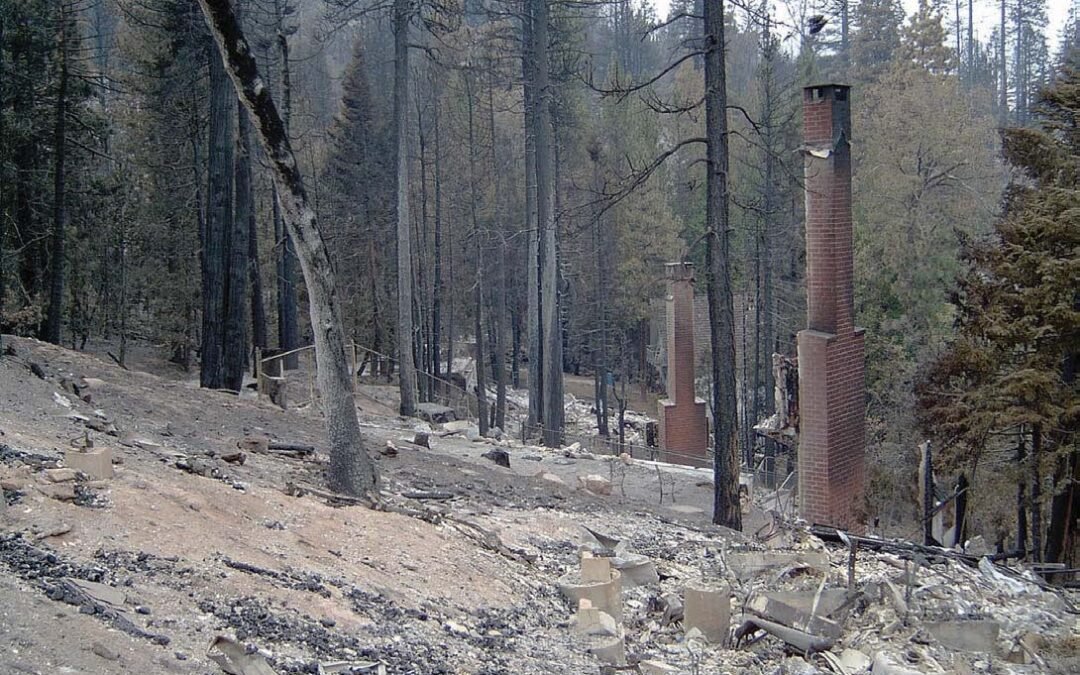
There is a photograph that comes out of almost every one of these disasters, and once you have seen it, you cannot stop seeing it. A residential street burned to the slab. Foundations, chimneys, the melted aluminum puddle where a car used to be. And standing over all of it, green trees. Unburned brush. Leaves still on the branches.
That photograph is not a curiosity. It is the whole argument, sitting there in plain sight, and the American fire service has spent about thirty years walking past it.
We have been calling it by the wrong name
The disasters we care about — Paradise, the Marshall Fire, Lahaina, Palisades and Eaton — are not wildfire disasters in any useful physical sense. They are urban conflagrations that happened to be ignited by a wildfire. That distinction is not academic. It determines the entire solution set, and getting it wrong has cost us towns.
Jack Cohen spent a career at the Missoula Fire Sciences Laboratory documenting this and being politely ignored for it. His post-incident examinations keep turning up the same pattern: homes destroyed while the vegetation around them stands green and unconsumed, which means the high-intensity flaming front never swept through the neighborhood as a wave at all. The houses ignited from lofted embers landing in receptive fuel, from low-intensity surface fire creeping into contact with the structure, and then — in anything resembling a subdivision — from one burning house to the next. His conclusion is unsentimental. The home ignition zone defines wildland-urban fire as a structure ignition problem, not a problem of controlling wildfires.
Anyone who has stood on one of these streets knows the moment Cohen is describing. Somewhere in the first hour, the vegetation stops mattering. The houses become the fuel. From that point forward, you are not fighting a wildfire, and you never were. You are fighting the Great Chicago Fire with brush trucks and a hydrant system that was engineered for two structure fires at once, not two hundred.
Here is why the name matters so much. If wildland-urban fire disaster is a wildfire behavior problem, then the answer is always more — more engines, more aviation, more crews, bigger budgets — and the answer always arrives about ninety minutes late, and the fire service becomes the permanent public scapegoat for a physics problem it was never going to win. If it is a structure ignition and community fire spread problem, then the answer is building codes, noncombustible Zone 0, ember-resistant vents, fence materials, and the distance between one wall and the next. Cheap. Boring. Permanent. Done years in advance, in daylight, by somebody who is not wearing a helmet.
Cohen has been making this case for three decades, and the reason it has not taken hold is not that people fail to understand it. It is that it moves the hero out of the frame. Nobody puts a decal on the side of the engine that reads WE AMENDED THE FENCE ORDINANCE.
What the numbers actually say
It feels this summer as though the whole planet is on fire, and in the way that matters, it is. Europe blew past 500,000 hectares burned by the sixth of August, already ahead of the same date in 2025 — which had itself been the worst year on record — and running roughly two and a half times the twenty-year average. Nearly 900 fires were burning across Canada, more than nine million acres gone, with Ontario having its worst season ever recorded. France and Spain both set records. Michigan has spent weeks under smoke that originated hundreds of miles north of us.
And yet the amount of land burning worldwide has been going down, not up. That sentence is going to be used against anyone who writes honestly about wildfire, so let us handle it ourselves rather than let someone else spring it on us.
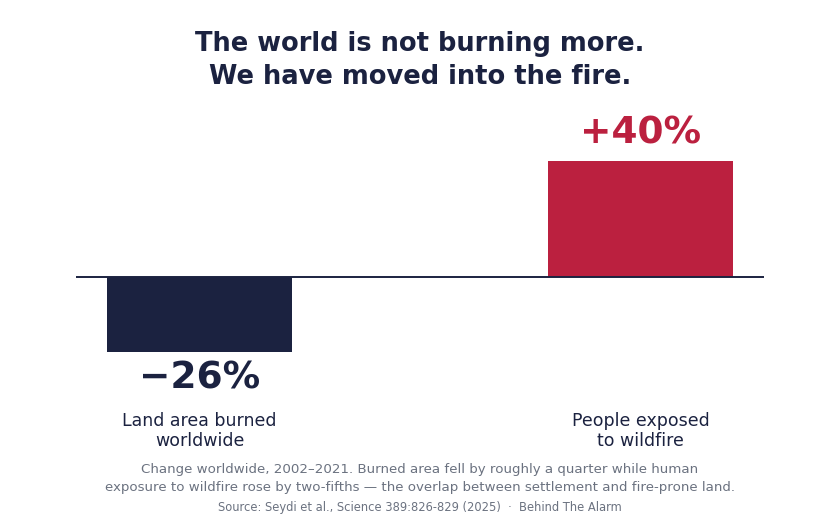
Seydi et al., Science, August 2025. Burned area worldwide fell 26% between 2002 and 2021. Human exposure over the same period rose 40%.
The study, published in Science in August of 2025, found that the population directly exposed to wildland fire increased forty percent globally between 2002 and 2021, while burned area declined twenty-six percent. The decline is real, and it is mostly agricultural expansion fragmenting African savanna, which accounts for more than half of all land that burns on Earth. Mike Flannigan put it plainly: it looks like a paradox, but both things are true at the same time.
That pair of numbers is the entire argument in arithmetic, and I would put it near the front of any conversation you have about this. The planet is not burning more. We moved into the fire. The authors say so directly — the increase came down to a growing overlap between human settlement and fire-prone land, which roughly doubled the exposure produced per acre burned. Four hundred forty million people exposed, and eighty-five percent of them in Africa, which tells you something about whose fires make the news.
Catastrophe, in other words, is not something the fire did. It is a siting decision, repeated a few million times, and then a construction decision layered on top of it. Which is exactly why the word inevitable does not belong in this conversation.
The physics did change, and it changed under our feet
None of the above means the fire environment is what it was. It is not, and the single variable that explains the most is not temperature, and it is not drought. It is vapor pressure deficit — the atmosphere’s thirst, its raw capacity to pull moisture out of a fuel bed. VPD climbs faster than temperature does, which is why fuel moisture minimums keep setting records in years that are not themselves record hot.
The operational consequence is the part I want every officer reading this to sit with, because it quietly invalidates doctrine most of us were trained on. This service was built around the nightly reset. Temperature dropped, humidity came back up, fine fuels picked moisture back out of the air, and the fire lay down. That was the window — the hours you used to build line, reposition, get ahead, and hand off something better than you received.
That window is closing. Satellite-detected nighttime fire radiative power over the lower forty-eight rose roughly fifty-four percent between the first and second halves of a 2003-to-2020 study period. A 2026 study in Science Advances found the number of hours in North America with fire-favorable weather is thirty-six percent higher than fifty years ago and fire-prone days up forty-four percent, with California alone picking up something on the order of 550 additional potential burning hours since the mid-1970s. Nights are warming faster than days, so the humidity recovery simply does not arrive the way it used to. The researchers’ own summary of the stakes is that losing the night brakes means more escaped fires that are more intense, longer-lasting, and larger.
Think about everything downstream of that. Initial attack success is predicated on catching it before the next burning period. Shift planning, the two-to-one work-rest ratio, the assumption that a line will hold overnight and you can reinforce at dawn, the entire rhythm of an incident — all of it rests on a physical guarantee that is being quietly withdrawn. This is not a climate abstraction for somebody else to argue about. It is a Type 3 incident commander standing at a morning briefing trying to explain why the fire is four times the size the model said it would be.
The spark is still ours
Climate and fuel conditions load the dice. Somebody still has to roll them. The overwhelming majority of fires that threaten people are human-ignited, and the timing matters more than the raw count, because human beings start fires in the seasons and under the conditions when lightning would not. Powerlines account for a wildly disproportionate share of the catastrophic ones.
This is where I want to push back gently on the way the climate framing usually gets used, including by people I largely agree with. When every wildfire story becomes a climate story, it quietly launders a set of failures that are entirely inside human control on a five-year timeline — deferred line maintenance, no de-energization protocol, no ignition-source engineering, no enforcement of the ordinances already on the books. Climate change is a large part of why a spark becomes a catastrophe. It is not the reason there was a spark. Both of those sentences are true, and most coverage carries only the first one.
Why nothing changes: follow the money
If Cohen has been right for thirty years, the obvious question is why the frame has not moved. The answer is visible in a budget line.
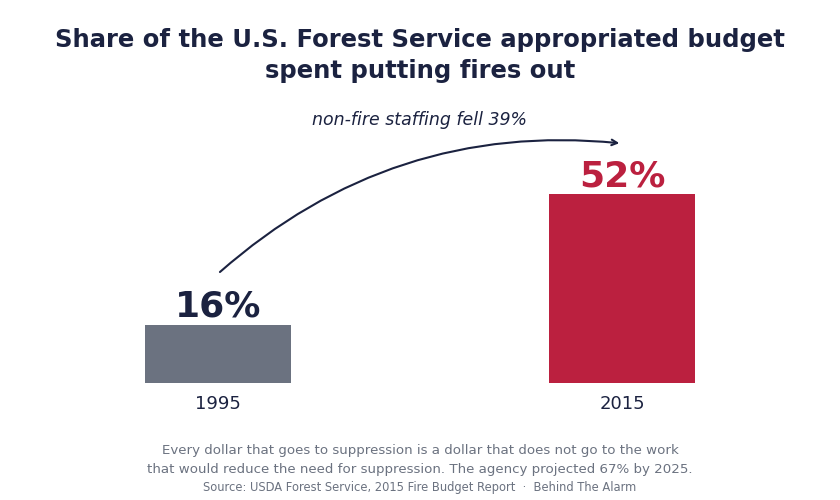
USDA Forest Service, 2015 Fire Budget Report. Fire went from 16% of the agency’s appropriated budget in 1995 to 52% in 2015 — the first majority in its history.
In 1995, fire consumed sixteen percent of the Forest Service’s congressionally appropriated budget. By 2015, for the first time in the agency’s hundred-and-ten-year history, more than half of it went to suppression. Alongside the dollars went the people: a thirty-nine percent reduction in all non-fire personnel. The agency projected that, left alone, fire’s share could exceed sixty-seven percent by 2025 — two of every three dollars Congress appropriates to manage the national forests, spent instead on putting fires out.
That is a machine that eats its own prevention. Every dollar spent suppressing this year’s fire is a dollar not spent on the thinning, the prescribed burn, the code work, and the community mitigation that would have reduced the need for suppression next year, which raises next year’s suppression bill, which takes another bite out of prevention. Congress patched the worst of the mid-season fire borrowing in 2018, and that helped. It did not touch the underlying shape of the thing.
And the political economy runs in the same direction as the budget. Suppression is visible, photogenic, and rewarded. Mitigation is invisible and, when it works, indistinguishable from nothing having happened. No elected official has ever been thanked for the fire that did not occur. That asymmetry is not a Forest Service problem or a federal problem. It runs straight down to a township board deciding whether to fund a chipper program or a new set of extrication tools, and I have sat in that room.
It is not a failure of willpower. It is worse than that.
The instinct is to end a piece like this by asking whether we have the resolve to change. I have come to think that framing is a trap, and that it makes the problem harder rather than easier.
Mitigation at the parcel level is a commons problem. Structure-to-structure ignition means your noncombustible Zone 0 is worth a fraction of its value if the house thirty feet away has juniper packed against the siding and a wood privacy fence running to your wall. The Insurance Institute for Business and Home Safety, examining conflagration in the built environment, found dense vegetation inside the zero-to-five-foot zone on nearly every home in the areas it studied, combined with wood fences that physically connected the structures into one continuous fuel path. You cannot willpower your way out of that as an individual. It is a rules problem — ordinances, covenants, code adoption, insurance underwriting — in which the neighborhood, not the parcel, is the unit. Telling individuals to try harder inside a collective action problem is how you get a decade of well-meaning brochures and no measurable change in loss.
There is a harder version of the willpower question, though, and it belongs to us more than to the public. We say we want good fire. But we have almost no public tolerance for the smoke, the risk, and the liability of a prescribed burn — while accepting vastly more smoke, more risk, and more liability from the wildfire that the burn would have prevented. That asymmetry is the real failure of nerve, and the fire service owns a share of it.
Mack Lake
You do not have to go to California to see what that costs. It happened on the Huron-Manistee National Forests.
On the fifth of May, 1980, crews from the Mio Ranger District ignited the Crane Lake prescribed burn — a twenty-eight-acre unit in jack pine slash, intended to prepare habitat for the Kirtland’s warbler. A cold front was forecast for early afternoon. The plan was to be lit by 0900 and done by noon, ahead of conditions going out of prescription. Ignition did not begin until 1026. It spotted over the line almost immediately. An engine got stuck, stalled, and ran dry. By the seventh spot fire, the objective had already collapsed back to holding it along M-33.
It jumped the highway. It consumed 23,834 acres and forty-four structures in the Mack Lake subdivision. James Swiderski, a Forest Service dozer operator, was entrapped on the north flank; he turned the tractor away from the advancing fire, dismounted, and tried to make it out on foot. He was found deceased at 1500, several hundred feet from his burned-over plow. The Forest Service’s own analysis noted that few documented wildfires have exceeded its spread rate or energy release, and that horizontal roll vortices may have contributed to his death.
Now here is the part that finishes the argument. The legacy of that afternoon became, in the words of the managers who came after, a significant barrier to using fire in jack pine on that forest at all. It took until May of 2014 — thirty-four years — before the first stand-replacement jack pine prescribed burn was implemented on the Huron-Manistee. And that burn went in directly adjacent to the same subdivision that lost forty-four homes in 1980.
Thirty-four years of paralysis out of one bad afternoon. That is the willpower question in local terms, and notice the shape of it: the barrier was never that we did not know what to do. It was that we could not absorb the risk of doing it. Swiderski’s name belongs in this piece because he is the cost of getting it wrong, and because the Mack Lake staff ride now exists so that his death teaches instead of merely accusing.
Manistee already answered this
On Sunday the eighth of October, 1871, fire took a broad swath of Michigan and Wisconsin on the same night — Peshtigo, Holland, Port Huron, Chicago, and Manistee. Rainfall in the preceding months had run about a quarter of normal. Early October was unseasonably warm, and the wind was up. Logging slash was piled everywhere, and nobody had disposed of it.
Two-thirds of this city was destroyed. Through what I can only call providence, no one here was killed. And in the accounts of what happened afterward, there is one sentence that ought to be read aloud at every township meeting in the state: instead of wood, many chose brick.
That is it. That is the whole answer, arrived at by people with no fire science, no VPD charts, no satellite record, and no federal grant program — working from the only evidence they had, which was the smoking hole where their town used to be. They did not conclude that they needed a bigger fire department. They concluded that the buildings were the problem, and they changed the buildings.
We know more than they did. We have Cohen’s work, the ignition data, the exposure numbers, and a hundred and fifty-five years of hindsight. The question in front of us is not whether catastrophic fire is inevitable. The numbers say it plainly enough that it is not. The question is whether a city that once rebuilt itself in brick still remembers why.
Sources
Cohen, J. D. “A More Effective Approach for Preventing Wildland-Urban Fire Disasters”; “Community Wildfire Risk: a structure ignition problem.” USDA Forest Service (ret.), Missoula Fire Sciences Laboratory.
Seydi, S. T., Abatzoglou, J. T., Jones, M. W., Kolden, C. A., et al. “Increasing global human exposure to wildland fires despite declining burned area.” Science 389 (6762): 826–829, 21 August 2025. DOI: 10.1126/science.adu6408.
European Commission Joint Research Centre, European Forest Fire Information System (EFFIS), current wildfire situation in Europe, data as of 6 August 2026.
Union of Concerned Scientists, “A World Ablaze,” August 2026 (Canadian and U.S. season figures).
Luo, K., et al., Science Advances, April 2026 — North American fire-favorable hours and days since the 1970s.
Freeborn, P. H., et al. (2022) — nighttime fire radiative power trends, conterminous United States; Balch, J. K., et al. (2022), Nature — warming weakens the nighttime barrier to global fire.
USDA Forest Service, “The Rising Cost of Wildfire Operations: Effects on the Forest Service’s Non-Fire Work,” 2015 Fire Budget Report.
Insurance Institute for Business and Home Safety (IBHS), “Return of Conflagration to the Built Environment,” suburban wildfire conflagration white paper.
NWCG Wildland Fire Leadership Development Program, Mack Lake Fire Staff Ride; Mack Lake Fire Accident Investigation Report; Simard, A. J., Haines, D. A., Blank, R. W., Frost, J. S., “The Mack Lake Fire,” USFS General Technical Report NC-83 (1983).
Lake States Fire Science Consortium, Maple Ridge Prescribed Burn (11 May 2014), Huron-Manistee National Forests.
Library of Congress, “Today in History — October 8”; Northern Michigan History and Manistee News Advocate accounts of the 1871 Manistee fire.
Behind The Alarm · Fred R. LaPoint · Michigan Fire Chief / Paramedic, Stronach Township Fire Department · 50+ years in emergency services
This article first appeared in Behind The Alarm, the newsletter of Fred R. LaPoint, Fire Chief Paramedic of the Stronach Township Fire Department, on August 10, 2026. Read the original.