
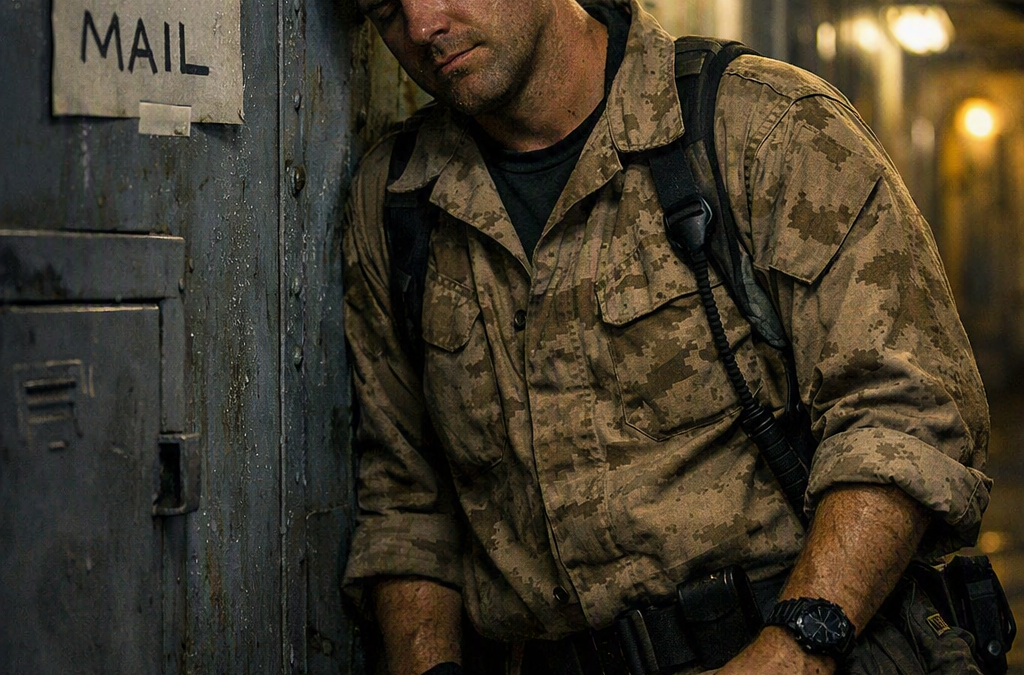
Two Hundred and Eight Days
On the night of Thursday, August 6, about two hundred people crowded into a banquet room at the Island Club on Naval Air Station North Island in San Diego. They were the wives, husbands, mothers, fathers, and stepparents of the roughly five thousand sailors and Marines aboard the aircraft carrier USS Abraham Lincoln, and they had come to ask the acting Secretary of the Navy, Hung Cao, one question. When are they coming home?
He could not tell them. He told the room that another carrier strike group, the Theodore Roosevelt, was being prepared to relieve the Lincoln, but he would not say when, citing operational security. Later that same night, a second meeting was held virtually for the families who could not get to San Diego, and it went the same way. Spouses cried. One mother said her daughter has come to believe she will never come home, that she is going to die on that ship. Another woman said aloud what a good many people are thinking privately and getting shouted down for saying, and the room applauded her, which tells you something about the temperature.
I am not writing this to litigate the war. I am writing it because of a number, and because I have spent fifty years in a line of work where that number would end a career.
The arithmetic
The Lincoln left San Diego on November 21, 2025, on what was billed as a routine deployment. She was diverted to the Middle East during the buildup, and when Operation Epic Fury opened on February 28, 2026, aircraft from her air wing were in the first strikes. She has made exactly two port calls in nine months: Guam, on December 11 and 12, and a brief stop in Oman on July 7. Between those two stops, she went two hundred and eight consecutive days without touching land, breaking the modern record of two hundred and six days set by the Eisenhower in 2020. As of Friday, August 7, she had been deployed two hundred and fifty-nine days, with no announced return date. The deployment has been extended twice past its original seven months, and because there are not enough carriers to go around, she may be out another one to two months yet.
Across those two hundred and eight days, families say the crew got two days off.
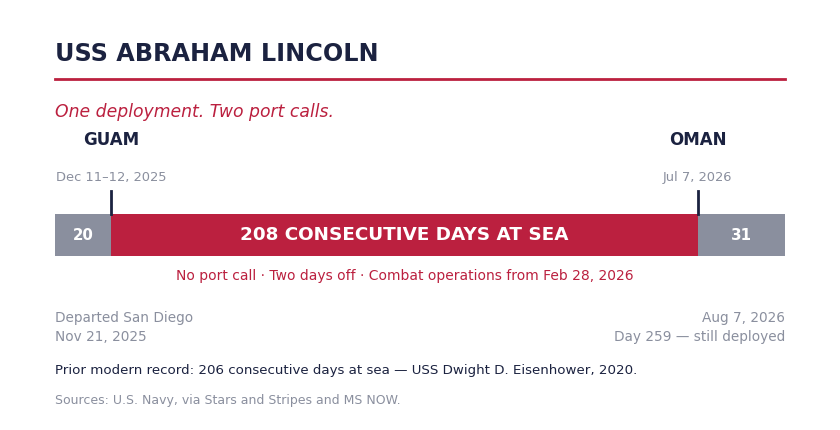
Two port calls in nine months. Sources: U.S. Navy, via Stars and Stripes and MS NOW.
There is one more detail that turns the screw. When the Lincoln finally does come home, she is changing homeports, from San Diego to Bremerton, Washington. The families in that banquet room do not know when their sailors are coming back or, in any practical sense, where.
What the families describe
The interior picture comes mainly from MS NOW, which spoke with a dozen family members and reviewed recordings of the meetings between families and Navy leadership. Moldy showers. Toilets out of service. Laundry facilities down for weeks at a stretch. Long stretches without hot water. Food shortages, and sailors running out of toothpaste, soap, and deodorant. A mail system so disrupted by the war that care packages were not arriving. Water contamination was raised at the town hall. A father who is himself a Navy veteran said his son described holes worn through the flight deck.
Before anybody waves that off as one outlet’s reporting, understand that it is not. On July 9, Stars and Stripes published a message a Lincoln sailor had written to his own family, saying their mental and physical health was in danger and asking for help. The family gave it to the paper on condition of anonymity because they feared retaliation against their sailor. That is independent of MS NOW and a month ahead of it. In April, USA TODAY published photographs of the food being served aboard the Lincoln and the Tripoli, half-empty trays and gray processed meat, and those photographs moved members of Congress to call for investigations. The deployment dates, the port calls and the record are the Navy’s own figures.
And the Navy’s answer, when it came, was not a denial. The Fifth Fleet spokesman acknowledged that lines build up on a ship that size, said leadership was staggering meal hours and store access by department to manage them, and allowed that there had been water issues, which he characterized as occasional and quickly fixed rather than chronic. He noted that sailors clean their own heads. Read that carefully. That is a confirmation with adjectives attached.
Why a fire chief is writing about a ship
I spent 1972 to 1976 in the Coast Guard as a Telephone Technician Second Class, working out of the electronics shop in Muskegon. My work was land-based, shipboard electronics, tower work, and submarine cable operations. We mounted a surface and air search radar antenna on the roof of that electronics shop so we could beat on it through a full Northwest Michigan year before it ever went to sea, because you do not learn what a set does in freezing spray by reading the manual. I worked the boats and the antennas at stations up and down that coast, from Michigan City, Indiana up to Sault Ste Marie, MI. I know what those spaces smell like. I know how narrow the ladders are, how little room there is between a man and the machinery, and how much of a warship’s day is spent doing hot, loud, repetitive work in a compartment where a moment of inattention has serious consequences.
The other fifty years I have spent on fire apparatus and at disaster sites here and abroad. And the one thing those worlds agree on completely, the thing every generation has to relearn at somebody’s funeral, is this: a tired crew is a hazard to itself.
Fatigue does not announce itself. It does not feel like danger. It feels like being a little slower to notice, a little quicker to accept the first answer, a little less willing to speak up about the thing that looks wrong. Judgment goes long before muscle does. On the fireground it shows up as the man who does not hear the radio traffic, who loses track of his crew, who forgets which way he came in. On a flight deck, where high-speed aircraft launch and recover around the clock, and ordnance is moved by hand, it shows up as the mistake that gets somebody killed. One of the family members quoted in the reporting, a Navy veteran whose son is aboard, put it as well as anyone I have heard: the most dangerous workplace in the world, ground out day after day with no break, is an environment ripe for accidents.
Then stack the rest of it on top. Moldy showers and broken laundry are not comfort complaints; they are infection control. Food shortages are not a morale issue; they are a caloric deficit in people doing hard physical work. No mail is the severing of the last thin line to the people you are doing it for. Every one of those drains the same reservoir, and every one of them makes it harder to sleep when the chance finally comes.
The standard we hold ourselves to
Here is what makes this hard to swallow for anyone in emergency services. We have written rules against exactly this, and we wrote them because we buried people.
In the fire service, rehabilitation is a standard, not a courtesy. It used to live in NFPA 1584 and now sits inside the consolidated NFPA 1580, and it assigns responsibility by name: the incident commander, the company officer, the rehab manager, the member. Somebody is accountable for pulling people out of the fight and putting fluid and rest into them before they go back in.
On the wildland side, where I have spent a part of my younger days in the fire service during wildfire season, the numbers are explicit. The interagency standard is a two-to-one work-to-rest ratio: for every two hours worked or traveled, one hour of sleep or rest. Any shift running past sixteen hours requires advance approval and written documentation by someone holding delegated authority. Assignments cap at fourteen days, with mandatory days off after. An incident commander who blows through those has to justify it in writing, on the record, with mitigations named.
Two hundred and eight days at sea and two days off would not clear a single one of those gates. Not one. And these are not soft standards written by people who have never been dirty. They are the distilled cost of previous funerals.
The gap nobody wants to name
I want to be fair about where responsibility actually sits, because a good deal of the anger I have seen is aimed at the wrong deck.
The commanding officer of the Lincoln cannot generate a port call. He cannot end a combat mission. He cannot conjure a relief carrier out of a fleet that does not have one available. What he can do is adjust watch bills, stagger meals, protect what sleep is protectable, and push bad news up the chain, and it appears that is roughly what has been done. The length of that deployment was decided far above the strike group.
That is the problem in one sentence: command responsibility and command authority have come apart. The officer answerable for the welfare of five thousand people does not hold the lever that would relieve them. Everyone who does hold that lever is further from the ladder wells, the chow line, and the flight deck than the man who is accountable for them.
We have the same fracture in our world, and it is worth naming out loud. A company officer is responsible for his crew’s safety and has no authority over staffing levels, apparatus condition, or how many calls a district takes in a shift. A strike team leader is responsible for his people and does not control how long the incident runs. The difference is that on a fireground somebody can call for relief, and the system is built to hear it. The question worth asking of the Navy right now is whether anyone in that chain still has a mechanism to stop the clock, and whether using it would end the career of whoever reached for it.
When the report becomes the problem
There is one more thing, and it worries me more than any broken toilet.
In April, when the first reports of food shortages aboard this same ship surfaced, the Secretary of Defense went on social media and called them fake news. Whatever you think of the politics of that, consider what it teaches a chain of command. Every officer watching learned exactly what happens to a report of degraded conditions: it gets called a lie from the top, in public.
Deficiency reporting is a safety system, and it functions only if reporting is safe. Punish the report, and you do not fix the deficiency; you lose sight of it, and you go on operating with a picture of the ship that is prettier than the ship. That is how you end up with a spokesman describing occasional water issues in the same week families are describing water contamination. Both statements can be sincerely made. Only one of them came from someone who has been down there recently.
And remember that the Stripes family asked for anonymity out of fear of retaliation. When the people closest to the problem are afraid to say the problem out loud, you no longer have an information system. You have a rumor mill with a chain of command attached.
None of this is new, either. On March 31, eleven members of the House Armed Services Committee wrote to the Secretary of Defense about the USS Gerald R. Ford, then approaching its tenth straight month at sea, warning about crew endurance, force sustainability, degraded living conditions, lost berthing and declining morale, and asking for a classified briefing. The Ford came home on May 16 after three hundred and twenty-six days, the longest American carrier deployment since Vietnam, having suffered a laundry fire that burned for some thirty hours, displaced six hundred sailors from their berths, and sent nearly two hundred crew members for treatment for smoke inhalation. She went straight into the shipyard, which is part of the reason there is nobody available to relieve the Lincoln.
Four months after that letter, the same story is playing out on a different hull. The warning was made. It was made in writing, by people holding oversight authority, and the answer was to run the next crew harder.
The record nobody should want
I have said this to young firefighters for decades, and I will say it here. Your people are not a consumable. Apparatus, hose, air bottles, and fuel are consumables. People are capital, and they are the only capital in this business that cannot be replaced with a purchase order. You can run them hard, and there are nights when you have to. What you cannot do is run them until they drop and then act surprised at the outcome, because the outcome is not a mystery. It is arithmetic with a delay built into it.
Two hundred and eight consecutive days at sea is being reported as a record. It is not an achievement. It is a mishap report that has not been written yet, and the only question still open is whether anybody moves before somebody’s name goes at the top of it.
Those families in that banquet room are not asking for a parade or a pep talk. They know their sailors are heroes; nobody needs to tell them that. They are asking a chain of command whether anyone up there is still counting the hours their people have been on shift. Somebody owes them a real answer, and “operational security” is not it.
Bring them home.
Sources
● MS NOW, “Moldy showers and no soap: Military families are outraged by conditions on USS Lincoln,” August 5, 2026.
● MS NOW, “In fiery meeting, military families confront acting Navy secretary over conditions on the USS Lincoln,” August 7, 2026.
● Stars and Stripes, Alison Bath, “Navy carrier in Mideast at sea for more than 200 days, testing crew resilience,” July 9, 2026.
● USA TODAY, Cybele Mayes-Osterman, reporting on military mail and shipboard food conditions, April 2026.
● Task & Purpose, “Sailors on the USS Abraham Lincoln reportedly dealing with poor conditions, weak morale, families say,” August 2026.
● Forbes, Peter Suciu, “USS Abraham Lincoln Faces Poor Morale From Twice-Extended Deployment,” August 6, 2026.
● Snopes, “USS Abraham Lincoln crew reportedly faces food shortages, low morale. Here’s what we know,” August 7, 2026.
● U.S. Rep. Wesley Bell, press release and letter to Secretary of Defense Pete Hegseth on the USS Gerald R. Ford Carrier Strike Group, March 31, 2026.
● Stars and Stripes, “Home at last: USS Gerald R. Ford returns after record-setting deployment,” May 16, 2026.
● USNI News, “Carrier USS Gerald R. Ford Starts First Major Post-Deployment Maintenance Period,” July 14, 2026.
● NFPA 1584, Standard on the Rehabilitation Process for Members During Emergency Operations and Training Exercises, now consolidated into NFPA 1580, Standard for Emergency Responder Occupational Health and Wellness, 2025 edition.
● NWCG work/rest and length-of-assignment standards; Interagency Incident Business Management Handbook, PMS 902.
● Mark Hertling, “When the Deployment Doesn’t End,” The Bulwark, August 8, 2026.
A note on sourcing
The deployment dates, port calls, day counts, and the congressional letter are documented and verifiable. The crew-distress and food-shortage accounts are supported by three outlets working independently: Stars and Stripes in July, USA TODAY in April, and MS NOW in August. The specific interior details — the moldy showers, the broken laundry, the holes worn in the flight deck — rest on family accounts gathered by MS NOW and have not been independently confirmed at this writing, though the Navy has not denied the underlying strain. Corrections will be published here if any of that changes.
Fred R. LaPoint is Fire Chief and paramedic of Stronach Township Fire Department in Manistee County, Michigan, with over 50 years in emergency services. A Vietnam-era Coast Guard veteran and Team Rubicon disaster responder with more than three dozen deployments, he writes Behind The Alarm and Guardians of Truth.
This article first appeared in Behind The Alarm, the newsletter of Fred R. LaPoint, Fire Chief Paramedic of the Stronach Township Fire Department, on August 9, 2026. Read the original.